
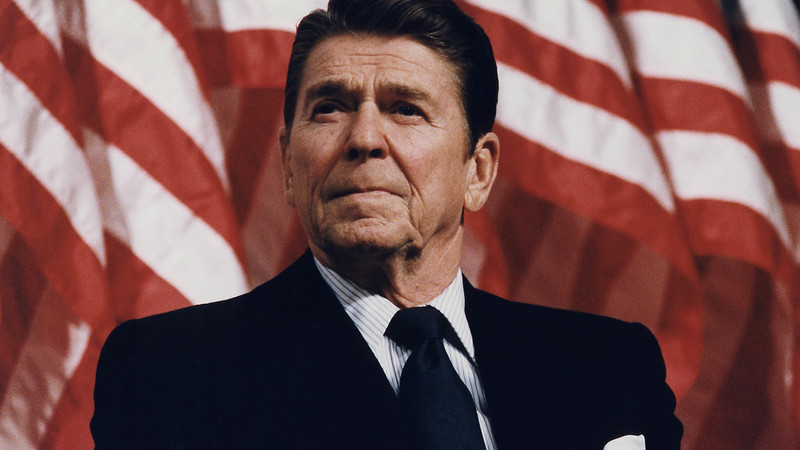
Ronald Reagan’s 1980 coalition was a fusion of Barry Goldwater’s 1964 libertarian-conservative insurgency and the populist energy of disaffected blue-collar Democrats. Goldwater had railed against the Eastern Establishment, the “dime-store New Deal,” and the “Rockefeller Republicans” who treated conservatism as a country-club hobby. Reagan inherited that anti-elitist DNA but broadened it: tax revolt in California, evangelical turnout in the Sun Belt, and a visceral “Make America Great Again” before the phrase existed. The glue was distrust of Washington insiders, foreign entanglements, and crony capitalism.
George H.W. Bush represented the precise antithesis. A Yale Skull-and-Bones patrician, former CIA director, and Trilateral Commission member, Bush embodied the very “kinder, gentler” managerial class that Goldwater-Reagan voters despised. His 1988 campaign leaned on Reagan’s coattails, but the cracks were immediate. The 1990 budget deal—explicitly breaking the “read my lips” pledge—crystallized the betrayal. Pat Buchanan’s 1992 primary challenge polled 37 percent in New Hampshire on a platform of economic nationalism and anti-NAFTA fervor. Ross Perot siphoned another 19 percent nationally. The Reagan coalition did not merely lose; it shattered because the populist base refused to stomach elite compromise.
- Fast-forward to 2016. Donald Trump’s ascent replicated the Goldwater-Reagan formula on steroids:
- Economic nationalism (tariffs, immigration enforcement, China hawkishness)
- Anti-elitism (drain the swamp, fake news, deep state)
- Cultural traditionalism without theocratic overtones (school choice, law and order, Second Amendment absolutism)
- Crucially, MAGA is not monochromatic. It contains four overlapping but distinct constituencies:
- America First nationalists – trade protectionists, border hawks, non-interventionists abroad.
- Independents – Obama-Trump voters in the Rust Belt who want competency, not ideology.
- Libertarians – tech-savvy, crypto-friendly, anti-lockdown, anti-Fed.
- Freedom First conservatives – limited-government purists who tolerate Trump’s personality for judicial appointments and deregulation.
Enter the post-2024 landscape. Assume Trump wins or loses narrowly; the institutional GOP reasserts control via donor class pressure. The new leadership cadre—think a Nikki Haley, Brian Kemp, or a rebranded Ron DeSantis—pivots toward:
- Resumption of pre-2016 trade orthodoxy (USMCA tweaks, not tariffs)
- Re-engagement in Ukraine and Middle East quagmires under “rules-based order” rhetoric
- Soft-pedaling on Big Tech censorship and FBI reform to preserve donor relationships
- Rhetorical nods to “working families” while advancing corporate tax gimmicks
America First Nationalists
They view trade and immigration as zero-sum survival issues. A Kemp-style “compassionate conservatism” that pairs tax cuts for multinationals with guest-worker expansions is indistinguishable from Jeb Bush’s 2016 platform. The Club for Growth will fund ads touting “free markets”; the base will hear “sellout to Beijing.” The 2028 primary will feature a Doug Burgum or Glenn Youngkin promising “smart tariffs,” and the response will be a third-party nationalist ticket polling 15–20 percent.
Independents
The Obama-Trump voter is transactional, not tribal. They want bridges fixed, fentanyl stopped, and grocery prices down. If the GOP reverts to Paul Ryan austerity (entitlement “reform” floated in 2025 budget negotiations), these voters return to Democrats or sit home. The 2022 Pennsylvania Senate race—Oz vs. Fetterman—showed that celebrity without economic populism loses swing voters even in red counties.
Libertarians
The lockdown wing of the GOP—parents radicalized by school boards, crypto investors furious at SEC overreach—views the national security state as the primary threat. A Haley-esque foreign policy that pairs Taiwan saber-rattling with domestic digital-ID pilots will be seen as trading one tyranny for another. The Libertarian Party, moribund since 2016, suddenly clears 5 percent nationally with a Dave Smith–type candidate.
Freedom First Conservatives
Goldwater’s ghost still haunts the movement. These voters tolerated Trump’s deficits because tax cuts and deregulation outweighed fiscal scolds. But a return to Bush-Rove “compassionate conservatism”—Medicare Part D on steroids, faith-based initiatives 2.0—will trigger the Club for Growth defectors and the Ted Cruz holdouts. The House Freedom Caucus splinters; some join a populist caucus, others retire.
The 1990s analogy is instructive but ultimately too sanguine. George W. Bush and Karl Rove managed to paper over the evangelical–libertarian divide with:
- A muscular foreign policy (satisfying hawks)
- Tax cuts (placating supply-siders)
- Social-issue red meat (partial-birth abortion ban, marriage amendment)
MAGA’s four factions, by contrast, are larger, more ideologically heterogeneous, and empowered by digital infrastructure. Some back-of-the-envelope math:
- America First nationalists: ~35 percent of GOP primary voters (per 2024 exit polls on trade/immigration)
- Independents: ~15 percent of general election deciders (Obama-Trump counties)
- Libertarians: ~10 percent (Paul delegate counts + Mises Caucus growth)
- Freedom First: ~20 percent (Freedom Caucus + Club for Growth overlap)
2026 Midterms – GOP holds House by 12 seats, Senate by 1. Leadership celebrates “bipartisan infrastructure” while quietly advancing a DACA deal. Base turnout collapses in special elections.
2027 Budget Fight – Speaker negotiates a continuing resolution that funds Ukraine at $60 billion and includes a “border security” package with 100,000 new visas. X erupts; #RINO trends for 72 hours.
2028 Primaries – Establishment consolidates behind a Kemp-Youngkin ticket. A nationalist (Vance?), libertarian (Massie?), and independent (RFK Jr. running as Republican?) split the vote. Winner ekes out 35 percent plurality.
General Election – Third-party nationalist polls 12–18 percent, libertarian 4–6 percent. Democrat wins with 46 percent in a five-way race. GOP loses House, Senate, and six governorships.
The Reagan-Bush rupture healed only because the Cold War provided an external enemy and because the populist energy was pre-internet, pre-talk radio, pre-Substack. Today’s populists have:
- Alternative media ecosystems (Rumble, X, Telegram)
- Decentralized fundraising (WinRed knockoffs, crypto PACs)
- A generational memory of betrayal (2013 Gang of Eight, 2020 lockdowns, 2021 infrastructure bill)
- The H.W. Bush accommodation worked once because the base had no megaphone. It will not work again
- Codify China tariffs into law with sunset clauses tied to trade deficits.
- De-weaponize the state: Pass a federal civil-service reform bill capping FBI domestic surveillance authority.
- Decentralize cultural fights: Return education and health policy to states via block grants; defund federal agencies that enforce ideological mandates.
- Embrace monetary populism: Audit the Fed, explore digital-assets framework that protects privacy.
The Reagan-Goldwater coalition tolerated H.W. Bush for one election cycle before exploding. MAGA is larger, angrier, and more ideologically diverse. The establishment’s instinct—rebrand, moderate, manage—will accelerate the breakup. Unlike the 1990s, there is no exogenous shock to unify the factions, no monopoly on communication, and no forgiveness for perceived surrender. The result will not be a mere primary challenge but a five-alarm political realignment whose aftershocks make the Bush-Rove evangelical detente look quaint. The only question is whether the GOP elite recognizes the cliff before or after the plunge.
Editorial comments expressed in this column are the sole opinion of the writer.
