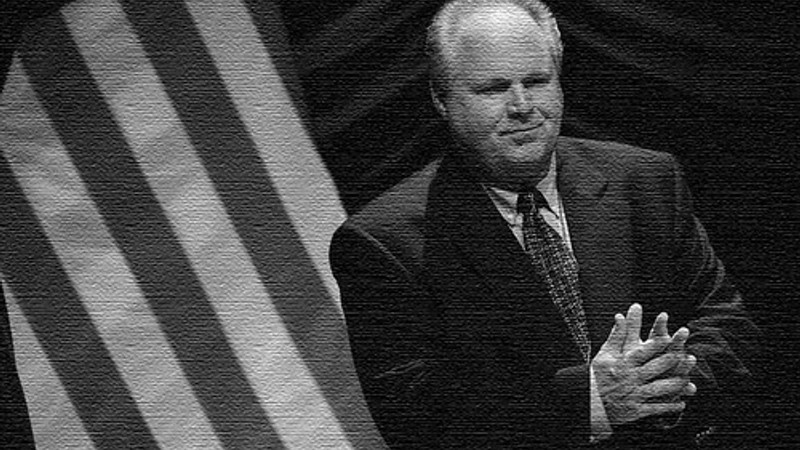
"There aren't too many legends around. But he is a legend," "And those people who listen to him every day, it was like a religious experience for a lot of people." Donald J Trump 17 February 2021
Five years have passed since the "doctor of democracy" signed off for the final time. In February 2021, when Rush Limbaugh succumbed to lung cancer, American conservatism lost more than its most recognizable voice—it lost the gravitational center that had held the movement's disparate factions in orbit for three decades. Today, as we mark half a decade without his booming baritone cutting through the afternoon airwaves, the right finds itself fractured into warring camps, each shouting past the other in an endless cacophony that Limbaugh, for all his provocations, once managed to harmonize into something resembling a coherent political philosophy.
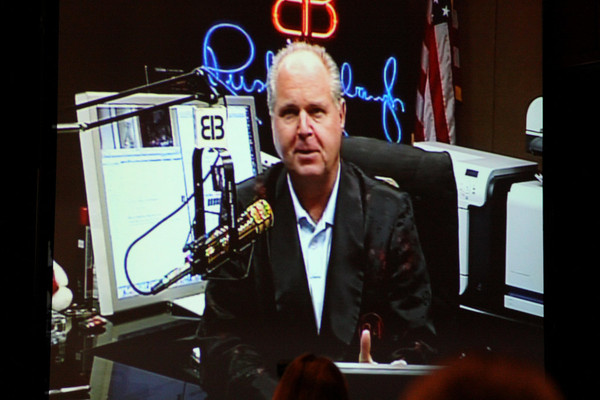
To understand what disappeared with Limbaugh, one must recall the theatrical audacity with which he approached the microphone. He entered his studio with the swagger of a performer who claimed to operate with "half my brain tied behind my back, just to make it fair." It wasn't merely braggadocio; it was a framing device that elevated conservative talk radio into performance art. Limbaugh understood that politics was entertainment long before cable news hosts adopted the same ethos. He possessed what he humbly described as "talent on loan from God"—a phrase that served simultaneously as joke, theological wink, and brand statement. Whether one viewed him as prophet or charlatan, there was no denying the alchemical quality of his delivery. He could make the Fairness Doctrine sound like tyranny, could transform the moderate Republican into an endangered species, could turn three hours of broadcasting into a daily congregation for millions who felt unheard by coastal elites.
The "doctor of democracy" didn't just diagnose the nation's ills; he prescribed a specific kind of medicine: absolute certainty. In an era of "squish" moderates and country-club Republicans, Limbaugh offered crystalline clarity. You were either with the movement or against it. This rigidity, which critics denounced as demagoguery and supporters celebrated as principled conviction, created a remarkably durable coalition. From the Christian right to libertarian leaners, from blue-collar Reagan Democrats to anti-establishment populists, Limbaugh provided the soundtrack that made divergent interests feel like a unified front. His show was the town square where Pat Buchanan readers and Jack Kemp enthusiasts could find common ground in their mutual disdain for liberalism.
But the microphone eventually went cold, and with it, the discipline it imposed.
In the five years since, conservative media has metastasized into a fractured ecosystem of competing grievances. The fragmentation that began in Limbaugh's final years accelerated into full dissolution. Where once there existed a clear hierarchy—Rush at the apex, with a constellation of local hosts and imitators orbiting below—there now reigns a civil war of voices. The populist-nationalist wing dismisses the Reaganite remnant as "Conservative Inc."; the establishment-aligned pundits dismiss their populist counterparts as dangerous demagogues; and both factions wage proxy wars through podcasts, Substacks, and Twitter threads that Limbaugh, with his mastery of the long-form monologue, would have found chaotic and unproductive.
The irony is stark: a movement that once prided itself on message discipline has become postmodern in its cacophony. Limbaugh could attack a Republican Senator for insufficient loyalty without endangering the broader coalition because he alone provided the connective tissue. The current landscape lacks such synthesizing authority. When Matt Gailey clashes with Mitch McConnell, when Tucker Carlson critiques Mike Pence, when the Twitter right eviscerates the Wall Street Journal editorial board, there is no Rush to provide the final word. The "doctor of democracy" has left his patients to self-medicate, and the results have been toxic.
What conservatives have discovered since 2021 is that Limbaugh was not merely a broadcaster but a moderating institution. His show operated as a pressure-release valve and organizing tool simultaneously. Today's right has the pressure without the release, the organizing without the tool. The "talent on loan from God" proved irreplaceable not because of the talent itself, but because the ecosystem that created it—the fusion of AM radio, the post-Cold War consensus, and the personality-driven politics of the 1990s—no longer exists.
Five years on, the silence is telling. Conservatives aren't just failing to convert liberals; they've stopped listening to each other. The movement that once operated with the confidence of someone performing with half his brain tied behind his back now flails with the anxiety of a student who hasn't completed the reading. The golden microphone sits in its museum case, a relic of a time when one voice could drown out the noise. In its absence, there is only noise.
And nobody, it seems, is making it fair anymore.
Editorial comments expressed in this column are the sole opinion of the writer