6 I marvel that you are turning away so soon from Him who called you in the grace of Christ, to a different gospel, 7 which is not another; but there are some who trouble you and want to pervert[the gospel of Christ. 8 But even if we, or an angel from heaven, preach any other gospel to you than what we have preached to you, let him be accursed. 9 As we have said before, so now I say again, if anyone preaches any other gospel to you than what you have received, let him be accursed. Galatian 1:6-9
The Catholic Church in America has undergone profound transformations over the past six decades, shifting from dramatic decline following the Second Vatican Council (1962-1965) to what some observers now identify as a remarkable resurgence among Generation Z. These contrasting trends and the factors behind the post-Vatican II collapse and the contemporary revival among young Americans are worth paying attention to.
The period immediately following Vatican II witnessed an unprecedented collapse in Catholic religious practice across the United States. In 1973, 34 percent of Americans raised Catholic attended Mass every Sunday—a figure that plummeted dramatically in the decades that followed, with Mass attendance effectively halving since the Council's implementation.
Research published in Church Life Journal in 2025 confirmed what many Catholics had long suspected: Vatican II triggered a significant decline in worldwide Catholic attendance relative to other denominations. Beginning in 1965 and continuing through the 2010s, monthly Mass attendance in Catholic nations decreased by an average of 4 percentage points more than in Protestant countries. The study's authors concluded that the Council itself, rather than broader cultural trends, was the primary catalyst for this religious abandonment.
Several factors contributed to this collapse. The liturgical reforms eliminated Latin, transformed the Mass into the vernacular, and stripped away many traditional devotional practices that had anchored Catholic identity for centuries. Many Catholics experienced these changes as a rupture with their inherited faith rather than a renewal. The cultural upheaval of the 1960s and 1970s coincided with these reforms, creating a perfect storm of religious disaffiliation.
The numbers tell a devastating story. A 2025 study revealed that 9 in 10 cradle Catholics eventually leave the Church, representing a hemorrhaging of members that has continued for over half a century. Religious vocations collapsed, seminaries emptied, and Catholic schools closed across the nation.
Against this backdrop of decline, a surprising reversal has emerged. Catholic identification among Americans aged 13-28 jumped from 15% to 21% in just one year, according to 2025 reports. This represents a remarkable turnaround that has caught the attention of researchers and Church leaders.
56 percent of Catholics voted for President Reagan in the 1984 national election while 44 percent voted for Walter Mondale. Pew Research Center reported that about 22% of those who voted in the 2024 election and cast their ballot for President Donald Trump were Catholic.
Even more striking than raw numbers is the nature of this revival. Data from 2025 surveys indicate that while overall Catholic numbers among young adults may be down, engagement among those who remain has increased dramatically. Two-thirds of young Catholic adults (65%) now report attending Mass at least monthly, compared with only 43% of previous generations at comparable ages.
The demographics of this revival are particularly noteworthy—**young men are leading this Catholic resurgence**. The phenomenon of "TradCath"—embracing traditional Catholicism—has become a significant cultural marker among Generation Z converts.
Several factors drive this reversal. First, many Gen Z Catholics are attracted to traditional practices, including the Latin Mass. A study by the Priestly Fraternity of St. Peter documented significant interest in the Latin Mass among millennials and Gen Z, who find in these ancient liturgies a sense of transcendence and permanence absent from contemporary culture.
Second, young people today face unprecedented anxiety, isolation, and meaninglessness in an increasingly digital world. The Church offers what converts describe as "objective truth," moral clarity, and belonging to something larger than themselves. In an era of moral relativism, the Church's unchanging teachings provide stability.
Third, social media enables young Catholics to connect with believers worldwide, share conversion testimonies, and discover Catholic tradition outside institutional channels that failed previous generations.
The current revival presents a fascinating paradox: young Catholics today are often more traditionally minded than their parents. While the post-Vatican II generation emphasized liturgical experimentation, Gen Z Catholics frequently seek out the Latin Mass, traditional devotions, and orthodox teaching. This suggests that reforms intended to make Catholicism "relevant" may have inadvertently created conditions for a traditionalist backlash.
By contrast, in 2024, the Southern Baptist Convention baptized more new members than in any of the previous seven years but still saw an 18th consecutive year of overall membership decline.
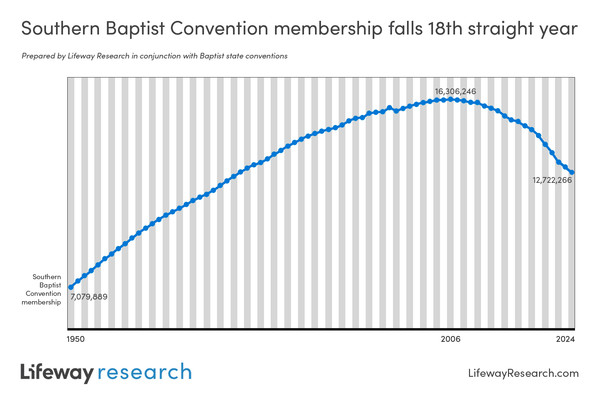
The 12,722,266 members of Southern Baptist congregations mark a 2 percent decline from 2023, according to the Annual Church Profile (ACP) compiled by Lifeway Research in cooperation with Baptist state conventions. However, more than a quarter of a million baptisms (250,643) represent a more than 10 percent jump over 2023 and the most since 2017.
The Church has traveled a remarkable arc from Vatican II optimism through devastating decline to apparent renewal among the young. This resurgence—driven by young men, characterized by traditional practice, and fueled by rejection of secular modernity—represents a dramatic reversal. Whether it can reverse long-term numerical decline remains uncertain. However, the qualitative change in engagement suggests something more significant than statistical recovery: a transformation in what it means to be Catholic in twenty-first century America. The young Catholics of today, embracing tradition in an age of innovation, may succeed where their parents' generation failed—building a faith simultaneously ancient and authentically responsive to contemporary spiritual hunger.
Editorial comments expressed in this column are the sole opinion of the writer