
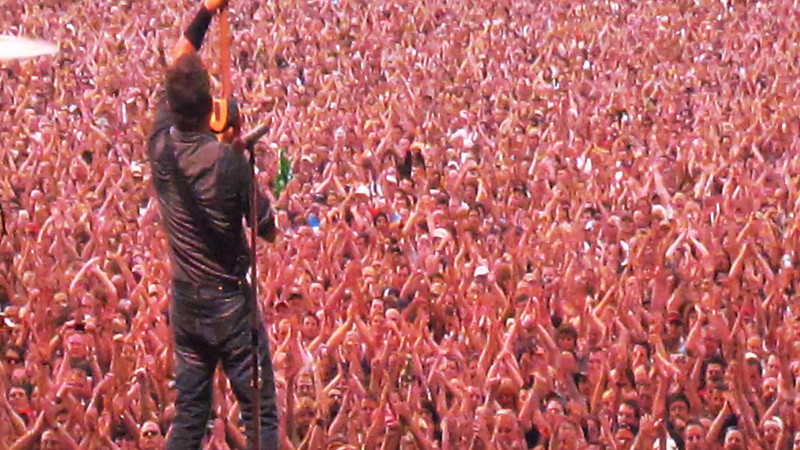
In our interconnected digital world, how America presents itself to global audiences carries unprecedented weight. When international viewers witness Bruce Springsteen's latest music video or catch Green Day's Super Bowl performance, they're not just consuming entertainment—they're forming impressions about the country's soul. These cultural moments, combined with how international media covers American domestic policy, create a complex tapestry of perceptions that often diverge dramatically from how Americans see themselves.
Bruce Springsteen, long known as "The Boss," has built a career chronicling the American experience—its promises and its shortcomings. His recent work, Streets Of Minneapolis - like much of his catalog, explores the nuanced relationship between the American dream and American reality. While some domestic viewers might interpret his storytelling as critique, international audiences often perceive it differently. In many countries, artistic expression that questions governmental authority isn't just accepted—it's considered a hallmark of a healthy democracy. When international audiences see American artists freely expressing concerns about social issues, they may view it not as anti-American sentiment but as evidence of America's democratic robustness.
“Yeah, Just felt sad that the song is based on reality. Sometimes I'm scared for my family there, because we're brown. That's one of the things I'm always scared about whenever my mom says she will do some errands alone outside. Social media is really misleading sometimes, or most of the time.”
Similarly, when Green Day takes the stage, in front of an estimated 127.7 million viewers tuned in for Super Bowl LIX with politically charged statements, viewers abroad process these moments through their own cultural lenses.
In nations with less protected free speech, such high-profile criticism of government policies might seem radical. For others, it might reaffirm their view of America as a place where dissent flourishes. The same performance that some Americans view as unpatriotic might reinforce others' belief in America's commitment to free expression.
The media dimension adds further complexity. International coverage of American domestic policies—particularly immigration enforcement and civil rights issues—varies significantly across different countries and news organizations. CNN's coverage of ICE operations might look dramatically different when filtered through international broadcasters, each bringing their own editorial perspectives and national interests to their reporting.
What emerges is a fascinating disconnect. Domestic political discourse often frames internal criticism as harmful to America's image abroad. Yet international audiences frequently distinguish between America's government and its people, its policies and its principles. Many understand that a society capable of self-criticism is often one worth admiring.
Consider how this plays out in practical terms. A student in India might see Springsteen's video and appreciate America's artistic freedom while simultaneously questioning certain foreign policy decisions. A business owner in Brazil might watch coverage of immigration protests while maintaining positive views of American economic opportunities. These nuanced coexisting perspectives challenge simplistic narratives about how America is perceived globally.
The reality is that America's international image has always been complex—a mixture of admiration for its democratic values, criticism of its policies, and fascination with its cultural exports. What's changed is the immediacy and volume of information flowing across borders. Social media ensures that a Super Bowl moment, a new music video, or news clip about domestic policy can become part of global conversations within minutes.
For Americans concerned about their country's international standing, the path forward might involve greater recognition of how cultural expression and press freedom—sometimes criticized domestically as "anti-American"—can actually reinforce some of America's most admired qualities abroad. The ability to question, critique, and protest publicly remains one of America's most powerful exports, even when it makes some Americans uncomfortable.
As global consumers of American culture continue to shape their perceptions of the United States, they demonstrate a sophisticated ability to distinguish between government actions, societal problems, and national ideals. This nuanced understanding suggests that America's cultural exports—with all their complexity, contradictions, and controversies—may ultimately paint a more authentic portrait of the nation than any carefully managed public relations campaign could achieve. It helps when it tells the truth.
In this light, perhaps the most American thing America can do is continue allowing its artists, journalists, and citizens to express themselves freely—trusting that global audiences are sophisticated enough to understand that democracy's heart beats strongest when unafraid of its own critics.
Editorial comments expressed in this column are the sole opinion of the writer
