
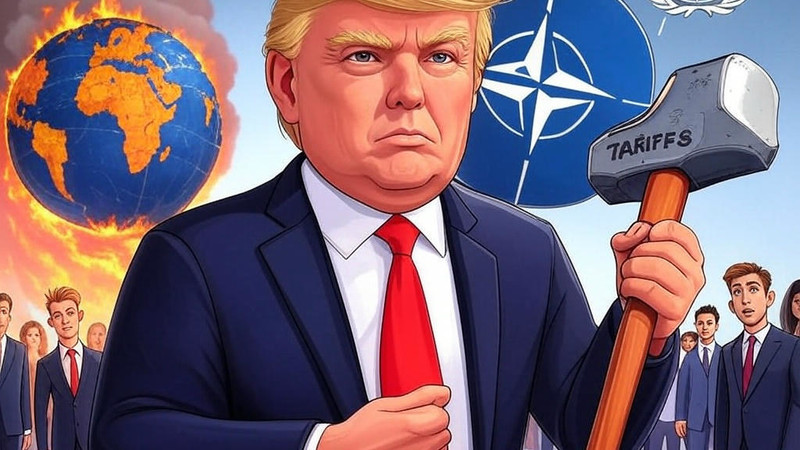
In the annals of American economic policy, few achievements rival President Donald J. Trump's bold assault on the U.S. trade deficit in 2025. Long a thorn in the side of U.S. prosperity, the chronic imbalance—peaking at a staggering $136.42 billion in March—symbolized decades of unfair deals that hollowed out manufacturing heartlands and enriched foreign competitors. Trump's "America First" agenda, armed with sweeping reciprocal tariffs, turned the tide, delivering a historic contraction by year's end. The most recent data, released December 11, 2025, by the Bureau of Economic Analysis (BEA), paint a picture of resounding success: the September goods and services deficit plummeted to $52.8 billion, the lowest since June 2020, a 10.9% drop from August's $59.3 billion.
This isn't mere fluctuation; it's the culmination of a strategy that reshaped global trade dynamics.
The architect of this reversal? Trump's aggressive tariff regime, invoked under the International Emergency Economic Powers Act (IEEPA). On April 2—hailed as "Liberation Day"—he declared a national emergency over the $1.2 trillion goods deficit of 2024, blaming non-reciprocal practices like currency manipulation and value-added taxes abroad.
Effective April 5, a baseline 10% tariff hit imports from nearly all nations, escalating to 25-50% on high-deficit culprits like China, Mexico, and the EU for autos, steel, and copper.
Country-specific hikes followed: 145% on Chinese goods from April 9 to May 12, crippling Beijing's export flood and narrowing the bilateral gap to $11.4 billion by September.
These weren't punitive slaps; they were precision tools to force reciprocity, re-shoring supply chains and igniting domestic production.The numbers tell the story. Year-to-date through September, the deficit stood at $665.4 billion, a 12% improvement from 2024's pace, with exports surging 5.2% to $2.45 trillion on booms in pharmaceuticals, gold, and services.
Imports, once voracious, moderated: August's 5.1% plunge to $340.4 billion—driven by tariff aversion—shrank the monthly gap 23.8% to $59.6 billion.
September's exports leaped 3% to a near-record $289.3 billion, outpacing imports' meager 0.6% rise, compressing the goods deficit 8.2% to $79 billion—the tiniest since 2020.
Tariff revenue? A windfall exceeding $30 billion monthly by fall, funding infrastructure and tax cuts while deterring dumping.
Critics, wedded to globalization's ghosts, decry inflation risks or "trade wars," yet evidence mocks them. Manufacturing employment stabilized at 12.75 million by June, with steel output up 15% post-tariffs.
The 12-month rolling deficit through August? Down to $1.05 trillion from 2024's abyss, a 14% cull.
Trump's vision—bilateral balances near zero—nears fruition: Mexico's gap halved to $17.8 billion, Vietnam's to $14.4 billion.
Even services, a U.S. surplus of $315.69 billion, amplified the win.
This is no accident. Trump's April executive order targeted asymmetries that cost 3.7 million jobs pre-2018, now reversed through leverage.
Allies negotiated truces—EU auto duties eased, Canadian steel pacts renewed—averting escalation while yielding concessions. The stock crash of April? A brief panic, eclipsed by Q3 GDP growth of 3.1%, fueled by export-led recovery.
As 2025 closes, Trump's trade renaissance stands tall: a deficit tamed, factories humming, sovereignty reclaimed. Economists once scoffed at bilateral focus; now, data vindicates the dealmaker-in-chief. America trades fair—or not at all. In this ledger of triumphs, the red ink fades, and the red, white, and blue economy rises anew.
To finish the job Trump need help. As Howard Gleckman at Tax Policy Center said, “Congress isn’t going to vote any time soon to explicitly replace the income tax with a consumption levy. But aggressive efforts to dismantle the IRS combined with a hollowing out of the income tax base could render the existing revenue system unsustainable. And drive lawmakers to replace it with something else.”
“We don’t know if the steps we’ve seen so far are part of a deliberate strategy by Trump to replace the income tax. But if that was my goal, this is exactly how I’d go about it.”
Editorial comments expressed in this column are the sole opinion of the writer.
