
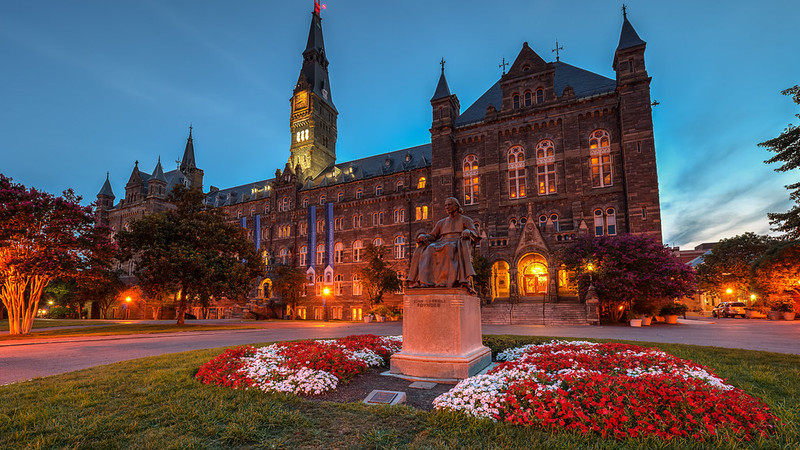
One of the most disturbing and under-reported stories last week that further exposes how much control Qatar has in our country and inside US Educational institutions is the fact that Georgetown University Law School has hired Liz Magill, the former President of the University of Pennsylvania, who resignend in disgrace after failing to definitively state that calling for the genocide of Jews violated school policy, leading to donor and political pressure. She is set to be the Executive Vice President and Dean of Georgetown University Law Center, with her term to begin on August 1, 2026.
In a February 14, 2026, social media post, conservative activist Laura Loomer raised alarms about Qatar's financial influence over hiring decisions at American universities, particularly highlighting recent congressional testimony by Georgetown University's president.
Loomer's post, which includes a screenshot of what appears to be official testimony, focuses on a statement from Georgetown's interim President Robert M. Groves. According to the provided excerpt, Groves acknowledged that "The Qatar Foundation provides financial support that Georgetown uses to pay the salaries of its faculty and staff in Doha and costs of their use." Loomer characterizes this as evidence that Qatar, which she describes as "the largest financier of Hamas and the Muslim Brotherhood," is now "making personnel decisions at Georgetown."
This social media commentary references a July 2025 appearance before the U.S. House Committee on Education and Workforce, where university leaders testified about antisemitism on their campuses. The broader context involves increased scrutiny of foreign funding to American educational institutions, particularly from Gulf states like Qatar, which has established satellite campuses of several prestigious Western universities through its Qatar Foundation.
Georgetown University's Qatar campus was established in 2005 as part of Qatar's Education City initiative, which hosts branch campuses of several American universities. This arrangement involves substantial financial support from the Qatar Foundation to cover operational costs, including faculty salaries—something that appears to have been confirmed in President Groves's testimony.
Reports show Georgetown has received more than $971 million, and in some estimates over $1 BILLION, from Qatari sources since establishing its branch campus in Doha in 2005, primarily through the Qatar Foundation.
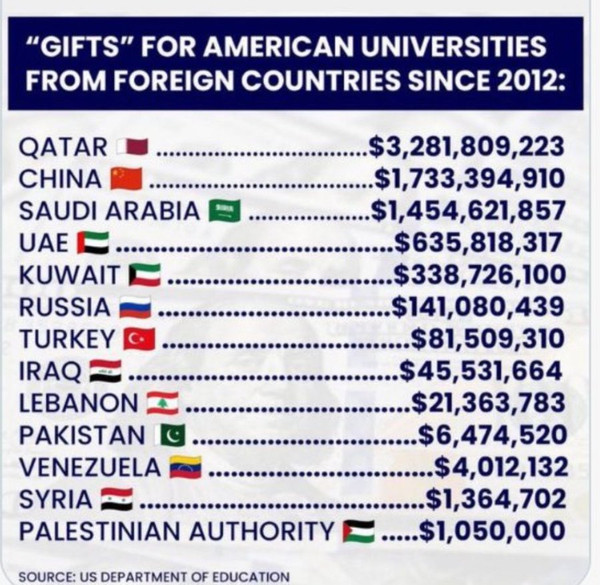
Critics like Loomer argue that such financial dependencies create conflicts of interest that could compromise academic freedom and American values. They suggest that Qatar's alleged support for extremist groups raises questions about its influence on curricula, faculty selection, and research directions at these satellite campuses. This concern has gained traction among conservative lawmakers and advocacy groups who have called for greater transparency regarding foreign funding of American universities.
“It appears that Qatar, the largest financier of Hamas and the Muslim Brotherhood, is now making personnel decisions at Georgetown!’ she said in her X post.
Supporters of international campus partnerships note that these arrangements facilitate cultural exchange and educational opportunities in regions where higher education infrastructure may be developing. They emphasize that universities maintain academic oversight and control over curricula and hiring decisions, regardless of funding sources.
The concerns raised in Loomer's post reflect a growing debate about the appropriate boundaries for foreign involvement in American higher education including hiring decisions. As with many issues involving foreign influence, the conversation tends to become polarized, with nuanced discussions about academic collaboration sometimes getting lost in more alarmist narratives.
What remains relevant in evaluating such claims is understanding the actual governance structures of these international partnerships, the extent to which standards of academic freedom are maintained, and the transparency with which these relationships are disclosed to stakeholders. Without this broader context, individual statements—while potentially accurate in isolation—can be framed to suggest implications that may or may not reflect the full reality of how these international educational partnerships operate.
