
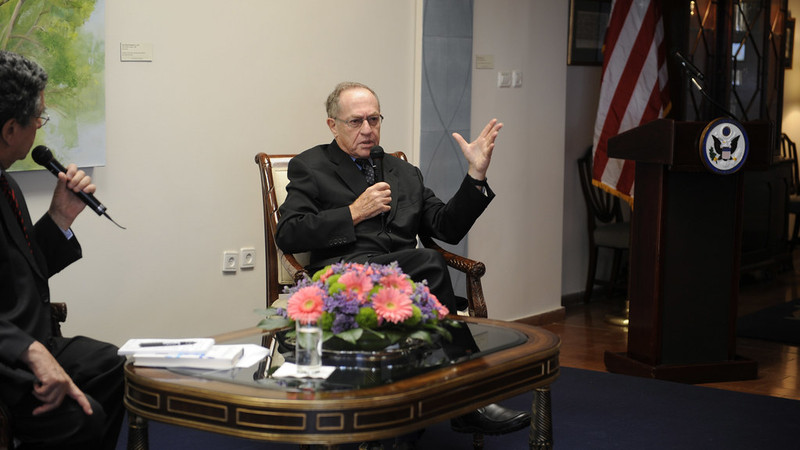
The ACLJ just filed a landmark case against CNN at the U.S. Supreme Court after the news agency defamed Harvard Law School professor emeritus and famed constitutional lawyer Alan Dershowitz during his Senate oral arguments against the impeachment of President Trump. We have filed a petition for writ of certiorari to the Supreme Court on behalf of Professor Dershowitz in his critical defamation case against CNN.
This case presents the Court with an opportunity to reconsider whether the actual malice standard established in New York Times v. Sullivan remains consistent with the First Amendment’s original meaning and whether it adequately protects individuals’ reputational interests while preserving robust public debate.
When mainstream media outlets can falsely vilify, smear, and attack public figures with impunity, there is a fundamental problem in the law. This case represents far more than one man’s fight to clear his name – it’s a battle for truth, constitutional fidelity, and the fundamental right to seek justice when wronged.
What Happened: CNN’s Systematic Distortion
On January 29, 2020, Professor Dershowitz – a distinguished Harvard Law School professor emeritus and practicing attorney – appeared on the Senate floor to defend the Constitution and establish why the Constitution would not authorize a conviction of President Trump. Professor Dershowitz served as part of a distinguished legal team, alongside White House Counsel Pat Cipollone, now-Attorney General Pam Bondi, Jordan, and myself, among others.
In response to a question from Senator Ted Cruz (TX), Professor Dershowitz delivered a carefully crafted constitutional analysis that made critical distinctions about what conduct could and could not constitute an impeachable offense.
Professor Dershowitz was crystal clear: Actions motivated by “personal pecuniary interest” – such as a President demanding a hotel with his name on it or a million-dollar kickback – would be “purely corrupt” and present “an easy case” for impeachment. This wasn’t a throwaway line. It was the central point of his constitutional argument.
CNN’s coverage, however, focused on portions of Professor Dershowitz’s statement while omitting his repeated qualifications regarding personal pecuniary interest, broadcasting to millions of viewers that Dershowitz had said the opposite of what he actually argued. As one CNN commentator wrote, “The Dershowitz Doctrine would make presidents immune from every criminal act.” Another claimed Dershowitz was “essentially saying it doesn’t matter what the quid pro quo is as long as you think you should be elected.”
The problem? As even the district court acknowledged, Professor Dershowitz “said nothing of the kind.”
The Constitutional Crisis: New York Times v. Sullivan Gone Wrong
Here’s where this case becomes critical for every American who values truth and accountability. According to Judge Lagoa in her concurring opinion, when the case was before the Eleventh Circuit Court of Appeals, CNN had “defamed” Professor Dershowitz “under any common understanding of that term.” Yet New York Times v. Sullivan and its impossibly high (and judicially created) actual malice “standard” barred any remedy.
In New York Times v. Sullivan, the Supreme Court created a new constitutional rule that makes it extremely difficult for public figures to win defamation cases. As the Supreme Court explained in Anderson v. Liberty Lobby, Inc., under the Sullivan standard, a public figure cannot recover for defamation unless they prove by “clear and convincing evidence” that the defendant acted with “actual malice” – meaning the defendant either knew the statement was false or acted with “reckless disregard” for whether it was true or false. The result? Even when media organizations publish demonstrably false statements that destroy someone’s reputation, public figures are left without remedy if they cannot prove the publisher subjectively knew or strongly suspected the falsity.
This is not what the Framers intended. The First Amendment protects not just speech and press, but also the right to “petition the Government for a redress of grievances.”
