
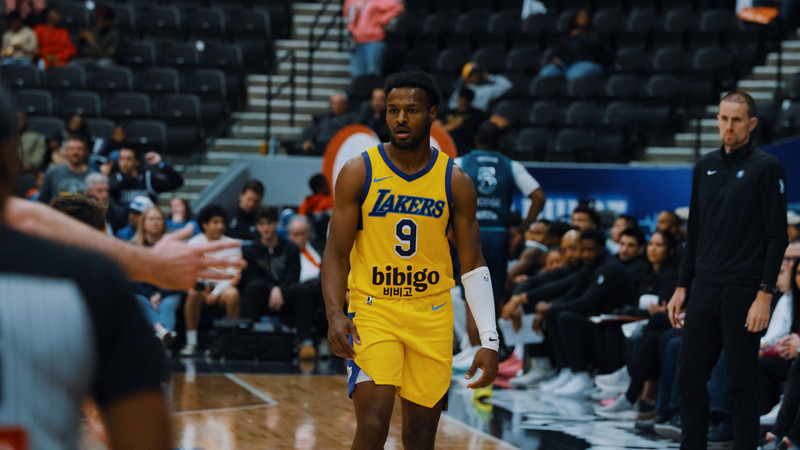
There are certain names in sports that arrive with applause before accomplishment. Bronny James was one of them.
The moment he declared for the draft, the discourse wasn’t about mechanics, defensive footwork, or pick-and-roll reads. It was about lineage. It was about proximity to greatness. It was about whether the son of LeBron James had earned his opportunity, or inherited it.
That distinction is at the center of the scrutiny.
The Case for the Criticism
Professional sports are meritocracies in theory, but marketplaces in reality. When Bronny entered the NBA conversation after a modest collegiate stint at USC Trojans men's basketball, evaluators pointed to limited production, inconsistent offensive assertiveness, and a role-player profile. He was not viewed as a franchise-altering prospect. He was viewed as developmental.
Yet he received national broadcast attention, headline cycles, and a draft narrative that most second-round guards never experience. That attention wasn’t accidental. It was attached to the James name.
When a player benefits from amplified visibility, elevated marketing value, and immediate brand capital, scrutiny follows. That is not cruelty; that is market correction.
If the NBA is the highest level of competitive basketball on earth, every roster spot is sacred. Critics argue that when familial proximity appears to influence opportunity, fairness must be questioned.
That argument is not inherently malicious. It is rooted in competitive integrity.
The Case Against the Criticism
But here is where nuance matters.
Bronny did not choose his father. He did not design the media machine. He did not negotiate television segments dissecting his draft projection. He is a 19-year-old guard navigating a developmental arc under a microscope that few veterans could withstand.
And the idea that he must be “exceptional” to justify his presence reveals the imbalance.
Second-round players are typically afforded time. They are projects. They are G League contributors. They are defensive specialists. They are situational guards. They are not required to be saviors.
Bronny’s skill set, defensive intensity, point-of-attack pressure, catch-and-shoot potential—aligns with a role player trajectory. The standard developmental pathway should apply to him as it would to any other guard drafted in that range.
Holding him accountable is fair. Holding him hostage to his father’s legacy is not.
The Reality of the Name
The truth is this: the James surname is both privilege and pressure.
LeBron’s career has redefined modern expectations for greatness—longevity, durability, statistical dominance, and championship contention. Inevitably, the comparison machine activates. It always does.
But lineage in sports is not new. From Ken Griffey Jr. to Stephen Curry, second-generation athletes have navigated similar terrain. The difference is scale. Social media has industrialized scrutiny. Debate has become content.
Bronny is not competing against other rookies. He is competing against expectation.
So, Does He Deserve Extra Scrutiny?
Deserve is the wrong word.
Will he receive it? Absolutely. That is the cost of global branding and historical proximity.
Should evaluation be rigorous? Of course. This is the NBA.
Should criticism exceed performance-based analysis and drift into legacy projection? No.
Bronny James should be evaluated like every other young guard fighting for rotational minutes: by defensive metrics, by efficiency, by growth curve, by basketball IQ.
Nothing more. Nothing less.
A lot of questions need to be answered. Only time will tell when it comes to this type of story.
If he thrives, it will be because he earned it.
If he struggles, it will be because development at the professional level is unforgiving.
But the microscope does not define the player.
Production does.
Editorial comments expressed in this column are the sole opinion of the writer800-766-1159
Music By Dalla
"We make your Vision a reality"
