
The artificial intelligence revolution runs on water. While the public discourse around data centers tends to focus on electricity consumption and semiconductor supply chains, an equally critical resource crisis is unfolding beneath the surface. As the global fleet of hyperscale facilities expands to meet insatiable demand for cloud computing and AI, the industry’s relationship with water has entered a perilous new phase. After facing mounting scrutiny over the depletion of lakes and rivers, data center expansion is increasingly targeting aquifers—underground reservoirs that communities and ecosystems rely upon but cannot easily see or measure.
The scale of the thirst is staggering. The United Nations has estimated that data centers will consume 9.3 trillion liters of water over the coming decade, a volume sufficient to meet the entire planet’s drinking water needs for more than a year. The vast majority of this water is not used for processing or cleaning, but for cooling. Inside these massive facilities, thousands of server racks generate extraordinary heat, and the cheapest, most efficient way to manage that thermal load is evaporative cooling. In this process, water is circulated through systems to absorb heat and then released as vapor, effectively removing it from the local watershed entirely.
[see Georgia Wyoming Mississippi Tennessee]
For years, data centers have relied heavily on surface water. They have been situated near lakes, rivers, and reservoirs to secure the millions of gallons needed to keep servers operational. In Texas alone, data centers are projected to use 49 billion gallons of water in 2025 and as much as 399 billion gallons annually by 2030. To put that in perspective, that latter figure is equivalent to drawing down Lake Mead—the largest reservoir in the United States—by more than sixteen feet in a single year. As climate change intensifies drought cycles across the American West and other regions, these surface water sources are shrinking precisely where data center construction is accelerating.
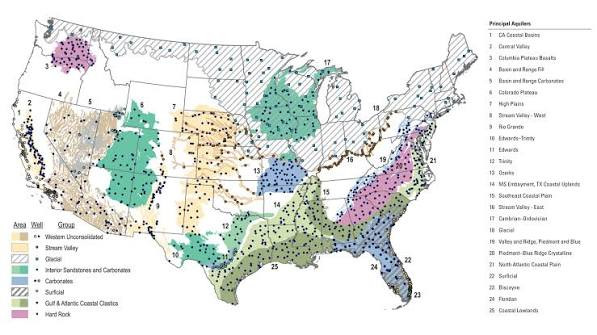
Communities near depleted aquifers should worry about sinking ground, cracking foundations, and dwindling water supplies.
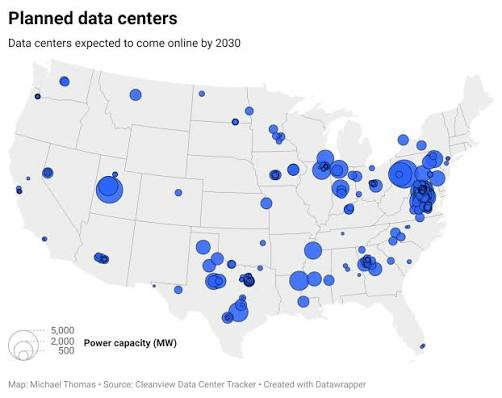
The geographic mismatch is no coincidence. A majority of new AI data centers are being built in drought-stricken regions, often in close proximity to rapidly shrinking lakes. Facilities have been proposed or constructed near the Great Salt Lake and other stressed terminal lakes, where any additional upstream withdrawal compounds the loss of inflow. As surface water levels drop and public backlash grows, companies are facing tighter restrictions on river and lake withdrawals. Environmental advocates and local governments have begun pushing back, recognizing that taking water from visibly receding reservoirs invites immediate political and regulatory consequences.
Faced with these constraints, the industry is increasingly turning to what lies beneath the surface. Aquifers—underground layers of water-bearing rock—are becoming the next frontier for data center water procurement.
Groundwater offers several advantages to operators. It is often less regulated than surface water, with fewer public reporting requirements and weaker oversight mechanisms. In many jurisdictions, landowners can drill wells and pump groundwater with minimal permitting, especially when compared to the complex water rights associated with rivers and lakes. Because aquifers are invisible to the public eye, withdrawals generate less immediate outcry than the sight of a once-full reservoir dropping to record lows.
The environmental risks of aquifer targeting are profound. Unlike surface reservoirs, which can replenish relatively quickly with seasonal rainfall and snowmelt, many aquifers are ancient stores of water that recharge over centuries or millennia. Once pumped out for evaporative cooling, that water is lost to the local cycle forever. Large-scale withdrawals can cause land subsidence, the gradual sinking of the ground above the aquifer, which damages infrastructure, alters drainage patterns, and can permanently reduce the aquifer’s storage capacity. In already groundwater-depleted regions, from the High Plains to the desert Southwest, data center demand threatens to accelerate a crisis that has been building for generations.
Moreover, the move underground often evades the transparency that environmental groups have fought to establish for surface water use. While shrinking lakes make headlines, dropping water tables are measured in private well logs and academic studies that the public rarely sees. Data center operators frequently cite proprietary concerns when asked to disclose water consumption figures, and groundwater extraction is notoriously difficult to meter and regulate. This opacity allows the industry to expand in areas where surface water has already been effectively claimed or restricted, often without the same level of ecological or community scrutiny.
The United Nations has explicitly warned that even when data centers recycle some portion of withdrawn water, large-scale extraction can strain aquifers and river systems, particularly in arid or groundwater-depleted regions. The warning underscores a fundamental reality: the AI boom is not creating new water; it is redirecting existing, finite supplies away from agriculture, ecosystems, and human consumption toward computational processes. As one water specialist noted, we are in a state of systemic water deficit almost everywhere on the planet, and unrestricted demand from any sector is no longer tenable.
There are alternatives, but they come with costs. Air-cooled systems, wastewater recycling, and seawater cooling can reduce freshwater dependence, though they require greater capital investment and energy. Some newer facilities are experimenting with closed-loop systems that minimize consumption. Yet the industry’s default trajectory remains anchored to the cheapest, most accessible water source available, and as rivers and lakes become politically and physically unavailable, the drill bit turns downward.
Land subsidence is the primary risk. When vast volumes of groundwater are withdrawn, the water pressure that helps support the overlying rock and sediment drops. Without that pressure, the aquifer skeleton compacts, and the ground above sinks. In California’s Central Valley and the Phoenix-Tucson area of Arizona, decades of groundwater pumping have caused tens of feet of subsidence, damaging roads, bridges, and canals. This is by far the dominant geological hazard tied to low water tables.
The targeting of aquifers represents a strategic displacement of the data center water crisis rather than its resolution. It is a shift born not of abundance below ground, but of scarcity and conflict above it. If the industry continues to expand on its current trajectory, the unseen depletion of groundwater reserves will become one of the defining environmental legacies of the digital age. The servers will stay cool, but the wells may run dry.
Editorial comments expressed in this column are the sole opinion of the writer
