

A provocative idea is gaining traction among fiscal hawks and America-first economists: What if the U.S. government revalued its massive gold reserves at market prices, eliminated trillions in alleged waste and fraud, and radically simplified the tax code? Proponents argue this could sustain a lean $900 billion federal budget, preserve the world's largest military, and exempt all incomes under $500,000 from federal taxes. It's a bold vision that echoes recent DOGE initiatives and historical precedents, potentially reshaping America's economic landscape.
Let's break it down. The U.S. holds 261.5 million troy ounces of gold, officially valued at an archaic $42.22 per ounce – totaling just $11 billion on the balance sheet. But with gold trading at around $4,332 per ounce as of January 1, 2026, the real market value exceeds $1.13 trillion. Revaluing these reserves – a move proposed by figures like Sen. Cynthia Lummis and economist Judy Shelton – could inject over $1 trillion into the Treasury. This isn't printing money; it's marking assets to market, as done in past crises like the 1930s under FDR.
How? The Treasury could issue gold certificates to the Federal Reserve, receiving dollars in return to retire debt. With national debt hovering near $35 trillion and annual interest payments topping $1 trillion, paying down even a portion could save $50 billion yearly in interest alone (assuming 5% rates). That's immediate fiscal breathing room, reducing the need for deficit spending and stabilizing the dollar without inflation spikes.
Now, pair this with eradicating "fraud" – a term popularized by Elon Musk's Department of Government Efficiency (DOGE). Musk has estimated government waste, improper payments, and outright fraud at a staggering $1.5 trillion annually, far exceeding DOGE's initial $214 billion in identified savings. Critics call it hyperbole but reports from Senate probes and OIG audits reveal billions squandered on redundant contracts, lease cancellations, and abuse in programs like Medicare and defense procurement. If DOGE delivers even half its promised cuts, federal spending could plummet from projected $7 trillion in FY2026 to a core $3-4 trillion – focused on essentials.
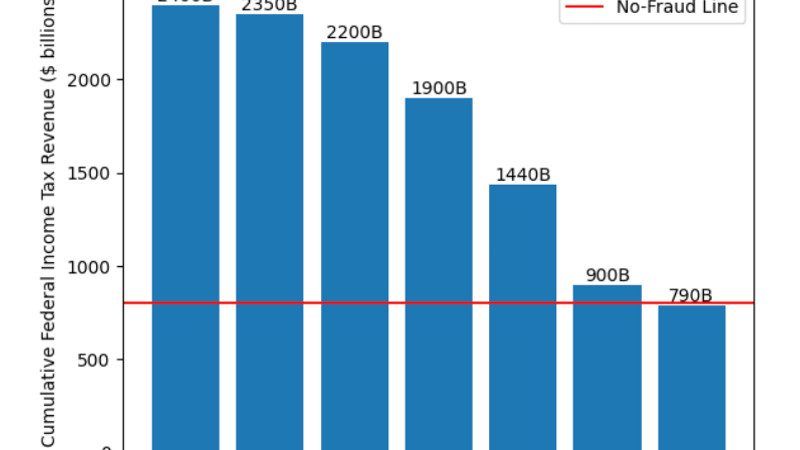
Under this scenario, income tax revenue – currently around $2.4 trillion – becomes redundant for most. Cumulative taxes from earners above $400,000 already hit $900 billion. Exempting those below $500,000 would yield roughly $850-900 billion from high earners alone, covering a stripped-down budget. Add corporate taxes ($500 billion), excises, and tariffs, and total revenues could align with needs.
Critically, this preserves U.S. military supremacy. The FY2026 defense bill authorizes over $900 billion – more than the next 10 nations combined. A $900 billion overall budget? Unrealistic today, but with gold revaluation offsetting debt and fraud cuts eliminating bloat, it's feasible to allocate the lion's share to defense while axing non-essentials like overlapping agencies and foreign aid.
Skeptics warn of market disruptions – gold prices could surge or dip on revaluation news – and one-time gains won't fix structural entitlements like Social Security ($1.5 trillion). Yet, precedents abound: Switzerland and Germany have revalued reserves without chaos, boosting credibility.
In a post-pandemic era of fiscal reckoning, this isn't fantasy – it's optimization. By floating gold and purging fraud, America could unleash growth, reward workers, and dominate globally. The question isn't if we can afford it; it's why we haven't already.
Simply put, the US collects $2.4T in income tax but spends $1.5T on fraud. If we didn't have to pay for fraud, only $900b would need to be collected. This means anyone with any less than 500k in income could pay *literally $0* in income tax. We don't need to raise taxes. we need to cut fraud.
In 1913, zero American families paid income tax. In 2025, every family paid income tax, and about 2/3rds of it just covered fraud.
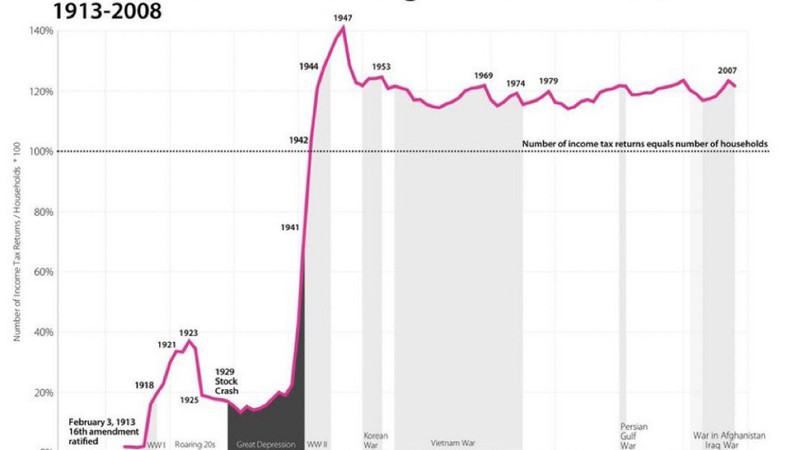
The largest source of federal revenue for most of U.S. history were tariffs on imported products and were essential to government funding pre 1913. Before the modern income tax (post-1913), the U.S. government funded itself primarily through these tarriffs. Now, given that for Fiscal Year (FY) 2025, U.S. tariff revenue saw a massive increase, with estimates ranging from roughly $195 billion to over $200 billion by year's end, we're fully funded.
Editorial comments expressed in this column are the sole opinion of the writer.
