
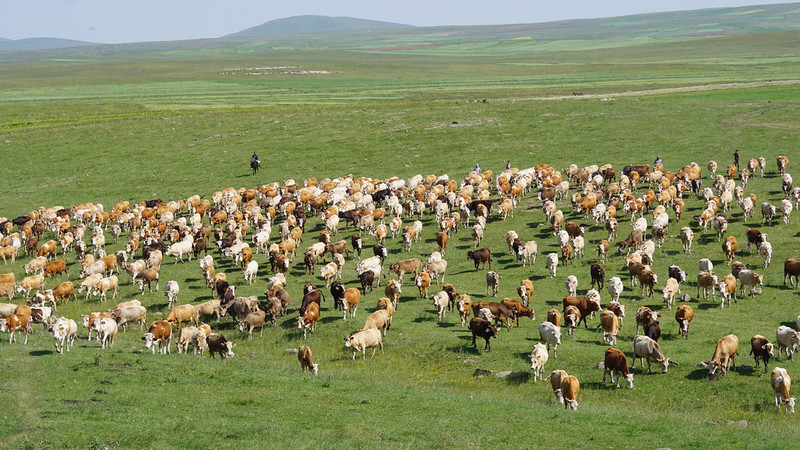
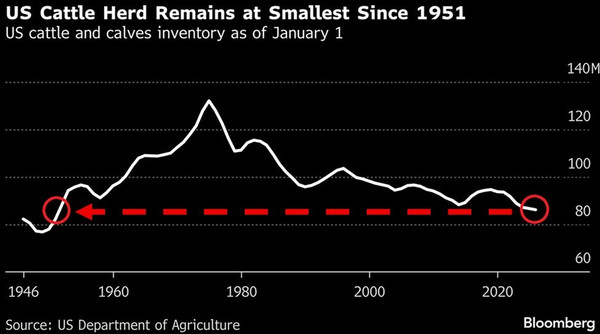
The United States is grappling with a severe cattle shortage that has pushed livestock inventories to their lowest levels since 1951, according to the latest data from the USDA. This dramatic decline signals significant challenges ahead for American consumers and the agricultural sector.
The number of US farms shrank by 15,000 in 2025. Farm bankruptcies are on the rise. Between 2017 and 2022, the number of farms in the U.S. declined by 141,733 or 7%, according to USDA’s 2022 Census of Agriculture, released on Feb. 13. Acres operated by farm operations during the same timeframe declined by 20.1 million (2.2%), a loss equivalent to an area about the size of Maine. Only 1.88% of acres operated and 1% of farm operations were classified under a non-family corporate farm structure.
According to the USDA's cattle and calves inventory report, American herds have dwindled to approximately 85 million head—a figure that represents a staggering drop of roughly 45 million animals from the all-time peak of 130 million reached in 1975. The decline has been particularly steep in recent years, with the herd shrinking by approximately 10 million head since 2020 alone.
The consequences of this beef shortage are already being felt throughout the food supply chain. Beef and veal prices are surging as a direct result of shrinking supply. In an effort to ease pressure on prices President Donald Trump says he has agreed to boost beef imports from Argentina as part of a sweeping trade deal, despite outrage from his allies in the agriculture industry.
Market analysts report that cattle prices have increased by 21% in 2025 compared to the previous year, and projections suggest prices will climb an additional 7% in 2026, regardless of quadrupling Argentine imports. This escalation threatens to worsen inflationary pressures already burdening American households.
Several interconnected factors have contributed to this decades-long decline. Prolonged drought conditions across major cattle-producing regions have devastated grazing lands and driven up feed costs, making it economically challenging for ranchers to maintain their herds. Additionally, high input costs—including expensive feed, fuel, and veterinary services—have squeezed profit margins and discouraged herd expansion. Perhaps more concerning for the industry's long-term outlook is the demographic shift among ranchers; an aging rancher population means fewer young people are entering the profession, and those who remain are increasingly selling off their operations.
The timing of this crisis is particularly problematic given the broader economic context. With beef prices rising sharply, consumers face yet another source of food inflation at grocery stores. The USDA's Economic Research Service has already adjusted its 2026 cattle price projections upward based on recent market data, suggesting that relief may be years away rather than months.
Market participants note that herd rebuilding—a natural response to high prices—will take considerable time. Cattle are not commodities that can be quickly replenished; the biological cycle from breeding to market-ready cattle spans several years. Even if conditions become favorable for expansion tomorrow, it would take 2-4 years before supply could meaningfully increase.
The situation has garnered significant attention from commodity traders, agricultural economists, and policymakers. Some analysts view this as potentially the most bullish cattle market in decades, while others warn about the structural headwinds facing American beef production. Climate change, [as I write this a major wildfire is threatening farms and ranches across the Southern Plains, with at least 145000 acres burned in Oklahoma], water scarcity [exacerbated by new data centers and housing development}, and shifting consumer preferences toward alternative proteins add additional layers of uncertainty to the industry's future.
For consumers, the implications are clear: beef will likely remain expensive for the foreseeable future. For policymakers, the challenge lies in balancing support for ranchers with the need to maintain affordable protein sources for American families. This is not a temporary blip but rather a fundamental supply constraint that will shape the agricultural landscape for years to come.
For more on the cattle industry in America see our recent interview with new Tennessee Agriculture Commissioner Andy Holt | HLJ Ep 422
