"San Francisco isn't what it used to be, and it never was." Herb Caen.
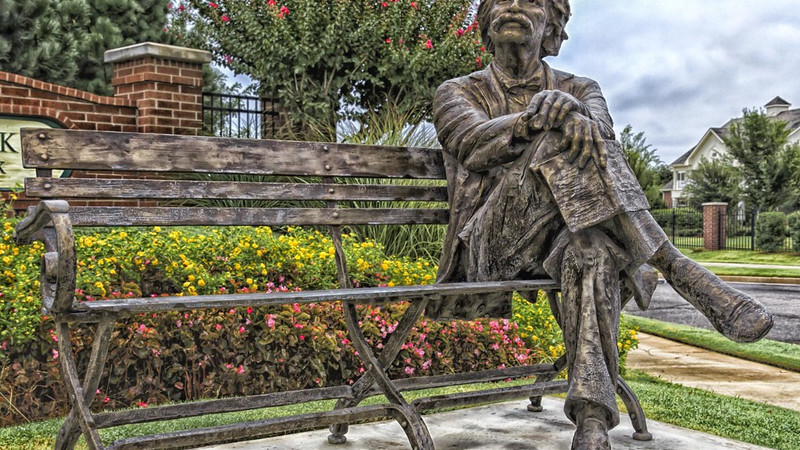
"America is built on a tilt, and everything loose slides towards California." Mark Twain
There was a time—not so long ago—when California stood proudly as a bastion of investigative journalism, a place where the powerful trembled at the sound of a reporter's pen scratching against paper. In 2010 and 2011, the Golden State celebrated its storied journalistic heritage by bestowing the Mark Twain Award for Journalism Excellence upon two titans of the trade: Samuel Clemens (the man who was Mark Twain himself) and Herb Caen, the beloved three-dot columnist who served as "the voice and conscience of his city" for nearly six decades at the San Francisco Chronicle. These weren't mere golden handshakes for retired newsmen—they were declarations of principle, loud proclamations that California valued transparency, truth-telling, and the kind of muckraking courage that held institutions accountable.
The California News Publishers Association still hosts its annual California Journalism Awards, but one wonders if the trophies gathering dust in their display cases feel like grave markers now—memorials to a dead ethos. Because California in 2026 has become something unrecognizable, something pitiful, something almost tragically ironic: a state that once celebrated its Mark Twains now desperately attempts to muzzle its Nick Shirleys.
Enter AB 2624, cruelly and aptly nicknamed the "Stop Nick Shirley Act"—a piece of legislative machinery so transparent in its intent that it would be laughable if it weren't so terrifying. Introduced by Assemblymember Mia Bonta (wife of California Attorney General Rob Bonta), this bill would extend the state's "Safe at Home" privacy protections—which were originally designed to shield domestic violence survivors—to immigration support service providers, their employees, and volunteers. On its surface, it claims to protect workers from harassment and threats. In reality, it creates a legal fortress around an ecosystem of government-funded nonprofits that independent journalist Nick Shirley has spent months exposing.
And oh, what exposures they have been. Shirley, a young independent journalist working outside the ossified structures of legacy media, has documented what appears to be staggering fraud in California's social services programs. His investigations have revealed "ghost" daycare centers billing taxpayers millions while operating out of empty lots and unrelated businesses. He's identified adult daycare facilities claiming $19.8 million in billing with no adults present, no enrollment information, and phone numbers that lead nowhere. His work echoes findings by Dr. Mehmet Oz, who identified a $3.5 billion hospice fraud ring in Los Angeles where 42 providers were clustered within a single four-block radius—a grotesque monument to bureaucratic incompetence and criminal ingenuity.
The response from California's ruling Democratic supermajority? Not "thank you for uncovering this theft." Not "we will investigate these allegations." No. Their response was AB 2624—a bill that would criminalize the publication of personal information or images of these "immigrant service providers" when done with intent to "threaten, intimidate, or incite violence," carrying penalties of $10,000 fines and imprisonment.
The message couldn't be clearer: expose the wrong kind of corruption, and the state will become your persecutor.
How did it come to this? How did the state that gave birth to so much fearless reporting—the home of the Watergate-busting Washington Post's western spirit, the launching pad for generations of war correspondents and corruption hunters—become a place where lawmakers openly conspire to shield multi-billion-dollar fraud schemes from public scrutiny?
The answer lies in the calcification of political power. When one party controls every lever of government for decades, accountability becomes an inconvenience rather than a virtue. The nonprofits implicated in these alleged frauds—daycare operators, hospice providers, immigration service agencies—represent a constellation of interests woven tightly into California's Democratic political machine. They employ voters. They donate to campaigns. They provide the infrastructure of clientelism that keeps the party in power. Investigative journalists like Nick Shirley aren't just exposing fraud; they're threatening a political ecosystem.
For decades, California politics operated as a closed circuit of intermarried dynasties, where the Getty oil fortune served as the connective tissue binding the ruling class together. Nancy Pelosi's brother-in-law was Ron Pelosi, whose wife Barbara was the sister of Getty matriarch Ann Getty, while Dianne Feinstein's ascent in San Francisco politics paralleled the rise of this same social set—her husband Richard Blum's business dealings and the Getty family's philanthropic web creating an overlapping Venn diagram of power that few outsiders could penetrate. Gordon Getty, the opera-composing billionaire heir, mentored a young Gavin Newsom like a second son, bankrolling his early business ventures and providing the seed money that would launch his political career, even as the Pelosi and Newsom families intertwined through marriages and godparent relationships. This tight aristocratic circle—where the Browns, Newsoms, Pelosis, and Gettys socialized, intermarried, and funded each other's ambitions—meant that California's "progressive" politics were often little more than boutique causes discussed over wine at the Getty Villa, while the state's media ecosystem, dependent on access to these powerful families and their networks of donors, rarely subjected them to the kind of adversarial scrutiny that a healthy democracy requires.

So the state responds not by cleaning house, but by boarding up the windows. AB 2624 doesn't just protect individual workers from harassment—though its supporters will insist that's its sole purpose. It creates a zone of legal opacity around entire categories of government contractors, making it prohibitively risky for journalists or citizen watchdogs to document wrongdoing. The bill's language about "intent to threaten" is a cudgel that can be wielded against any aggressive reporting that makes its subjects uncomfortable. Under this regime, every exposé becomes potentially criminal; every undercover investigation, a candidate for prosecution.
What a pathetic fall for the Golden State. The California Press Foundation still lists its Mark Twain Award recipients on its website—a roll call of honor that includes names like Ruben Salazar, the groundbreaking Chicano journalist who gave his life reporting on police violence, and Jonathan Gold, the fearless food critic who chronicled Los Angeles in all its messy glory. These were journalists who understood that their duty was to the truth, not to protecting the powerful from embarrassment. One imagines Herb Caen—who spent 58 years skewering San Francisco's elites with his poison-tipped typewriter—would be appalled at a California where journalism requires legislative permission slips.
But perhaps the saddest element of this tragedy is how unnecessary it all is. If California's political class had any confidence in the integrity of these social service programs, they would welcome scrutiny. They would join Nick Shirley in demanding answers about $170 million daycare billing for empty buildings. They would investigate the $3.5 billion hospice fraud alongside Dr. Oz rather than dismissing it as political theater. Instead, they've chosen the path of the guilty: silence the messenger, obscure the message, and hope the public's attention moves elsewhere.
The "Stop Nick Shirley Act" represents more than just bad policy. It's a confession written in legalese—a tacit admission that the state's governmental apparatus has become so corrupt, so entangled with fraudulent contractors and phantom service providers, that transparency itself has become an existential threat. California isn't just failing to honor its journalistic heritage; it's actively betraying it, substituting the Mark Twain Award's celebration of truth for a legislative gag order.
There was a time when California led the nation in sunshine laws, in open government, in that peculiarly American faith that sunlight is the best disinfectant. That California is gone now, replaced by something darker and smaller—a state so afraid of its own reflection that it would criminalize the mirror. The Mark Twain Awards still sit in their cases, gathering dust, testifying mutely to a standard that California's current leaders have chosen to abandon. What a pity. What a waste. What a tragedy for the republic that California once aspired to be.
Editorial comments expressed in this column are the sole opinion of the writer