

In the wake of Donald Trump’s 2024 victory, the electoral map revealed a fracture that Democrats could no longer ignore. The party was hemorrhaging young men—particularly white working-class men, but increasingly men of color as well—at a rate that alarmed strategists. The narrative was simple and, by some accounts, accurate: progressivism had cultivated a culture of scorn toward masculinity, leaving millions of young men politically unmoored and culturally vilified. It was, by most reckonings, a generational opportunity for the Republican Party. If conservatives could speak to the economic despair, social isolation, and spiritual hunger among young men without indulging the most toxic elements of grievance culture, they had a chance to lock in a cohort for decades.
Instead, conservatives are setting that opportunity on fire. And the single most critical accelerant was the assassination of Charlie Kirk.
Kirk, the 31-year-old founder of Turning Point USA, was shot and killed on September 10, 2025, while speaking at an event at Utah Valley University. The murder of the conservative activist—one of the most effective youth organizers in modern Republican politics—created an immediate leadership vacuum. But nearly a year later, that vacuum remains. No conservative figure of comparable reach, credibility, and institutional infrastructure has emerged to engage young men at the intersection of faith, purpose, and politics. Without Kirk, the conservative movement finds itself with a map but no navigator in the most important demographic territory it has ever attempted to claim.

His death did not just remove a messenger; it halted a nascent institution. Turning Point Faith, in particular, was designed to do something the conservative movement had failed at for decades—mobilize pastors and church leaders into genuine engagement with a generation that had walked away from the pews. With a multimillion-dollar budget and a stated goal of “breathing renewed civic engagement into our churches,” Kirk was building the connective tissue between parish and precinct. After his murder, that project stalled. His widow, Erika Kirk, assumed leadership of Turning Point USA, and while she has vowed to continue his work, the specific mission of reaching disaffected young men through a faith-based framework has splintered without its most charismatic and entrepreneurial architect.
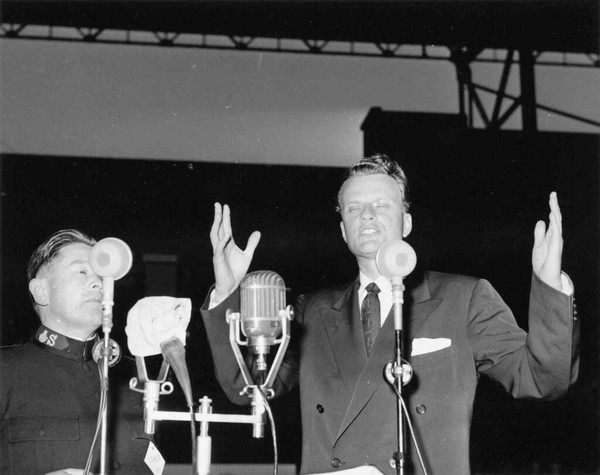
Before Charlie and for decades, prominent voices within American conservatism and evangelicalism itself have warned that entangling Christianity with partisan political warfare would ultimately corrupt both faith and governance. One of the earliest alarms came from conservative icon Barry Goldwater, who cautioned that if preachers seized control of the Republican Party, it would create a “terrible damn problem” because uncompromising religious doctrine is fundamentally at odds with the pragmatic bargaining required of politics. This concern echoed in the ministry of Billy Graham, arguably the most influential evangelical leader of the twentieth century, who deliberately retreated from close political ties and presidential advising following the Watergate scandal and Richard Nixon’s resignation, resolving to keep his mission strictly focused on the Gospel rather than electoral strategy.
Two generations later, this anxiety crystallized into collective action when, in May 2008, more than seventy evangelical scholars and seminary presidents published “A Gentle Plea for Civility” in Christianity Today, urging believers to withdraw from right-wing “culture war” combat and reject their exploitation as mere instruments for partisan gain.
The consequences are visible in the data. Despite the Democratic Party’s chronic inability to moderate its cultural messaging on gender and masculinity, Republicans are not consolidating their youth advantage. In 2025 off-year gubernatorial elections in Virginia and New Jersey, young voters backed Democrats by overwhelming margins. A Harvard Youth Poll conducted in late 2025 showed Democrats opening a 13-point lead over Republicans among young people when asked which party should control Congress after the 2026 midterms. The trend is even more sobering when viewed through the lens of faith. A recent Gallup survey suggested that young men are reporting higher levels of religious importance in their lives, reversing a decades-long slide. But that hunger is not being fed in the pews. Analysts like Ryan Burge, a pastor and data expert, have emphasized that reported religiosity is not translating into church attendance or institutional affiliation. Young men may be searching, but no one is answering the door.
This is precisely the void Kirk was trying to fill. And it is precisely why his absence is so devastating. The conservative movement is not lacking for politicians who can perform masculinity; it is not lacking for podcasters who can complain about the left’s gender politics. What it lacks—and what Kirk understood—is a faith leader who can translate grievance into purpose. The current landscape is dominated by media personalities whose engagement with young men begins and ends with rage. They identify the problems—economic precarity, dating market dysfunction, the decline of male-dominated occupational prestige—but offer no vision beyond resentment. Kirk, for all his controversial provocations, was at least attempting to build something: chapters on campuses, voter drives in churches, a tangible political identity for young men that was not purely oppositional.
Without him, the movement has defaulted to its worst instincts. The GOP’s messaging to young men has reverted to a crude, 1980s-style “bootstrap” individualism that feels laughably disconnected from the lived reality of a generation facing housing shortages, student debt, and stagnant wages. Where Kirk warned Republicans that young people were angry and needed a path to the American dream, the party’s establishment has largely treated their support as an entitlement. The assumption seems to be that because Democrats have become culturally unbearable to many young men, those voters have nowhere else to go. It is the same hubris that cost Democrats the working class, and it may yet cost Republicans their best chance at a generational realignment.
The irony is that the conditions for a genuine conservative moral awakening among young men have never been more favorable. The data suggest they are spiritually restless, socially isolated, and increasingly skeptical of the secular progressive catechism they were raised on. But the conservative church—once the beating heart of American moral instruction for young men—remains geriatric, timid, and institutionally fragmented. Few pastors are willing to speak to masculinity with the plainness that the moment demands; fewer still are willing to wade into the political thicket where young men now live their identities. The result is a generation of young conservative men who consume political content like a religious ritual but never experience the discipline, community, or moral formation that genuine faith demands.

And so the golden opportunity slips away. The Democratic Party remains deeply unpopular with young men, but the Republican Party has proven it is not serious about keeping them. It had a generational opening to become the party of meaning, belonging, and constructive masculine purpose. But after Charlie Kirk’s murder, it chose to mourn the man rather than continue the mission. The pulpits remain empty. The young men are still waiting. And the fire that conservatives lit is consuming their last best chance to win them.
Editorial comments expressed in this column are the sole opinion of the writer
