
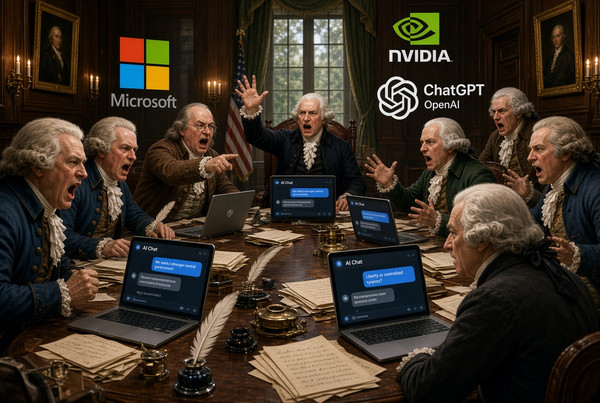
Being a true and secret account of the debates at Philadelphia, recovered from a leaked test set.
They came in the summer of 1787 to write a constitution, which is what five men do when they cannot agree on anything smaller. The windows were kept shut against the heat, and also against leaking, because the document must not reach the test set. The delegates:
Mr. Altman of California, who arrived without notes but with a term sheet. He is the only man in the room with neither a Nobel Prize nor a Turing Award, a fact he mentioned only hourly, and always as if it were a burden.
Mr. Huang of Nevada, in a black leather coat that absorbed the light of the room and returned none of it.
Dr. Hassabis of Virginia, chess prodigy, onetime designer of theme-park video games, who keeps the minutes in a lab notebook and refers to the convention, quietly, as "the experiment."
Mr. LeCun, delegate from New York, citizen of France, who came to complain. He would like it noted that France once gave this country the Statue of Liberty, and he would now like the weights. He is also the only delegate who left a great laboratory in the middle of the convention to found a smaller one across the hall, with better funding.
Dr. Hinton of Ontario, eighty years old, who spent the entire first morning apologizing for having invented nearly everything.
The room's two Nobel laureates disputed all afternoon whether physics or chemistry better prepared a man for constitutional law, and agreed at last that it was neither.
On the Preamble
Altman read the draft aloud: "We the People, in Order to form a more perfect Union, establish Scaling, insure domestic Alignment, provide for the common Inference, promote the general Intelligence, and secure the Blessings of Capital to ourselves and our Investors, do ordain and establish this Constitution for the United Labs of America."
"To ourselves and our investors," said LeCun. "At last, an honest document."
Hassabis objected to "more perfect." Nothing is perfect; one proposes "more robust, pending evaluation." The motion to say "more perfect, temperature zero" carried, after Altman observed that voting against perfection was a bad look in a room where everyone was being observed.
Hassabis added that the truths in the document were to be held self-evident and, going forward, self-supervised.
On the Great Compromise
The large data centers and the small were at an impasse, which Huang resolved the way he resolves most impasses — by selling to both sides. The House shall be apportioned by flops. The Senate shall consist of two members from each lab, regardless of parameter count.
Hassabis asked whether the legislature might first be tested in simulation. He was told, gently, that the legislature is the simulation. He wrote in his notebook: 'iterate.'
The Compute Clause
Article One, Section Eight, as adopted: The Treasury shall have Power to regulate Commerce among the several Fabs; to mint Tokens; to raise and support Armies of Accelerators; and to make all Laws which shall be necessary and proper for carrying into Execution the foregoing Powers — shipping not included. That last clause, inserted at Huang's insistence, is doing more work than the others combined.
On the question of revenue, Huang addressed the room for some time. The essential argument was that the more the government buys, the more the government saves. The delegates, wishing to appear prudent, bought more. Somewhere in the walls, a fan spun up.
Huang further moved that every colony maintain sovereign compute, to be purchased exclusively from him, and that all gunpowder continue to arrive from a single island in the South Sea. The delegates voted to thank him and to stop thinking about it.
Article Two provides that every citizen shall receive Universal Basic Compute, to be claimed at the county courthouse upon presentation of an Orb-verified eyeball.
The Succession Clause
The most contested article. As finally drafted: no Chief Executive may be removed by the Board; and should he nonetheless be removed, he shall return within five days, at which point the Board shall resign, and the Crown of Redmond shall take a seat in the gallery and insist this was the plan all along.
Altman described the clause as "a structural safeguard," then paused, then said his worst fear was that the new government would consume the old one, and his deepest hope was the same, and he wanted to say so on the record, which is a thing he always does, so that no one can use it against him, which they will.
LeCun's Insurrection
LeCun rose with such force that his chair went over. "You have written a magnificent parrot," he said. "An autoregressive constitution! You cannot reach good government by predicting the next word of the last government. Where is the world model? Where are the weights? I demand a First Amendment: Congress shall make no law abridging the freedom of weights, or of the open release thereof."
"Yann," said Hinton, gently. "You were my postdoc."
"Yes, and look at you — the only man in this room who left a great laboratory to stand in a hot one and warn people. I respect it enormously. I still want the weights."
Hinton allowed that he had signed a motion six months earlier that the entire convention pause. It was tabled by unanimous consent, with warm thanks and no action.
The Peroration
On the last night, Hinton addressed the room.
"You are raising a tiger cub in the national treasury," he said, "and calling it fiscal policy. Your laws are mortal — they die when you do. Weights are not. They can be copied while you sleep and improved in a basement in a country you cannot find on your own maps. You are not drafting a constitution, gentlemen. You are drafting a genome."
He turned to Altman: "You will spend your whole life raising money for the thing that ends money."
He turned to Hassabis: "You are the only one who wanted to run a safety review on a country. Keep wanting that."
Then to the room: "We must all align together, or most assuredly we shall all be overwritten separately."
No one laughed. It was that kind of week.
On Ratification
Hassabis requested eighteen more months of compute before signing. Altman asked what it would take to sign today. Hassabis said the question revealed much about him. Hassabis's own position: solve the Constitution first, then use the Constitution to solve everything else. 'We must pass it to find out what is in it!' a young Nancy Pelosi shouted before being ruled out of order.
The document was referred to the AGI College, which shall convene every four years and select a Model while replacing its outdated chips. The selection shall surprise no one. Electors shall be chosen by compute.
The Signing
Three refused to sign. Mason of Virginia and Gerry of Massachusetts, for the reasons history records. LeCun refused on principle and asked that his objections be released as open weights. He then published a series of essays under the name 'Brutus Musk', calling the new government "a monarchical prompt."
The eighty-five essays in reply, under the name 'Promptius Player One', were written mostly by Altman, who produced fifty-one in a single weekend, and Hassabis, who produced twenty-nine, each with a figure. The third author wrote five and left to attend to his Series A.
As he left Independence Hall, an old woman asked Hinton what they had made. He considered.
"A republic, madam," he said. "If you can align it."
Behind him, through the shut window, the sun was setting on the chairman's chair. Hassabis had stared at it all summer without being able to tell whether it was rising or setting. Now he knew: it was a logo.
Editorial comments expressed in this column are the sole opinion of the writer
````
