

"It is very rare for physicians to conceal information from Congress. Most doctors who are called to testify give veracious statements to the best of their ability. Fauci is only the second doctor to invoke his Fifth Amendment rights before Congress and only the third physician to be held in contempt." Peter A. McCullough, MD, MPH
If there’s one universal dream in American life, it is the fantasy that a single well-chosen word will make all your problems vanish. For most of us, that word is "refund." For Dr. Anthony Fauci, it turned out to be "Fifth." Specifically, the Fifth Amendment. Over. And over. And over again.
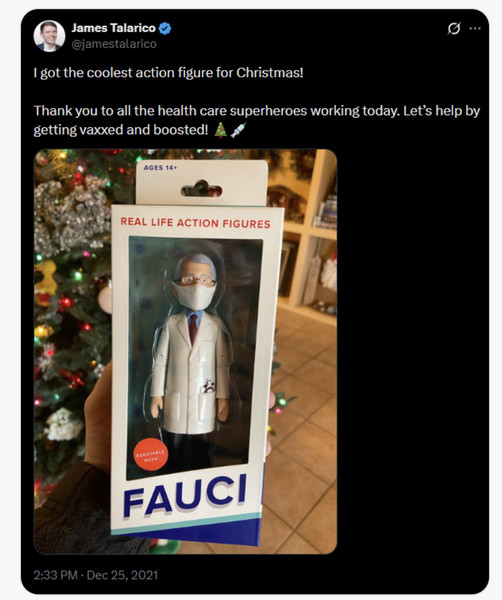
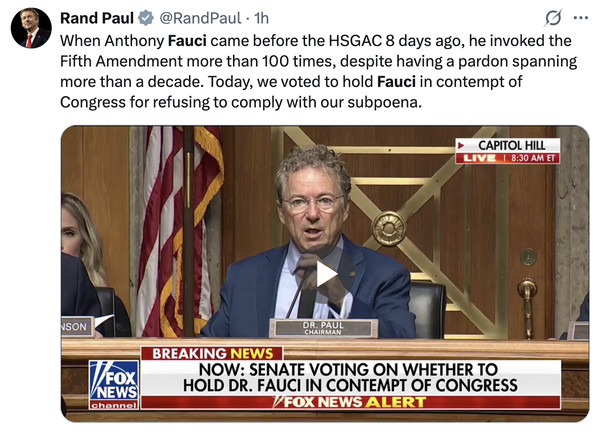
Picture it: the man who once stood at a White House podium telling 330 million Americans to mask up, stay home, and trust the science, suddenly reduced to a human pull-string doll with only one setting. Question about funding gain-of-function research? "On the advice of counsel, I invoke my Fifth Amendment privilege." Question about the origins of COVID-19? "Fifth." Question about whether he prefers dark roast or medium roast? You can guess. He pleaded the Fifth 111 times, which in Senate testimony terms is practically an Olympic event. If stonewalling were a category, Fauci would be on a Wheaties box.
So riddle me this, legal scholars of America: If you've already been pardoned for anything and everything you might have done, what, precisely, are you protecting yourself from by invoking the Fifth Amendment?
The Fifth Amendment is a beautiful thing. Truly. It is the Constitution's way of saying, "We don't make people help dig their own grave." It protects against self-incrimination. But here's the catch that makes Fauci's marathon of silence so magnificently awkward: a presidential pardon removes the possibility of federal prosecution. It's a get-out-of-jail-free card that Biden laminated, signed in calligraphy, and mailed certified. With that in hand, the legal justification for clamming up starts looking thinner than hospital gown fabric.
Yes, Fauci’s attorneys had an argument. They claimed the Fifth was about protecting him from being induced to say something that might expose him to *future* state charges, or perjury, or being caught in some material omission before Congress. Which, if you squint, sounds almost reasonable. Almost. Until you remember that the man had already been pardoned for a sweeping, undefined range of federal conduct. Which brings us to the great unspoken truth of the whole spectacle: Fauci wasn't acting like a man with nothing to hide. He was acting like a man who knew exactly where the bodies were buried and had invested in a very nice cemetery plot of his own.
Senator Rand Paul, who has been chasing the Fauci origin story with the tenacity of a bloodhound with a vendetta, was practically vibrating with anticipation before the hearing. He finally had his white whale in the chair. And then… nothing. A hundred waves of the Fifth Amendment. Paul called it a disgrace. Others called it cowardice. Aaron Rodgers, who has apparently expanded his portfolio from throwing touchdowns to throwing rhetorical haymakers, called Fauci an "absolute coward" and asked the question on everyone's mind: "What are you scared of, Tony?"
It's a fair question. Because in normal human experience, when someone shows up with a presidential pardon and then refuses to answer questions, it doesn't read as "careful legal strategy." It reads as "I've seen the sequel, and it doesn't end well for me."
The Republican Study Committee issued statements saying Fauci was hiding behind the Fifth instead of admitting the truth, which is technically what the Fifth is for, but still. The optics were devastating. A man who spent years as the face of public health authority, telling Americans to follow the data and trust the experts, suddenly decided that transparency was optional and accountability was someone else's department.
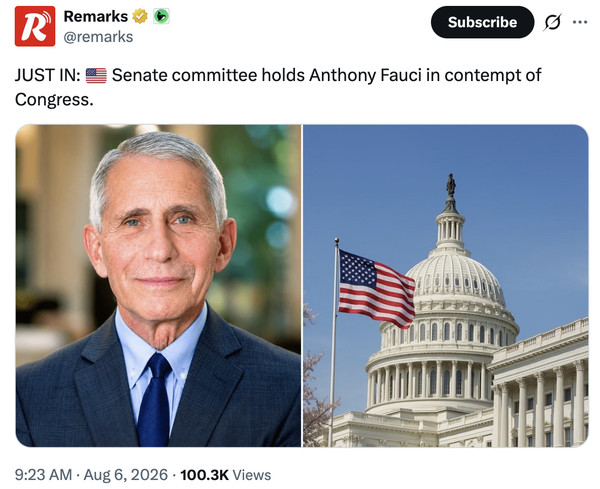
And then came the talk of contempt. Because Congress, bless its institutional heart, does not enjoy being treated like a Netflix show you can skip through. If you are subpoenaed and you show up only to refuse to cooperate, lawmakers have another card to play: criminal contempt. We saw it with Steve Bannon. We saw it with Peter Navarro. You can go to jail for telling Congress to kick rocks. The legal logic being floated now is deliciously ironic: if Fauci's pardon already immunized him from prosecution, then his Fifth Amendment claim was invalid, meaning he could be held in contempt for refusing to testify. The get-out-of-jail-free card might have been what puts him in the cell.
That is some galaxy-brain legal maneuvering. It’s like finding a loophole in Monopoly where using a "get out of jail free" card actually sends you *to* jail because you were never supposed to have drawn it in the first place.
Legally, the outcome remains uncertain. Scholars are split. Some say the Fifth Amendment doesn't evaporate just because you hold a pardon; the right against self-incrimination is personal and absolute. Others point out that if there is no possibility of prosecution, there is no possibility of self-incrimination, rendering the refusal spurious. Wired ran a piece practically begging someone to explain whether Republicans could actually lock him up. The answer? Maybe. The Senate is moving toward a contempt vote.
But regardless of how the courts sort it out, the political damage is already done. Fauci didn't just plead the Fifth. He practically composed a symphony in the key of silence. His credibility, once the most valuable currency in pandemic America, is now trading at junk-bond status. The man who demanded trust from a nation couldn't muster the nerve to answer a single question from a committee of elected representatives. He had the pardon. He had the platform. He had, allegedly, the truth. And he chose the mute button.
So no, in the end, pleading the Fifth was not a get-out-of-jail-free card. It was more like showing up to a knife fight with a paper umbrella. It might have looked like a shield for a moment, but it turns out Congress has its own sharp objects, and they are thoroughly unamused by the theatrics. The lesson, kids? If you're going to play legal Monopoly, make sure you actually read the rules. Because sometimes, the card you thought would save you is the one that gets you indicted for contempt.
And if nothing else, at least we all learned that "I take the Fifth" loses its dramatic punch around the 47th repetition. Somewhere in the Capitol basement, a court reporter's hand is still cramping.
Editorial comments expressed in this column are the sole opinion of the writer
