
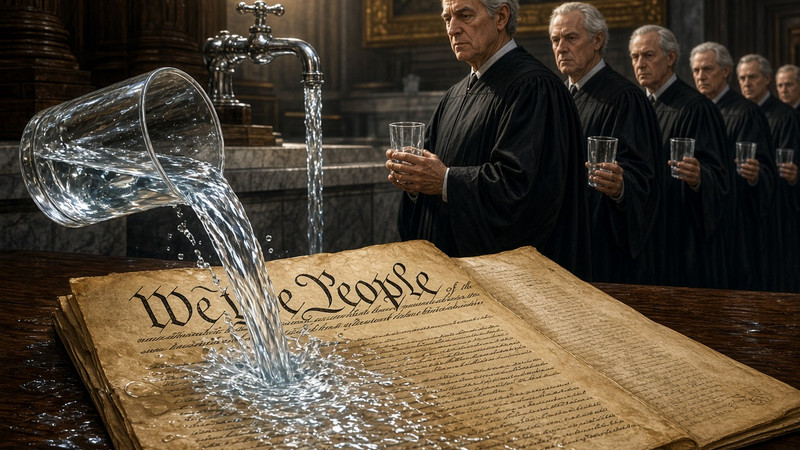
JACKSON, Miss. — The U.S. Constitution does not guarantee Americans clean drinking water — nor even a right to accurate information from public officials during a public-health crisis. That is the blunt conclusion of a 10–5 ruling issued Friday by the full Fifth Circuit Court of Appeals, as first reported by Bloomberg's Jacqueline Thomsen.
The decision in Sterling v. City of Jackson affirms dismissal of a 2022 class action brought by residents who say the city's chronically failing water system delivered lead-contaminated tap water to their homes while officials assured them it was safe to drink. Lead plaintiff Priscilla Sterling, a longtime Jackson schoolteacher, says several of her children were diagnosed with lead poisoning; the suit sought to represent nearly all residents of Hinds County.
The plaintiffs argued that city and state officials violated the 14th Amendment's due process guarantee both by allowing lead into the municipal supply and by falsely telling residents the water was safe. The en banc majority disagreed, holding that there is no cognizable substantive-due-process right to uncontaminated water and no constitutional right to truthful statements from officials — even in a drinking-water emergency. Water quality, the judges reasoned, is the business of statutes and regulators — the Safe Drinking Water Act, EPA oversight, and the Mississippi State Department of Health — not the federal courts.
Five judges dissented, pointing to what the majority conceded: ingesting lead causes serious, lasting harm. An earlier Fifth Circuit panel had allowed the residents' "state-created danger" claim to proceed in 2025 before the full court vacated that opinion and took the case en banc.
The ruling lands amid Jackson's years-long water emergency — decades of underinvestment, repeated boil-water notices, and the near-total system collapse after flooding in 2022. It echoes Flint, Michigan, where residents likewise discovered that lead in tap water carried no federal constitutional remedy. It also fits a broader pattern: the Supreme Court narrowed Clean Water Act protections in its 2023 Sackett decision, the Iowa Supreme Court rejected a public-trust challenge to Raccoon River pollution in 2021, and Florida appellate courts have twice struck down voter-approved local clean-water measures as beyond local power.
What's left for residents who get sick? Attorneys for the plaintiffs can seek Supreme Court review, though the high court has never recognized an environmental right in the Constitution. Advocates point instead to the levers the ruling leaves untouched: Congress, EPA enforcement, and state constitutions — Montana and Pennsylvania among them — that explicitly protect the right to clean water.
For now, the Fifth Circuit's message is unambiguous: in America, clean water is a policy choice, not a constitutional promise.
Sources: Bloomberg (Sept. 4, 2026); Bloomberg Law; Fifth Circuit en banc opinion, Sterling v. City of Jackson, No. 24-60370; Yahoo News; Magnolia Tribune; FindLaw; Food & Water Watch (Iowa); Florida Phoenix.
