
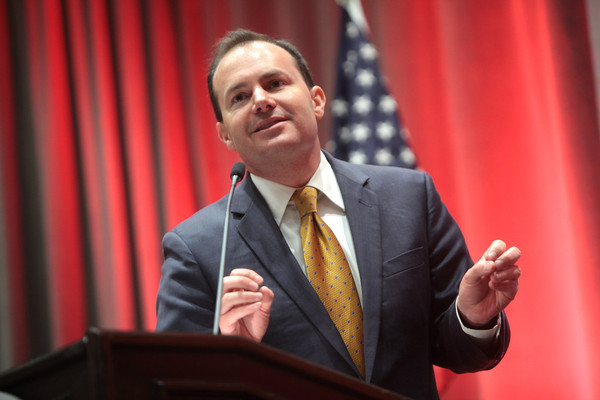
U.S. Senator Mike Lee (R-UT) introduced the Charlie Kirk Act to restore protections against government-funded propaganda targeted at American audiences. September 17, 2025
The recent release of Anthony Fauci’s private diaries and congressional testimony has confirmed what critics long suspected: during the COVID-19 pandemic, America’s top public health official repeatedly supplied the press with inaccurate information—most notably exaggerating the infection fatality rate by as much as tenfold compared with seasonal influenza—only to see those claims echoed uncritically across major media outlets. To many observers, this episode was not merely a failure of one man or one newsroom; it was the predictable consequence of a legal reform that had dismantled one of the country’s strongest bulwarks against domestic government propaganda. That bulwark was the Smith-Mundt Act, originally passed in 1948 to wall off American audiences from official state messaging, but gutted during the Obama administration in 2013. Restoring its original prohibitions is now viewed by proponents as an essential step toward preventing future episodes of state-sponsored narrative control.
The Passage of the Original Act
The U.S. Information and Educational Exchange Act of 1948, popularly known as the Smith-Mundt Act after its author Representative Karl E. Mundt of South Dakota, was born in the early twilight of the Second World War and the dawn of the Cold War. First introduced in 1945 and debated for three years, the measure was signed into law by President Harry S. Truman on January 27, 1948. Its primary purpose was to establish an infrastructure for “public diplomacy”: explaining American values and policies to foreign populations, principally through the newly created Voice of America. Mundt, a leading anti-communist, understood that ideas were weapons in the struggle against Soviet expansion. But he and his congressional colleagues were equally determined that these weapons not be turned inward. The United States government could broadcast to Prague, Warsaw, and Moscow; it could not, under the original statute, direct those same broadcasts at Manhattan, Omaha, or Los Angeles.
To ensure this separation, the 1948 act contained a de facto domestic dissemination ban. Congress harbored a deep skepticism of granting the State Department open channels to influence American citizens, mindful of the propaganda ministries that had poisoned public discourse in Nazi Germany and were now operating behind the Iron Curtain. Private U.S. broadcasters, too, lobbied against any arrangement that would force them to compete with a tax-funded government messaging apparatus at home. While researchers could physically examine government materials at the State Department, and aged documents eventually became public, the law erected a clear statutory barrier: materials created for foreign audiences—propaganda, journalism, or educational content—were not to be distributed domestically in real time. The intent was not merely procedural; it was philosophical. In a constitutional republic, the government could marshall arguments to the world, but the domestic marketplace of ideas was to remain the province of private citizens and an independent press.
Reinforcing the Wall
Over the following decades, Congress reinforced this firewall. Amendments adopted in 1972 and again in 1985 sharpened the domestic prohibition into de jure status, explicitly barring the United States Information Agency and its successors from targeting American audiences with government-produced media. For sixty-four years, the principle remained largely intact: the information operations funded by U.S. taxpayers were reserved for foreign consumption, an arrangement that served both transparency and trust. Americans could be confident that the news they encountered in their living rooms was not scripted by a federal agency in Washington.
The 2013 Repeal
That consensus shattered quietly. In January 2013, President Barack Obama signed the National Defense Authorization Act for Fiscal Year 2013, which contained buried within it the Smith-Mundt Modernization Act. Effective that July, the amendment eliminated the longstanding ban on domestic dissemination. The rationale offered by its supporters was couched in the language of technological inevitability: in an age of instantaneous internet communication, attempting to segregate audiences by geography was impractical. Transparency advocates argued that American citizens had a right to examine the material their government broadcast abroad, and national security officials suggested that making non-English content available at home might assist in countering homegrown extremism. On its face, the change seemed modest—merely permitting the Broadcasting Board of Governors and the State Department to honor requests from U.S. universities, broadcasters, and researchers for access to Voice of America programs and related content.
The Fauci Episode as Symptom
The Fauci episode is the most prominent example of why that change matters. During the COVID-19 pandemic, administration officials held daily briefings, issued guidance, and supplied statistical claims that were subsequently repeated as factual by major networks and newspapers. When those claims later proved distorted or flatly wrong—such as the persistent inflation of mortality risk—the correction never matched the reach of the original error. Proponents of reinstating Smith-Mundt argue that while the act was never a direct regulation of private journalism, its removal reflected and enabled a broader governmental philosophy: that official Washington had the right, and now the legal latitude, to wage information campaigns within the borders of the United States. The 2013 repeal did not create dishonesty, they concede, but it dismantled a legal presumption that the federal government should keep its persuasive apparatus pointed outward, away from the American public.
The Case for Reinstatement
The case for repeal is straightforward. Representative Thomas Massie of Kentucky has introduced legislation to restore the original Smith-Mundt domestic prohibition, arguing that “taxpayer-funded fake news should not be used by the federal government to wage influence campaigns against the American people.” Supporters of reinstatement maintain that the Cold War architects of the 1948 act understood something essential: even a democratic government armed with sophisticated media tools poses an inherent threat to informed self-governance when it directs those tools at its own citizens. Restoring the ban would not, by itself, guarantee that a future public official would never mislead a reporter. But it would re-establish the legal norm that the federal government’s public diplomacy apparatus is an instrument for foreign audiences, not a domestic messaging shop. It would restore transparency by forcing a clear statutory distinction between the government’s external messaging and the internal information environment.
Ultimately, the argument over the Smith-Mundt Act is about where trust originates in a free society. The 1948 Congress believed that trust depended on keeping the government’s persuasive machinery outside the nation’s own borders. The 2013 Congress, operating in a different technological climate, concluded that such boundaries were obsolete. The experience of recent years—wherein top officials delivered alarming data points to a credulous press, which then amplified them to a frightened nation—suggests to many that the older generation had the better insight. Reinstating the domestic ban would not solve every pathology of modern media, but it would replace a dangerous loophole with a restored wall: a declaration, once again, that the American government informs the world at its own discretion, but the American people inform themselves.
Editorial comments expressed in this column are the sole opinion of the writer