
Ten years ago, Ted Cruz called Donald Trump a "pathological liar," "utterly amoral," and a "serial philanderer." He had grounds. Trump had retweeted a side-by-side comparing Melania's modeling photos to an unflattering shot of Heidi Cruz, and had suggested Cruz's father — a Cuban émigré who'd been jailed fighting Batista — had something to do with Lee Harvey Oswald, on the strength of a supermarket tabloid. Cruz said all of this into a microphone in Indiana, lost Indiana that night, and walked off the stage. Four months later, after "vote your conscience" got him booed out of his own party's convention, he endorsed. He has been Trump's most industrious defender ever since — the lead objector on January 6, now chairman of Commerce, the 2028 aspirant nobody has to name.
It was the cheapest tuition in politics, and Cruz learned it well: Trump can do anything to you, and you will still be there in the morning. The trick is never again to hold an opinion that costs anything — vote yes when votes are free, and speak only where nobody keeps score.
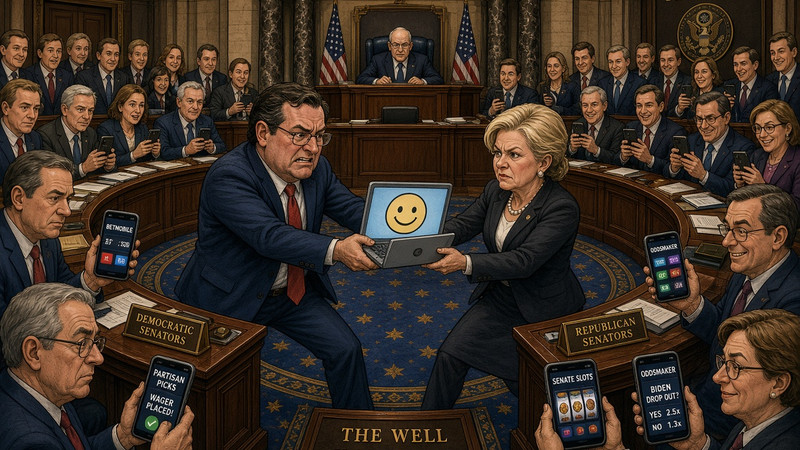
Wednesday afternoon on the Senate floor, Marsha Blackburn asked for unanimous consent on the NO FAKES Act, which would give every American a federal property right in their own voice and face — the thing her home state enacted in 2024 and named after Elvis. Cruz rose and pronounced the most powerful word in the United States Senate: "Object." His worry: the bill wasn't ready. Would the AI images "frequently promoted on President Donald Trump's social media accounts" be out of compliance? Would The Onion? The carve-outs for parody and criticism are written in; Blackburn said free speech isn't jeopardized. "I am happy to work with you," Cruz told her. "But at least as of now, I object."
Ready for primetime. Here is what else apparently isn't. Cruz voted for that exact bill in the Judiciary Committee this summer — yes in markup, no on the floor. The day before, he had objected to a different AI safety bill the same way. Last summer he wrote a moratorium on state AI laws into the One Big Beautiful Bill — ten years, trimmed to five to save it — and the Senate stripped it, 99 to 1. This summer he went to the Oval Office and told the president that the grand bargain — preemption, kids' online safety, NO FAKES, one package — had no chance in the Senate. Trump passed on the endorsement and let it die.
Study the two of them on paper and you would never guess they're at war. Conservative Review's Liberty Score — the anti-establishment card built to catch senators who talk conservative and vote establishment — grades the top 50 votes over a rolling six-year term, and has Blackburn at an A, 93 percent. Cruz grades in the same A-range, and Heritage Action shows him at 96 percent this session and 92 lifetime, against Blackburn's 98. GovTrack's ideology math ranked Blackburn the most right-wing senator in the chamber in 2020 and Cruz fourth. The lesson isn't who is more conservative. It's that the Liberty Score counts roll calls and not "I object" — and a chairman can kill any bill in the Senate without ever casting a vote against it. The card was built to catch talking conservatives. It never imagined one whose real power is exercised by refusing to let a vote happen.
And so the shape of the man's career: the senator who tried to hand Silicon Valley a ten-year shield from any regulation anywhere has decided that a bill protecting your grandmother's cloned voice isn't ready for primetime. The president's feed has already run an AI image of himself as pope and an AI video of a jet bearing his name dumping waste on his opponents. Cruz's fear, stated plainly, is that a law against stealing human faces might trip the boss's memes.
Now set that beside his own record. The Take It Down Act — Cruz's bill with Amy Klobuchar, criminalizing the publication of sexual images of real people, fake or genuine — passed the Senate by unanimous consent in February 2025. Nobody objected. When Ted Cruz wants a bill through, the floor opens like an automatic door. Trump signed it in May, and Cruz now advertises it as "the only major AI bill to become law in the 119th Congress." So he blocked the bill that would let you sue over the fake image of yourself, then pointed to the law that punishes only the worst version of it. Take It Down sends prosecutors after deepfake pornography. NO FAKES hands the victim standing to fight the deepfake everything else — the scam call, the counterfeit pitch, the cloned candidate.
Blackburn is running for governor back home, where Music Row donates to whoever protects its voices, and Nashville watched a senator with a 93 Liberty Score get vetoed by one with the same grade. Into the vacuum walked Chris Coons, Democrat of Delaware, with the calm of a man holding the only finished product on the market: "This is the most baked, ready-to-go AI-related bill there is. We've done hearings, we've done technical assistance, we've done markups. It's broadly bipartisan." Five weeks before a midterm, the two highest-scoring conservatives in the Senate are supply-blocking each other while a Democrat corners the center.
No Liberty Score will move for what happened Wednesday. Blackburn's 93 will not rise for the bill she almost passed; Cruz's will not fall for the bill he strangled. The ledgers count votes and never objections, and objections are where the power lives now. Somewhere tonight the phone will ring, and a cloned voice will say, "Grandma, I'm in trouble." Ten years ago, Ted Cruz taught his party how to absorb anything Trump did and stay standing. Yesterday he taught the rest of it: keep your grade, kill the bill, wait for 2028.
Editorial comments expressed in this column are the sole opinion of the writer
