

If a chemical sterilizes male frogs, shrinks their larynxes, and leaves them producing eggs instead of sperm, the conversation should not be whether we ban it, but how fast. Yet here in the United States—and inexplicably, Australia—we are still spraying tens of millions of pounds of atrazine across our food supply while pretending its devastating effects stop at amphibian skin. They do not. The science is screaming at us, and our regulators have chosen to cover their ears.
Dr. Tyrone Hayes demonstrated conclusively that atrazine at levels found in ordinary rainwater chemically castrates male African clawed frogs, collapsing their testosterone by tenfold and feminizing their anatomy. The larynx—what becomes the Adam’s apple in human males—is specifically targeted and demasculinized. Regulators dismiss this as irrelevant to humans, but that is industrial propaganda dressed in a lab coat. Vertebrate endocrinology is not a closed book after frogs. If atrazine disrupts the hypothalamic-pituitary-gonadal axis in amphibians, mammals, and rats, the burden of proof should be on Syngenta and the EPA to prove it does not do the same to human boys during puberty. They have not. In fact, they have actively avoided finding out.

We are observing population-level shifts in male development, fertility, and hormonal profiles that track neatly alongside the era of industrial atrazine saturation. To insist that a laryngeal demasculinizer in vertebrates has no relevance to human secondary sexual characteristics is not science; it is liability management. The precautionary principle demands that when a pesticide is shown to obliterate testosterone and destroy male sexual anatomy in animals, we assume risk to humans until rigorous longitudinal studies prove otherwise. Those studies have not been conducted because the chemical industry knows what they would likely find—and because the American regulatory system is funded to protect corn yields, not human endocrine systems.
Then there is the food supply. Roughly 99 percent of U.S. atrazine drenching is for corn, sorghum, and sugarcane—the very commodities that industrially feed the livestock Americans eat and sweeten virtually every packaged product with high-fructose corn syrup. When environmental and food-safety advocates warn that atrazine is in everything, they are not speaking metaphorically. This herbicide is designed to permeate plant tissue, runs off into watersheds, and bioaccumulates through the agricultural chain. The pathway from an atrazine-sprayed cornfield to the sweetener in a child’s soda is not theoretical; it is industrial design. Americans are not merely exposed to atrazine through well water in rural Iowa. They are marinated in it through the corn-syrup-soaked food system that Congress subsidizes and the EPA refuses to police.
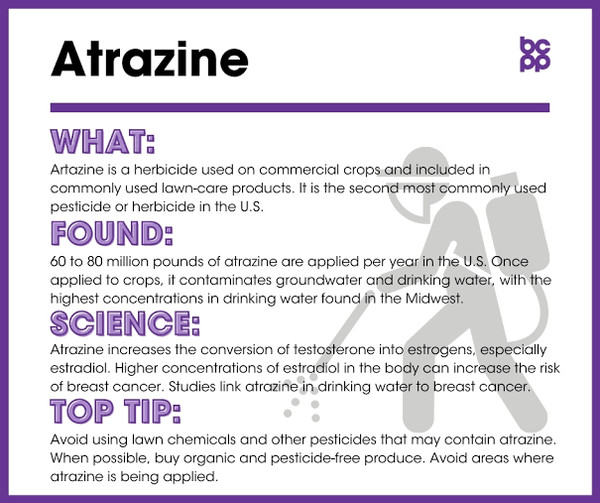
Source: Breast Cancer Prevention Partners
As if endocrine annihilation were not enough, the International Agency for Research on Cancer (IARC) has now classified atrazine as “probably carcinogenic to humans.” The EPA immediately dismissed the finding, which tells you everything about who agency leadership serves. The EPA’s refusal to acknowledge what the WHO’s cancer research arm has determined reveals a regulatory apparatus captured by agrochemical donors, not bound by toxicological reality. When an agency charged with environmental protection treats a probable human carcinogen as a public relations problem, public health becomes a casualty of corporate economics.
Meanwhile, the rest of the civilized world is leaving us behind. The European Union banned atrazine in 2004 due to unavoidable groundwater contamination, and the number of nations prohibiting or heavily restricting it has swelled to more than 60. From Switzerland to growing ranks of governments across every inhabited continent, the global consensus is hardening: this chemical is too dangerous, too persistent, and too biologically destructive to justify its use. The United States and Australia increasingly look like outliers clinging to an obsolete and poisonous agricultural model because banning atrazine would force a reckoning with industrial monoculture.
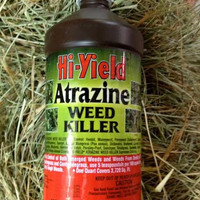
The defense of atrazine rests on a lie—that absence of specific human epidemiology equals absence of harm. But absence of evidence is not evidence of absence, especially when industry has fought for decades to prevent the evidence from being gathered. We know what atrazine does to testosterone. We know what it does to the male larynx in vertebrates. We know it is a probable human carcinogen. We know it persists in drinking water and saturates the commodity crop foundation of the American diet.
What we need now is not more timid “review.” We need an immediate ban, followed by the comprehensive human studies that should have been demanded before this poison was ever licensed. If it takes destroying the endocrine systems of an entire generation for regulators to act, then those regulators have already failed. Atrazine must be banned, the corn-syrup pipeline must be detoxified, and the chemical’s defenders must be held accountable for decades of institutional cowardice. The frogs warned us. We should have listened.
Editorial comments expressed in this column are the sole opinion of the writer
