
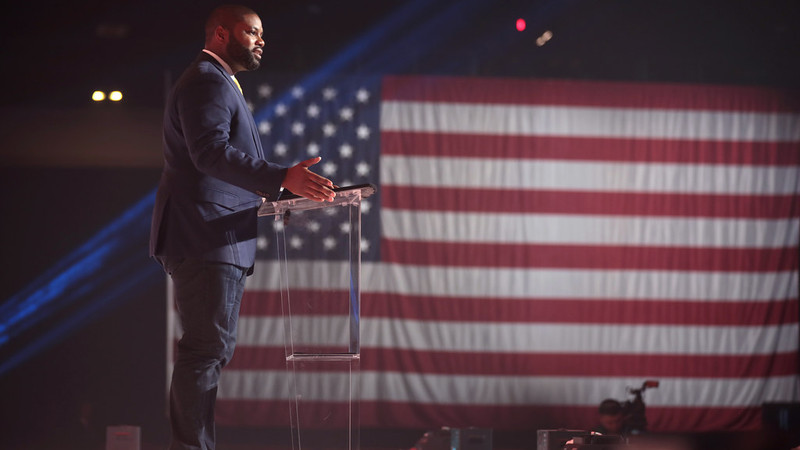
Businessman Zach Lahn’s narrow upset in Iowa’s Republican gubernatorial primary reveals a potent formula that Trump-endorsed candidates ignore at their peril. By defeating Rep. Randy Feenstra—despite Trump’s “Complete and Total Endorsement” delivered just four days before the election—Lahn demonstrated that a message of local independence and substantive policy can overcome MAGA royalty status. For Florida Rep. Byron Donalds, whose entire campaign is built on Trump loyalty, the lesson is clear: run more like Ron DeSantis, less like a Trump acolyte, or risk defeat.
Lahn’s victory rested on a platform that was distinctly Iowan rather than Washington-centric. A sixth-generation farmer and businessman, he campaigned on “Iowa First,” attacking what he called the “Big Ag cartels” and corporate capture of regulatory agencies. In his victory speech, Lahn declared that “Iowa has the fastest growing cancer rate in the world” and promised that “big ag and big pharma printed money” under the noses of politicians “from Washington, D.C., to Des Moines.” This was not generic MAGA rhetoric. It was geographically rooted, working-class populism aimed at specific economic power structures affecting everyday Iowans.
Crucially, Lahn directly cited Governor Ron DeSantis as a model for state-level leadership. In a KCCI interview, Lahn praised DeSantis for starting independent state research on product safety, noting that “the EPA is a captured agency” and declaring, “It’s incumbent upon us to be able to tell the truth.” By referencing DeSantis’s willingness to act independently—even against federal bureaucracies—Lahn signaled competence and autonomy, not deference to any national figure. He secured the endorsement of RFK Jr.’s MAHA Action, blending health-conscious populism with anti-corporate economic nationalism.
By contrast, Byron Donalds has constructed a campaign almost entirely around his Trump endorsement. His website’s top priority is to “Enact the Trump Agenda,” and he prominently features Trump’s “RUN, BYRON, RUN!” statement. While Donalds briefly broke with Trump on AI policy—advocating state-level rather than national regulation—this minor divergence does not obscure the broader pattern: his brand is Trump fidelity, not independent governance. He has raised over $67 million, but his messaging lacks the localized, issue-specific depth that propelled Lahn.
Herein lies the warning. Republican primary voters are increasingly sophisticated about distinguishing personalities from performance. Lahn’s win shows that even deeply conservative electorates will reject a Trump-endorsed candidate if the alternative offers tangible, state-focused policy substance. Feenstra had the entire Republican establishment behind him—former Governor Terry Branstad, Senator Joni Ernst, and Trump himself—and still lost because he represented an incumbent class tethered to Washington and corporate agribusiness interests.
DeSantis’s political strength has always been his ability to pair conservative principles with executive competence: tangible education reforms, property insurance battles, economic growth metrics, and the willingness to fight institutional power. That is the Lahn playbook. Donalds, by signaling that his governorship would be an extension of Trump’s presidential agenda rather than an independent laboratory of conservative policy innovation, risks appearing as a proxy rather than a leader. In an era where even Iowa Republicans are willing to buck the Trump imprimatur for a candidate promising to take on monopolies and put state interests first, Donalds’Trump-centric campaign looks increasingly brittle. If he does not pivot toward a DeSantis-style message of substantive, independent state governance, he may discover that Trump’s endorsement is no longer the invincible weapon it once appeared to be.
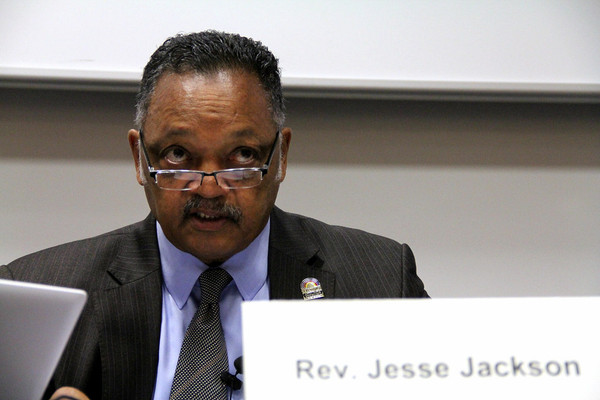
On June 13, 1992, then candidate Bill Clinton was speaking at Jesse Jackson's Rainbow Coalition conference. The day before, the organization had given a platform to Sister Souljah, a rapper and activist who had recently made incendiary comments about the Los Angeles riots. In a Washington Post interview, she had called black-on-white violence "wise" and said: "If black people kill black people every day, why not have a week and kill white people?"
Rather than ignoring this, Clinton—who had already clinched the Democratic nomination—went out of his way to attack her. With Jesse Jackson seated right beside him, Clinton declared that Sister Souljah's words were "filled with hatred." He then added his most stinging line: "If you took the words 'white' and 'black,' and you reversed them, you might think David Duke was giving that speech."
Byron Donalds needs his own Sister Souljah moment: he should publicly and conspicuously rebuke the establishment big-business wing of the Republican Party—ushing his platform-funded, corporate-friendly donors into the spotlight and rejecting their influence the same way Clinton rejected Sister Souljah in front of Jesse Jackson. Just as Clinton used that moment to prove he wasn’t beholden to traditional Democratic constituencies, Donalds must prove to primary voters that he is not merely Trump’s proxy or a tool of monied Florida insiders, but an independent populist willing to torch relationships with the GOP’s corporate establishment to show he fights for working people. If he cannot deliver that high-profile, painful break—calling out the donor class and pledging to block their agendas in Tallahassee—he risks looking like another kept politician, and voters who rallied to Lahn’s anti-Big Ag message will see right through him.
Memo to Rep Donalds: according to AP/Ballotpedia results, Zach Lahn won with 37.8% (80,765 votes) to Randy Feenstra’s 37.0% (79,113 votes)—a margin of roughly 0.8 percentage points, or about 1,652 votes. The Guardian reported it as 38% to 37.2%. Either way, it was effectively a photo finish where less than 2,000 votes separated the winner from Trump’s pick screaming out that MAGA Republicans matter.
Editorial comments expressed in this column are the sole opinion of the writer
