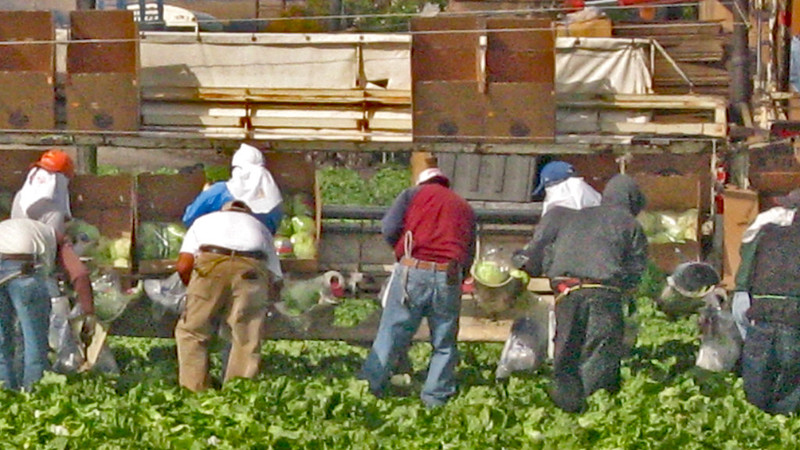
“These illegals are breaking farm worker strikes, displacing farm workers from their jobs in the US and depressing agricultural wages.” César Chávez
Labor Market Transformations
In small towns across America, the arrival of immigrant workers has become an economic lifeline. Many rural communities have faced decades of population decline, shuttered main streets, and labor shortages as younger native-born residents migrate to urban centers. The record foreign-born population is reversing these trends in certain areas, filling critical gaps in the workforce. In meatpacking towns across the Midwest and agricultural communities in the Southeast and California’s Central Valley, immigrant labor has kept industries operational and, in some cases, spurred modest economic revitalization.
Take one example, after decades of severe industrial decline, manufacturing closures, and rapid population loss, Springfield, Ohio's trajectory reversed when an estimated 12,000 to 20,000 Haitian immigrants arrived between 2020 and 2024. Navigating under Temporary Protected Status (TPS), these new residents filled critical labor shortages in local manufacturing, warehouse distribution, and service sectors, effectively making Springfield one of the fastest-growing cities in the region.
New residents bring entrepreneurial energy as well. Research consistently shows that immigrants have higher rates of business formation than the native-born population. In small towns, this translates to new restaurants, grocery stores, auto repair shops, and service providers that cater to both immigrant and established communities. These businesses create local jobs, generate tax revenue, and occupy vacant commercial real estate, injecting vitality into town centers that had been hollowing out.
In the 2020s, Columbus, Ohio stands out as the ultimate Midwest boomtown combining explosive IT tech growth, robust business creation, and rapid immigrant integration. In addition to Columbus, smaller hubs like Des Moines, Iowa and Columbus, Indiana have broken records specifically for the highest rates of per capita immigrant-driven population growth and business development.
However, the labor market impacts are not uniformly positive. In some communities, rapid workforce expansion has intensified competition for entry-level positions, placing downward pressure on wages in low-skill sectors. Additionally, small towns often lack the linguistic and vocational training infrastructure to help new residents transition from survival jobs to career pathways. When workforce development programs are absent, both immigrant and native-born workers may find themselves competing for a limited pool of stable, well-compensated employment, potentially generating social friction.
The Sewage Infrastructure Crisis
If the economic effects of immigration in small towns are mixed but largely manageable, the strain on sewage infrastructure represents a more immediate and visceral challenge. American small towns are frequently served by aging wastewater systems—some dating to the mid-20th century or earlier—that were designed for much smaller populations. According to the U.S. Environmental Protection Agency (EPA), small and rural communities already face disproportionate infrastructure challenges, including limited technical capacity to manage systems and constrained access to federal funding. The addition of thousands of new residents can push these fragile systems past their breaking points.
Logansport, Indiana is a prominent example where local leaders and congressional records have highlighted severe infrastructure strain—including wastewater, utilities, and public services—following a significant influx of immigrants in the 2020s
Increased population density produces higher wastewater flows from homes, greater strain on sewer lines, elevated risk of backups, and increased treatment demands at municipal plants. Many small towns operate combined sewer systems that handle both stormwater and sanitary waste. During periods of heavy use, these systems overflow, releasing untreated sewage into local waterways—a public health hazard and an environmental violation that can trigger costly EPA enforcement actions.
The strain is particularly evident in communities experiencing rapid, unplanned growth. Unlike urban areas that may have anticipated gradual expansion, small towns often see population surges that outpace infrastructure planning. The result is a widening gap between the community’s biological load and its mechanical capacity to process waste. Septic systems, which serve many rural properties, may be inadequate for higher-density housing arrangements or fail when multiple families occupy units designed for single households. In border regions and certain high-growth rural areas, colonias and similar communities have historically struggled with the most basic wastewater infrastructure, illustrating what happens when population growth outruns public investment.
The Interconnection of Economic Growth and Basic Infrastructure
Jobs and sewage are more closely linked in small towns than casual observation might suggest. Modern economic development is impossible without reliable wastewater infrastructure. The Urban Institute has documented how outdated or insufficient sewage systems act as a brake on rural economic development, discouraging business expansion and deterring new employers. A meatpacking plant cannot expand if the local treatment plant lacks capacity. A new housing development for workers cannot proceed if sewer lines cannot accommodate additional flow. A restaurant cannot open downtown if grease traps and connection fees are prohibitively expensive because the system is already overloaded.
This creates a paradox for small towns: immigrants arrive to fill jobs and stimulate growth, but the growth they generate exposes infrastructure deficits that threaten to choke off further development. Communities that cannot process the waste of a growing population cannot sustain the economic activity that attracted that population in the first place.
Pathways Forward
Addressing these twin challenges requires coordinated action at the federal, state, and local levels. On the jobs front, small towns need targeted workforce development partnerships that align immigrant workers with regional labor needs, including English-language instruction, credential recognition, and apprenticeship programs. Such investments maximize the economic dividend of immigration while reducing labor market competition between demographic groups.
For sewage infrastructure, the solutions must be both technological and financial. Decentralized wastewater treatment systems—modular units that process sewage close to where it is generated rather than trucking it to centralized plants—offer a scalable alternative for communities lacking the geography or capital for conventional infrastructure. These systems can be deployed incrementally, matching investment to actual growth rather than overbuilding. Simultaneously, small towns need enhanced access to federal infrastructure funding, including USDA Rural Development programs and EPA State Revolving Funds, with technical assistance to navigate complex application processes.
The Census Bureau’s 250-year perspective reminds us that the United States has always been a nation of immigrants. Today’s record foreign-born population represents continuity with this history, but the geography of settlement has shifted. Small towns, once bypassed by immigration, are now at the forefront of demographic change. Their ability to welcome new workers while maintaining basic sanitary infrastructure will determine whether this historic population milestone becomes a story of rural renewal or one of overwhelmed systems and missed opportunities. In the end, the measure of success will not be found in census counts alone, but in whether the pipes beneath the streets can carry the weight of a changing America.
More than 19 million eggs sold across six states have been recalled due to possible contamination with salmonella bacteria and Cyclospora has been linked to shredded iceberg lettuce. While salmonella infection can be prevented through hand washing and proper food safety practices, teaching a new influx of immigrants hygiene and how to handle food safely is a duty of their employers.
Editorial comments expressed in this column are the sole opinion of the writer