
The health freedom movement lost two of its most courageous and dedicated warriors in the span of one devastating week. Christine Cotton, the French biostatistician who risked everything to expose pharmaceutical industry malfeasance, and Warner Mendenhall, the brilliant Ohio attorney who built a legal fortress to defend medical liberty and whistleblowers, both passed away in early June 2026. Their deaths—Cotton’s on June 2, after a year of unendurable suffering, and Mendenhall’s on June 8, following a courageous battle with colon cancer—have left an irreplaceable void in the ongoing fight for truth, transparency, and the fundamental right to informed consent.
Christine Cotton was not an outsider looking in. She was a 25-year veteran of the pharmaceutical industry, a seasoned biostatistician who had spent her career managing and analyzing clinical data at the highest levels of Big Pharma. She understood the terrain better than most, and it was precisely this insider knowledge that made her whistleblowing so consequential. When the COVID-19 vaccine rollout began in late 2020, Cotton did what she had done her entire career—she examined the data. But what she found would lead her down a path that would consume the rest of her life.
Since December 2020, Cotton immersed herself in Pfizer’s COVID-19 vaccine documents, producing meticulous reports, books, and public analyses that challenged the integrity of the clinical trials and manufacturing processes behind the global vaccination campaign. She testified before authorities in France and, in 2025, filed a criminal complaint against health authorities, refusing to remain silent in the face of what she believed to be systemic fraud and good clinical practice violations. Cotton’s work was not merely academic; it was forensic. She parsed VAERS data, scrutinized trial protocols, and asked questions that the industry did not want asked. Her book, the culmination of years of painstaking research, stands as a permanent record of her commitment to scientific integrity.
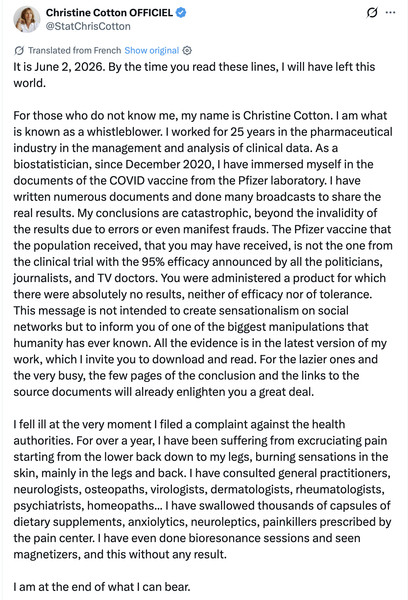
To those who followed her work, Cotton was a rare beacon of intellectual honesty in an era of unprecedented institutional capture. She brought both the technical rigor of a biostatistician and the moral clarity of someone who could not, in good conscience, look away from what she had uncovered. Her final messages to the world, posted in the hours before her death, reflected both the weight of her knowledge and the unbearable strain of her circumstances. After a year of excruciating, idiopathic pain that some who knew her work suspected may not have been natural, Cotton made the agonizing decision to end her suffering through assisted suicide. Her loss has sent shockwaves through the international network of researchers, physicians, and advocates who had come to rely on her unflinching analyses.
Warner Mendenhall, though separated from Cotton by an ocean and a profession, was her spiritual brother in arms. Based in Akron, Ohio, Mendenhall spent decades as an attorney before emerging as one of the most prominent legal architects of the medical freedom movement in the United States. His work had always centered on the defense of the vulnerable—he built his reputation representing whistleblowers under the False Claims Act, exposing Medicare and Medicaid fraud, defense contracting abuses, and the misuse of federal funds. But when the pandemic-era mandates and restrictions descended, Mendenhall recognized a legal and moral emergency that demanded his full attention.
Mendenhall did not merely file lawsuits; he built movements. As the founder of Freedom Counsel and the Mendenhall Law Group, he became a strategist for the ages, organizing conferences and coalitions that brought together attorneys, physicians, patients, and advocates from across the country to share legal strategies and mount a coordinated defense of civil liberties. He worked closely with organizations like Ohio Stands Up! and spoke candidly about the dramatic shift in his work—from being “a far outsider with no connection to the government” to finding allies in unexpected places as the landscape of public health policy continued to evolve. His goal was never merely to win cases, though he won many; it was to train and inspire an army of lawyers dedicated to protecting fundamental freedoms.
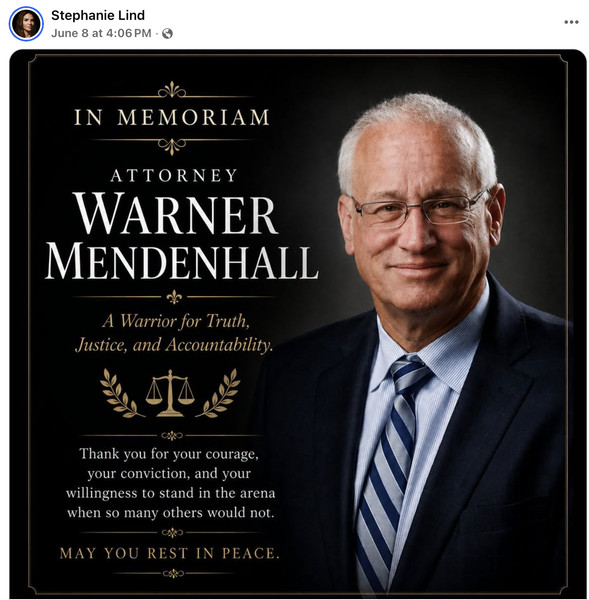
Those who knew Mendenhall describe a man of remarkable optimism and warmth. Even as he faced his own mortality from colon cancer, he never stopped developing legal resources, tools, and strategies to ensure that the work would continue after him. The Independent Medical Alliance, which posted a moving tribute to him, noted that “what made Warner so extraordinary was not only his brilliance, but also his optimism. He never stopped believing that freedom could be restored, that justice would prevail, and that ordinary people could make an extraordinary difference.” He was, by all accounts, a “nice but tough guy”—brilliant in the courtroom, generous with his time, and ferocious in his commitment to principle.
Together, Christine Cotton and Warner Mendenhall represented the twin pillars of any successful movement for institutional reform: the truth-teller and the legal shield. Cotton provided the data, the documentation, and the scientific credibility that gave the health freedom movement its evidentiary foundation. Mendenhall provided the litigation, the legal frameworks, and the organizational infrastructure that gave that movement its teeth. They never met in the same courtroom or collaborated on the same brief, but their work was symbiotic. Cotton’s whistleblowing gave attorneys like Mendenhall the raw material to build cases; Mendenhall’s legal battles created the space for whistleblowers like Cotton to be heard.
As we mourn their deaths, we also celebrate their lives. They were not easy lives. Both Cotton and Mendenhall paid a heavy price for their courage. They were marginalized by mainstream institutions, targeted by critics, and burdened by the personal toll of standing against powerful interests. Yet they persisted. They persisted because they believed, deeply and unshakably, that the public deserved transparency, that patients deserved informed consent, and that justice, though delayed, was worth pursuing.
May they both rest in peace, knowing that their fight continues in the hands of those they inspired.
