
An OpenTheBooks analysis examined federal improper payments under the Trump administration's first year (FY2025) compared to previous years, revealing mixed progress in government financial accountability.
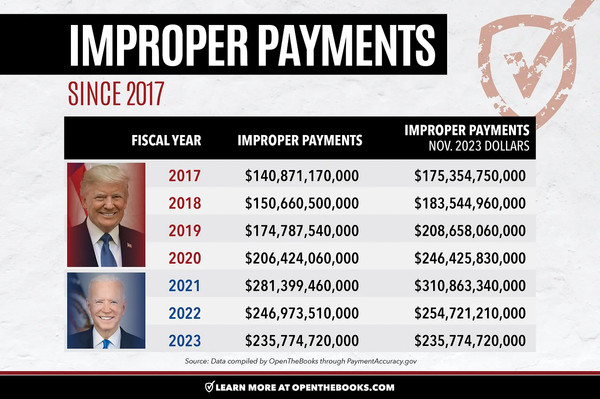
The federal government made $186 billion in improper payments in FY2025—President Trump's first year back in office—representing a $24 billion increase from the $161 billion reported in President Biden's final year (FY2024).
However, this figure is still significantly lower than the $236-281 billion annual improper payments seen during Biden's first three years, when COVID-era programs were active.
Trump's first term saw improper payments ranging from $141-206 billion annually ($168 billion average, unadjusted for inflation). The current $186 billion figure is lower than each of the four years preceding FY2024, suggesting a return to pre-pandemic baseline levels as emergency programs wind down.
The Centers for Medicare & Medicaid Services (CMS) remains the largest source of improper payments, accounting for $96.1 billion (52%) of all FY2025 improper payments. This follows a pattern where Medicare and Medicaid consistently generate more than half of all federal payment errors.
The most troubling revelation involves what's not in the FY2025 report. The Office of Management and Budget omitted the usual section tabulating "confirmed fraud"—which showed over $7 billion in court-confirmed fraud in FY2024. This data identifies which programs and agencies have been worst hit by criminal activity.
The FY25 report contains only 6 data sets versus 11 in FY24. Missing elements include:
- Historical improper payment totals
- Root cause analysis of monetary losses
- Recovery details (audit/investigation information)
- Eligibility verification data
- Root cause analysis of monetary losses
- Recovery details (audit/investigation information)
- Eligibility verification data
Twenty-four percent of federal agencies (15 of 63) failed to meet reporting requirements in FY2024. Chronic noncompliance plagues major departments:
- Health & Human Services, Treasury, Agriculture, and Veterans Affairs: Noncompliant for 14 consecutive years
- Defense and Labor: Noncompliant 13 of 14 years
- Homeland Security, Social Security, and HUD: Noncompliant 12 of 14 years
- Defense and Labor: Noncompliant 13 of 14 years
- Homeland Security, Social Security, and HUD: Noncompliant 12 of 14 years
These historically noncompliant agencies also report the highest confirmed fraud losses. HHS alone lost **$28.5 billion to confirmed fraud** between 2017-2024, while the Pentagon lost $10.8 billion and Labor lost $5.6 billion during the same period.
Congress recently passed the Ending Improper Payments for Deceased People Act, signed into law by President Trump in February 2025. This legislation formalizes data sharing between Social Security and Treasury's "Do Not Pay" list to prevent checks being issued to deceased individuals—a problem that included $3.6 billion in COVID stimulus payments to the dead.
While improper payments have declined from pandemic-era peaks, serious accountability gaps remain. The exclusion of confirmed fraud data—amid ongoing Medicaid fraud scandals in Minnesota, Maine, and elsewhere—creates a dangerous blind spot for taxpayers. Meanwhile, agencies with decade-plus records of noncompliance continue operating without consequence, undermining efforts to safeguard federal funds.
