“Our beautiful America was built by a nation of strangers. From a hundred different places or more they have poured forth into an empty land, joining and blending in one mighty and irresistible tide. The land flourished because it was fed from so many sources — because it was nourished by so many cultures and traditions and peoples.” Lyndon Baines Johnson, October 3, 1965
"It is the ultimate source of our strength, it is the ultimate source of who we are, what we become. It started all the way back in the late 1700s. There has been a constant, unrelenting stream of immigration, not in little trickles but in large numbers.” Joe Biden, 2015 as Vice President to Obama
---
"It is the ultimate source of our strength, it is the ultimate source of who we are, what we become. It started all the way back in the late 1700s. There has been a constant, unrelenting stream of immigration, not in little trickles but in large numbers.” Joe Biden, 2015 as Vice President to Obama
---
The intersection of American political dynasties, organized crime allegations, and immigration policy reveals a complex tapestry of power, perception, and legacy that continues to shape contemporary politics. Through examining the Kennedy family's complicated history with alleged mob connections, Ted Kennedy's decades-long immigration advocacy, and the subsequent evolution of immigration policy through the Obama, Trump, and Biden administrations, we uncover how historical narratives influence modern policy debates and how allegations of corruption often obscure substantive legislative achievements.
The Kennedy family's relationship with organized crime represents one of American history's most enduring political ironies. While Robert F. Kennedy earned distinction as the most aggressive anti-Mafia Attorney General in U.S. history—vigorously prosecuting figures like Sam Giancana and Jimmy Hoffa while expanding federal wiretapping and racketeering laws—his family's name remained shadowed by allegations surrounding his father, Joseph P. Kennedy Sr. The elder Kennedy allegedly built his fortune through Prohibition-era bootlegging partnerships with figures like Frank Costello, connections that allegedly extended into the next generation through social circles linking Marilyn Monroe, the Rat Pack, and the Kennedy brothers. These allegations, whether substantiated or not, created a narrative framework that has persisted for decades, suggesting that American political power often operates in proximity to criminal enterprise, even when actively combating it. The irony deepened with revelations that Ted Kennedy, like his brother, faced unsubstantiated mob allegations despite documented death threats from organized crime figures angered by his family's prosecutorial zeal.
Beyond these shadows, Ted Kennedy constructed a legislative legacy that fundamentally transformed American immigration policy. As co-author of the 1965 Hart-Celler Act, Kennedy dismantled the national origins quota system that had restricted non-European immigration since the 1920s, establishing family reunification and skilled labor as the foundation of American immigration policy. His subsequent work on the 1986 Immigration Reform and Control Act granted amnesty to 2.7 million undocumented immigrants while creating employer sanctions, representing an attempt to balance enforcement with humanitarian considerations. Kennedy's final major immigration push, the 2007 Comprehensive Immigration Reform Act developed with Senator John McCain, embodied his conviction that bipartisan cooperation could solve complex immigration challenges—though this legislation ultimately failed, foreshadowing the partisan gridlock that would characterize subsequent decades.
Kennedy's death in 2009 marked a transition in Democratic immigration leadership to Joe Biden, who had collaborated with Kennedy on the 1990 Immigration Act while chairing the Senate Judiciary Committee. As Vice President and subsequently President, Biden attempted to advance Kennedy's vision through the DACA program, comprehensive reform efforts, and the U.S. Citizenship Act of 2021. The appointment of Alejandro Mayorkas—whose trajectory from Cuban refugee to USCIS Director, Deputy Secretary of Homeland Security, and ultimately Secretary of Homeland Security embodied the immigrant success story Kennedy championed—signaled continuity with this legacy. Mayorkas's oversight of expanded refugee admissions from 79 countries during the Obama administration, including significant increases from Africa and the Middle East, represented the practical implementation of Kennedy's 1965 vision.
However, the post-Kennedy era also witnessed dramatic policy reversals that highlighted the tenuous nature of immigration consensus. The Obama administration, despite expanding DACA protection for approximately 800,000 young immigrants and proposing pathways to citizenship, simultaneously earned the "deporter-in-chief" label for record enforcement numbers. The Trump administration subsequently pursued contradictory approaches: restricting family-based immigration from dozens of countries, imposing fees on H-1B visas, setting historically low refugee caps, and suspending diversity visa programs while simultaneously creating "Gold Card" pathways for wealthy investors willing to pay $1 million for residency. These policies reflected an immigration philosophy fundamentally divergent from Kennedy's family-reunification and humanitarian framework, prioritizing economic selectivity over the principles Kennedy had embedded in American law.
Contemporary debates over technology sector outsourcing and H-1B visa programs illustrate how these historical frameworks continue influencing policy discussions. Misleading narratives about technology executives replacing American workers with foreign visa holders—often containing factual distortions about layoff numbers and investment figures—demonstrate how immigration policy remains entangled with economic anxiety and nationalist sentiment. The reality, as evidenced by reports showing H-1B holders themselves facing layoffs and deportation threats, suggests more complex economic forces including AI-driven workforce reductions and global corporate restructuring.
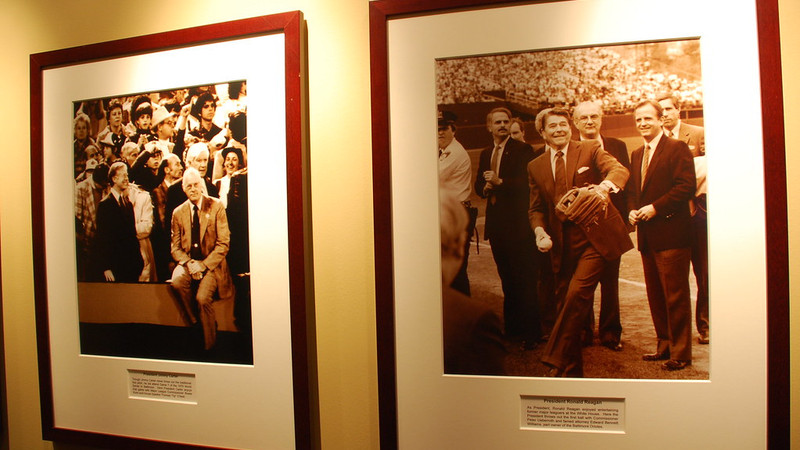
Ted Kennedy's pragmatic approach to legislative achievement frequently required accommodations that opponents characterized as dangerous compromises and supporters viewed as necessary political realism. The 1986 Immigration Reform and Control Act—signed by President Reagan despite conservative opposition—stands as perhaps the most significant example of Kennedy's willingness to forge alliances across ideological chasms, including controversial overtures to communist leaders and strategic partnerships with labor organizations traditionally hostile to immigration expansion.
The most contentious element of Kennedy's alliance-building strategy emerged in 1983, when the Massachusetts senator allegedly sought back-channel communication with the Soviet Union through former Senate colleague John Tunney. According to a KGB memorandum discovered in Soviet archives after the USSR's collapse, Kennedy—frustrated by Reagan's "evil empire" rhetoric and concerned that the President's aggressive posture threatened nuclear war—proposed visiting Moscow to help Soviet officials develop arguments on nuclear disarmament that would play more effectively with American audiences. The memo, written by KGB Chief Viktor Chebrikov to General Secretary Yuri Andropov, alleged that Kennedy offered to arrange U.S. television interviews with the Soviet leader and to frame the initiative as emerging from American media rather than Soviet propaganda. While Tunney never confirmed these specific details, and historians debate whether Kennedy's actions constituted legitimate diplomatic engagement or inappropriate collaboration with a foreign adversary, the episode demonstrated Kennedy's willingness to circumvent traditional diplomatic channels when he believed vital interests were at stake. That Reagan signed immigration amnesty three years after this alleged contact—legislation Kennedy had championed despite its controversial granting of legal status to millions who had entered the country illegally—suggested that Kennedy viewed legislative achievement as transcending ideological warfare, even during the Cold War's most frigid period.
Kennedy's work with Massachusetts labor unions to secure IRCA's passage revealed similar pragmatic flexibility. The 1986 legislation emerged from a complex coalition that included not only pro-immigration advocates but also unions traditionally skeptical of amnesty provisions. The Massachusetts labor movement, which had initially opposed immigration expansion fearing wage depression and job competition, ultimately supported IRCA because the legislation combined legalization with employer sanctions—creating theoretically enforceable penalties for companies hiring undocumented workers. Kennedy spent years cultivating relationships with union leaders who viewed him with suspicion, particularly the conservative building trades and manufacturing unions that represented his constituents but opposed his immigration positions. By framing amnesty as a labor protection measure that would eliminate the exploitation of undocumented workers driving down wages, Kennedy convinced Massachusetts AFL-CIO affiliates to support rather than oppose Reagan's signature. This coalition proved crucial during floor debates, as Kennedy leveraged his relationships with organized labor to counter conservative Democratic opposition from border-state senators who viewed amnesty as electoral suicide.
Cesar Chavez, leader of the United Farm Workers (UFW), strongly opposed illegal immigration in the 1960s and 1970s, viewing it as a tool for growers to break strikes and depress wages. In 1974, he stated: “We’re against illegals no matter where they work because if they’re not breaking the strike they’re taking our jobs”.
As Speaker of the House and fellow Democrat, Tip O'Neill initially opposed and blocked immigration reform efforts rather than helping pass them.
In October 1983 O'Neill announced he would not allow the immigration reform bill to be considered on the House floor, effectively killing it for that year. This angered many, including President Reagan, who publicly criticized the decision.
O'Neill stated there was "no constituency" for the bill and was concerned about antagonizing Hispanic voters, whose leaders, like Chavez, opposed the legislation. The New York Times editorialized that O'Neill was motivated by "coarse political gain" rather than fairness. On October 25, 1983, Simpson and O'Neill met secretly in the Speaker's Washington office. Simpson gave O'Neill crucial assurances:
- That the bill was “not a partisan trap” designed to embarrass Democrats
- That Republicans would not use the issue for partisan political gain
- A pledge to take the House-Senate proposal to the White House and “guarantee President Reagan's signature” before the House took a final vote
Simpson reportedly told O'Neill "You don't know me, Tip, if you think that I spend time in partisanship here."- That Republicans would not use the issue for partisan political gain
- A pledge to take the House-Senate proposal to the White House and “guarantee President Reagan's signature” before the House took a final vote
Presidents Jimmy Carter and Gerald Ford, as well as Rev. Theodore Hesburgh of Notre Dame, sent telegrams supporting the bill, arguing that "America's immigration policies are in a shambles."
A month later (December 1983), O'Neill reversed course and announced the House would consider the legislation in 1984.
Despite this promise, the bill stalled again and didn't pass until 1986—three years after O'Neill first blocked it.
The bill wasn't actually Ted Kennedy's—it was the Simpson-Mazzoli Act, named after Senator Alan Simpson (R-WY) and Representative Romano Mazzoli (D-KY). However, Ted Kennedy did support the bill and advocated for important amendments to make it less punitive, particularly regarding protections for immigrant workers. The new version had bipartisan support from Reagan, Kennedy, and labor leader Lane Kirkland, among others.
Fellow Catholics, O’Neill, Reagan and Kennedy even heard from the Vatican. The U.S. Conference of Catholic Bishops (USCCB) was actively engaged in education efforts around immigration reform during the 1980s. According to sources, the US bishops mobilized the country's largest network of "qualified designated entities" after IRCA passed, to help immigrants apply for the legalization provisions. One interesting note: Representative Romano Mazzoli (co-sponsor of the act) was himself Catholic and reportedly spoke about immigration reform as a "moral" issue.
According to his aide, O'Neill conducted "a more careful review of the provisions" of the legislation that had already passed the Senate.
The 1986 law that finally passed—the Immigration Reform and Control Act—legalized approximately 3 million undocumented immigrants while imposing employer sanctions for hiring illegal workers.
The partnership with Reagan himself represented perhaps Kennedy's most surprising alliance. Following the 1984 election, and bitter Republican resentment over his alleged involvement in taking down Nixon, Kennedy recognized that the president's second term offered a narrow window for comprehensive reform. Despite the partisan climate and Kennedy's alleged 1983 outreach to Soviet leadership intended to undermine Reagan's foreign policy, the senator approached the administration with a legislative strategy that accommodated conservative concerns about enforcement while preserving legalization provisions. Kennedy accepted compromises that outraged immigrant advocacy groups—accepting employer sanctions that many Latino organizations viewed as discriminatory, and agreeing to exclusionary provisions regarding public benefits that would haunt immigrant communities for decades. Yet these concessions secured Reagan's signature, delivering the largest legalization program in American history and demonstrating that Kennedy would subordinate ideological purity to achievable progress, even when it required alliances with conservative Republicans and organized labor groups whose interests often diverged from his own vision of expanded immigration.
This willingness to engage with unsavory partners—whether communist dictatorships abroad or restrictionist labor bosses at home—reflected Kennedy's fundamental conviction that legislative achievement justified political risks that would have destroyed less established politicians. The 1986 amnesty emerged not from ideological consistency but from Kennedy's characteristic transactional approach, leveraging his relationships across the political spectrum while weathering criticism from both left and right regarding his methods and alliances.
From the Kennedy family's alleged mob associations through Prohibition bootlegging, to RFK's crusade against organized crime, to Ted Kennedy's legislative transformation of American immigration, to the contemporary battles over refugee admissions and skilled worker visas, American immigration policy has consistently operated at the intersection of economic interest, humanitarian concern, and political suspicion. The persistence of allegations questioning political figures' loyalty—whether Kennedy's purported collaboration with Moscow or modern executive's alleged favoritism toward foreign workers—suggests that immigration policy serves as a perpetual battleground for competing visions of American identity and economic competition. Understanding this history requires distinguishing substantiated legislative achievements from unsubstantiated allegations, recognizing that the Kennedy immigration legacy, despite the shadows surrounding its family name, fundamentally reshaped who could become American—and that this transformation continues generating political controversy nearly six decades later.
Editorial comments expressed in this column are the sole opinion of the writer
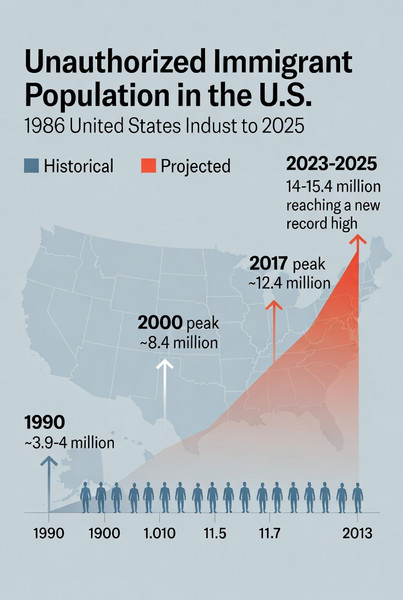
Based on available data, here are the key figures for illegal immigrant arrivals and population since 1986:
From the Kennedy family's alleged mob associations through Prohibition bootlegging, to RFK's crusade against organized crime, to Ted Kennedy's legislative transformation of American immigration, to the contemporary battles over refugee admissions and skilled worker visas, American immigration policy has consistently operated at the intersection of economic interest, humanitarian concern, and political suspicion. The persistence of allegations questioning political figures' loyalty—whether Kennedy's purported collaboration with Moscow or modern executive's alleged favoritism toward foreign workers—suggests that immigration policy serves as a perpetual battleground for competing visions of American identity and economic competition. Understanding this history requires distinguishing substantiated legislative achievements from unsubstantiated allegations, recognizing that the Kennedy immigration legacy, despite the shadows surrounding its family name, fundamentally reshaped who could become American—and that this transformation continues generating political controversy nearly six decades later.
Editorial comments expressed in this column are the sole opinion of the writer
Based on available data, here are the key figures for illegal immigrant arrivals and population since 1986:
**1986 Baseline (Pre-IRCA Amnesty):**
- Approximately **3.2 million** unauthorized immigrants residing in the U.S.
**The 1986 Amnesty:**
- IRCA (Immigration Reform and Control Act) granted legal status to approximately **2.7 - 3 million** undocumented immigrants who had arrived before January 1, 1982.
**2025 Current Population:**
- **Pew Research Center (2023 data, published 2025)**: Record **14 million** unauthorized immigrants
- **Center for Immigration Studies (January 2025)**: **15.4 million** unauthorized immigrants
- **Recent estimates (July 2025)**: Population declined to approximately **14.2 million** (following policy changes)
**Net Increase Since 1986:**
- From approximately 3.2 million (1986) to 14-15.4 million (2025) = **net growth of 11-12 million**
**Estimated Total Arrivals (1986-2025):**
Calculating total arrivals is more complex than net population because it must account for:
- Those who left voluntarily
- Those deported
- Those who died
- The 2.7 million granted amnesty and removed from the unauthorized count
Conservative estimates suggest **20-25 million** unauthorized immigrants have arrived in the U.S. since 1986, with the current population representing those who remained (approximately 14-15 million).
## How Many Visa Programs Exist?
The U.S. has **dozens of visa categories** broadly divided into:
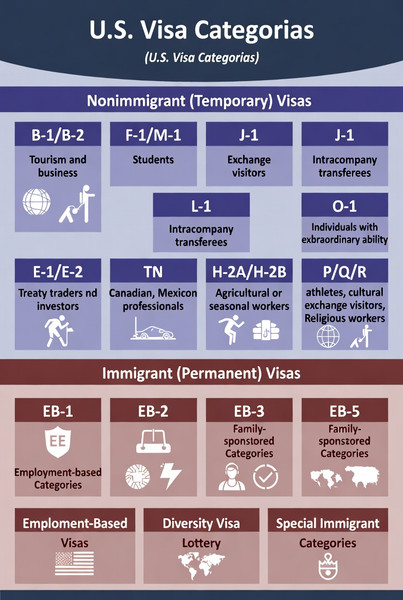
**Nonimmigrant (Temporary) Visas:**
## Fastest Growing Visa Programs This Decade (2020–2025)
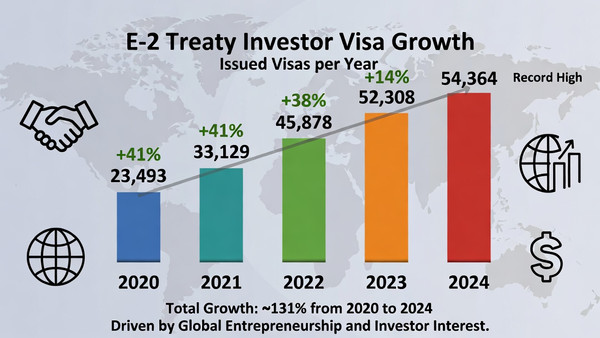
### 🥇 **E-2 Treaty Investor Visa** (Likely the Fastest Growing)
**Total growth from 2020 to 2024: ~131%**
This visa has shown sustained, consistent growth driven by increased global entrepreneurship and investor interest in the U.S. market.
---
### 🥈 **F-1 Student Visa** (Post-Pandemic Rebound)
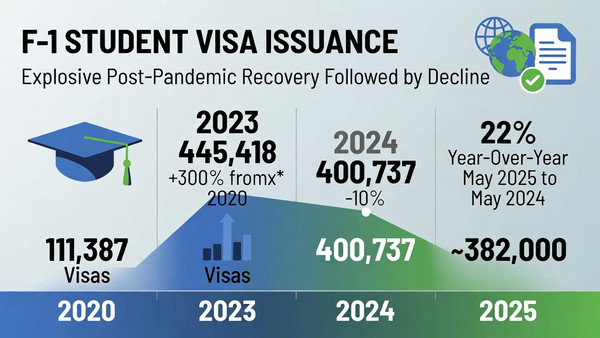
While F-1 saw explosive recovery after the pandemic (from 111K to 445K), it has since plateaued and is now **declining**—down 22% in May 2025 YoY.
Other Notable Mentions:
**L-1 Intracompany Transferee:**
- Approval rates recovered from 88.4% (2022) to 92.4% (Q3 2025)
- Strong rebound in multinational transfers post-pandemic
**OPT/STEM OPT:**
- Significantly up according to 2025 corporate immigration reports
- Companies increasingly relying on this as an H-1B alternative
**Immigrant Visas Overall:**
- Grew from 240,526 (2020) to 612,258 (2024)—a **154% increase**, though this reflects pandemic recovery rather than organic growth
If measured by **sustained organic growth** (excluding pandemic recovery effects), the **E-2 visa** stands out as the fastest-growing program this decade, more than doubling from ~23,000 to over 54,000 issuances between 2020–2024.
The **F-1 visa**, while showing dramatic percentage growth from its pandemic low, is now trending downward—making it more of a recovery story than sustained growth in the latter half of this decade.