
James Grundvig's article, "Public Relations vs Physics - Defending Cognition in the Age of Intelligent Systems" (Feb. 18, 2026), exposes a paradox in the AI boom: touted as history's ultimate optimizer, AI's data centers remain shackled to physics—thermodynamics, energy hunger, and water demands—prompting hyperscalers to pour fortunes into "Good Neighbor" PR teams rather than engineering fixes.
Grundvig argues AI excels at logistics, diagnostics, and markets but can't repeal entropy or cooling realities: "Cooling towers remain stubbornly unimpressed by branding exercises."
Data centers, "vast, windowless, humming" behemoths, sprawl into rural areas, guzzling megawatts and millions of gallons daily, sparking local backlash.
PR has evolved into "infrastructure diplomacy": Microsoft offers "Electricity Price Shields" and water replenishment; Meta dangles grants and jobs; Google deploys "Theory of Change" metrics, treating water use as a "trade secret."
Gemini AI estimates annual "engagement machine" costs per hyperscaler:
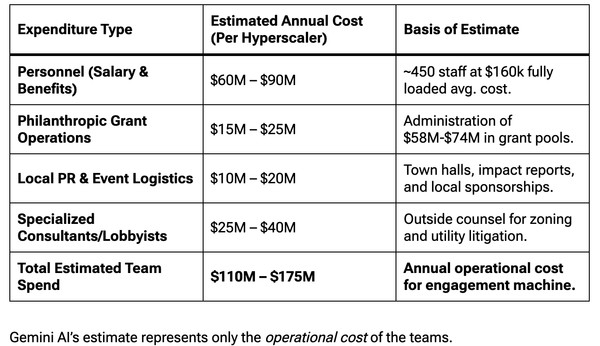
This "narrative management-as-a-service" softens perceptions while physics dictates consequences.
Grundvig proposes redirecting funds to R&D—advanced cooling, closed-loop water, AI-optimized hardware—via a "Manhattan Project 2.0" consortium (Meta, Microsoft, Google). Result: half-energy data centers, zero freshwater, no PR needed. "The most persuasive ‘Good Neighbor’ strategy... makes the Good Neighbor team unnecessary."
Ultimately, AI builders reshape civilization yet haggle over basics with neighbors—proof intelligence bows to physics.
Editorial comments expressed in this column are the sole opinion of the writer