
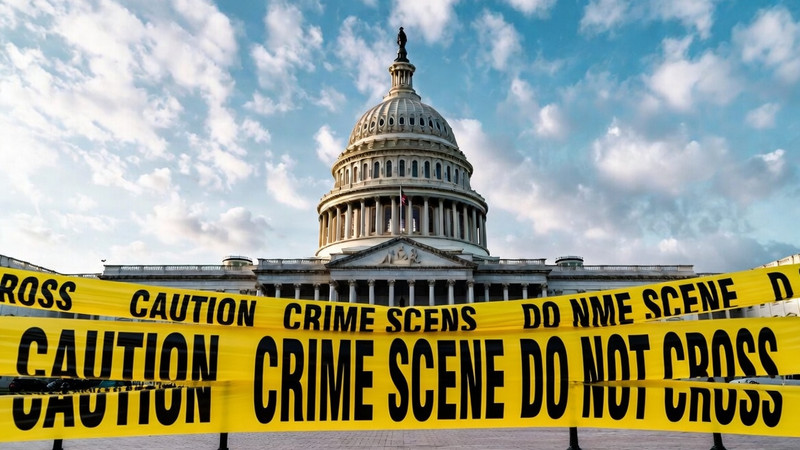
The United States Congress is facing an unprecedented crisis of confidence as four Democratic members of Congress find themselves embroiled in serious criminal investigations and prosecutions that strike at the very heart of public trust. Representatives LaMonica McIver, Sheila Cherfilus-McCormick, Ilhan Omar, and Eric Swalwell—each representing distinct districts across New Jersey, Florida, Minnesota, and California—stand accused of conduct ranging from physical assault on federal law enforcement to multi-million-dollar fraud schemes and mortgage fraud. These are not mere political disagreements or partisan witch hunts; these are documented criminal proceedings that demand serious consideration of the most severe constitutional remedy available: expulsion from Congress.
The principle is simple and non-partisan: those who make the laws cannot be above them. When elected officials betray the public trust through criminal conduct, the institution of Congress itself suffers. The American people deserve representatives who uphold the rule of law, not those who allegedly assault federal agents, steal from taxpayers, falsify mortgage documents, or facilitate massive fraud schemes. The evidence against these four members has become too substantial to ignore, and their continued presence in Congress constitutes an affront to the very democratic principles they swore to protect.
Representative LaMonica McIver: Assault on Federal Law Enforcement
In June 2025, Representative LaMonica McIver of New Jersey was indicted by a federal grand jury for allegedly assaulting federal officers during a confrontation at a Newark ICE detention facility. According to prosecutors, McIver forcibly impeded federal agents performing their lawful duties, with former President Donald Trump specifically noting that she "was shoving federal agents" and was "out of control" during the incident.
The charges against McIver—impeding federal officers and forcible assault—carry serious penalties including potential prison time. What makes this case particularly egregious is that McIver allegedly used her position as a member of Congress to interfere with law enforcement operations, attempting to leverage her elected status to disrupt the lawful execution of federal immigration policies. Her subsequent plea of not guilty and ongoing legal battles, including rejected motions to dismiss the charges, demonstrate a pattern of refusing accountability.
A member of Congress who physically assaults federal agents is not merely exercising civil disobedience—they are engaging in criminal conduct that undermines the rule of law. If McIver is willing to assault federal officers to advance her political agenda, how can constituents trust her to uphold the law in any capacity? Expulsion is not merely warranted; it is necessary to preserve the integrity of the legislative branch.
Representative Sheila Cherfilus-McCormick: The Florida Fraud Allegations
Florida Representative Sheila Cherfilus-McCormick faces equally serious charges. In November 2025, a federal grand jury indicted her on charges including conspiracy, wire fraud, and money laundering. These are not technical violations or paperwork errors—they represent a systematic scheme to defraud that violated the most fundamental fiduciary duties of public office.
While the specific details of the alleged fraud scheme continue to emerge through court proceedings, the nature of the charges—conspiracy, wire fraud, and money laundering—suggests a calculated, sophisticated operation designed to deceive and steal. Cherfilus-McCormick's characterization of the prosecution as a "sham investigation" rings hollow in the face of federal grand jury indictments, which require prosecutors to present substantial evidence of probable cause.
The presence of a member accused of financial crimes of this magnitude creates an impossible conflict. How can Cherfilus-McCormick participate in budget negotiations, oversight of federal spending, or financial regulatory matters while under indictment for financial fraud? The ethical implications are staggering. Congress cannot function properly when members accused of stealing from the system are simultaneously voting on the nation's finances.
Representative Ilhan Omar: Minnesota's Fraud Investigation
The case of Representative Ilhan Omar of Minnesota presents perhaps the most troubling scenario due to the scale of alleged criminality connected to her district. While Omar has not been indicted for assaulting federal agents, she faces serious allegations regarding the "Feeding Our Future" fraud scheme—a massive operation that prosecutors have described as involving billions in fraudulent claims.
President Trump has directly accused Omar of being "complicit" in a $19 billion scam involving Minnesota's Somali community, and the Department of Justice is reportedly investigating her connections to these fraud schemes. Federal prosecutors have already secured guilty pleas from multiple defendants in the "Feeding Our Future" case, establishing that massive fraud occurred. The investigation into Omar's potential role—whether through knowledge, facilitation, or willful blindness—remains active.
Additionally, the assassination attempt at her recent town hall meeting, while making her a victim of political violence, does not absolve her of these serious fraud allegations. Being a target of political attacks does not confer immunity from prosecution for financial crimes. The evidence trail suggesting Omar's knowledge of or involvement in fraud schemes impacting her constituents cannot be dismissed as mere political attacks when federal prosecutors are actively pursuing leads.
Representative Eric Swalwell: The California Mortgage Fraud Referral
California Representative Eric Swalwell adds another dimension to this pattern of alleged criminality among Democratic legislators. In November 2025, Trump administration housing official Bill Pulte criminally referred Swalwell to the Department of Justice for investigation over allegations of mortgage fraud and potential tax fraud related to his $1.2 million Washington, D.C. home.
The allegations are serious: federal investigators accuse Swalwell of making "false or misleading statements in loan documents" to secure favorable mortgage terms. These are federal crimes that strike at the integrity of the financial system. If proven, Swalwell knowingly submitted fraudulent documentation to lenders—a betrayal of trust that mirrors the conduct that led to the 2008 financial crisis.
Swalwell has fiercely denied the allegations, claiming the investigation is politically motivated retaliation for his vocal criticism of President Trump. He has filed a lawsuit alleging abuse of power and accusing the administration of targeting him to influence California's gubernatorial race. However, the emergence of reports in March 2026 that the FBI was reviewing old investigative files on Swalwell suggests the scope of potential misconduct may extend beyond mortgage documentation.
Swalwell's position on the House Intelligence Committee—where he had access to classified information—makes these allegations even more concerning. A member potentially facing criminal charges for fraud while holding a sensitive national security position represents an unacceptable security risk. The pattern of alleged dishonesty in financial matters raises serious questions about his judgment and fitness for any position of public trust.
New allegations have surfaced that “Eric Swalwell funneled $200,000 from his campaign directly back to himself, claiming he used the money on childcare. According to FEC filings from 2019 to 2025… Three payments totaling over $6,000 were made out to his wife, Brittany Swalwell, labeled as ‘childcare.’”
Over $105,000 in Uber spending since Jan 2020 (2nd highest in Congress) and nearly $25,000 on Uber Eats alone (highest in Congress). While transportation is a legitimate campaign expense, the volume and Uber Eats component suggest potential personal-use blending. $244,000+ in childcare payments (2019-2025), highest in U.S. House. Weekly payments to personal nanny ($102K) suggest routine expense, not event-specific as required by FEC AO 2022-07. Active FEC complaint filed Feb 2026. Post-election childcare spending ($42K in 5 months after Nov 2024 election) particularly concerning. Swalwell co-owns Findraiser, an AI fundraising startup valued at $100K-$1M, while serving in Congress and running for governor. Former Chief of Staff Yardena Wolf serves as CEO and used official position to market the product to congressional offices. House Ethics rules prohibit members and staff from promoting products in which they hold financial stakes. $305,118 paid to Coblentz Patch Duffy & Bass LLC (white-collar criminal defense) across 44 payments over 7 years. No comparable spending found among peer House members. Campaign attributes to "retaliatory investigations" but no public legal proceeding is known beyond the Fang Fang counterintelligence matter. 39.6% of governor campaign funds come from outside California, nearly double the next highest candidate (Becerra, 21.3%). $1.1M from New York and Florida alone. Heavy entertainment-industry concentration. For a governor's race, this level of out-of-state reliance raises questions about donor base alignment with state constituents.
When Eric Swalwell entered Congress in January 2013, he was among the least wealthy members, with an estimated net worth indicating significant debt. Financial disclosures from that period suggest his net worth was in the negative, largely driven by student loans, with estimates placing it around negative to near zero.
The Case for Expulsion
Perhaps most infuriating is the complete abdication of responsibility by those entrusted with enforcing the law. For thirteen critical months, former Attorney General Pam Bondi sat idly by, allowing these alleged crimes to fester while her Department of Justice turned a blind eye to mounting evidence of corruption within the legislative branch. This wasn't mere negligence—it was a deliberate dereliction of duty that allowed members like Omar and Cherfilus-McCormick to continue accessing classified information and wielding committee power while under active investigation. Now, with two interim Attorneys General who are registered Democrats installed during the transition period, the American public faces yet another roadblock to accountability. These partisan placeholders have already signaled their reluctance to pursue charges against their political allies, effectively granting these four members immunity through bureaucratic inertia. The message is clear: when Democrats control the Department of Justice, the law applies differently to Democratic members of Congress. This weaponization of inaction—the deliberate refusal to investigate and prosecute—is every bit as dangerous as the alleged crimes themselves, creating a two-tiered justice system where political connections shield criminals from consequences.
Article I, Section 5 of the Constitution grants Congress the authority to expel members with a two-thirds vote. This remedy exists precisely for circumstances like these—when members engage in conduct so incompatible with public trust that their continued service becomes damaging to the institution itself.
The standard for expulsion is not criminal conviction; it is conduct unbecoming of a member of Congress. In all four cases, that standard has been met. McIver stands indicted for assaulting federal agents—conduct that would disqualify any applicant for federal employment. Cherfilus-McCormick faces charges of financial fraud that demonstrate a fundamental breach of fiduciary duty. Omar faces active federal investigation for potential involvement in one of the largest fraud schemes in American history. Swalwell has been criminally referred for mortgage fraud allegations that, if true, represent deliberate deception in financial dealings.
These four cases represent a crisis of ethics in Congress that transcends partisan politics. When members allegedly assault law enforcement, steal through fraud, falsify mortgage documents, or enable massive schemes to defraud the public, the institution suffers. Constituents in Newark, Fort Lauderdale, Minneapolis, and the California Bay Area deserve better than representation by members facing serious criminal charges.
The path forward is clear. Speaker Johnson and House leadership must immediately bring expulsion proceedings against all four members. The Republican majority, joined by principled Democrats who recognize that corruption has no party affiliation, must vote to remove these compromised members from office. To do otherwise is to tell the American people that criminal conduct is acceptable behavior for their elected representatives.
Justice demands action. Integrity demands expulsion. The American people are watching.
