
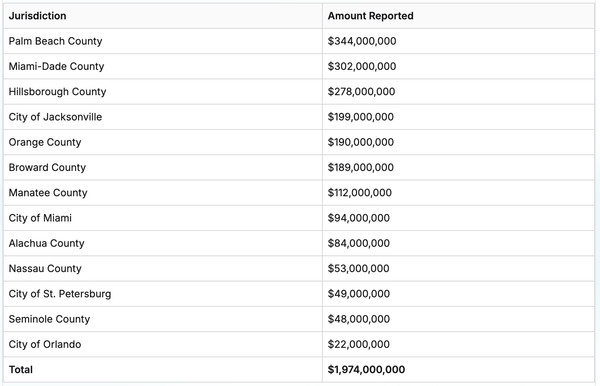
Florida's Department of Government Efficiency (DOGE), established in 2025 under Governor Ron DeSantis' administration, has conducted audits of 13 major local government entities across the state. According to Florida Chief Financial Officer Blaise Ingoglia, these reviews have identified approximately *$1.97 billion in what the state has classified as "wasteful and excessive spending" compared to 2019-2020 fiscal year baselines.
The Florida DOGE initiative was created to identify "waste, fraud, and abuse" in local government budgets. During 2025 and early 2026, auditors visited 12 jurisdictions and sent data requests to all 411 Florida municipalities and 67 counties. The 98-page report used the 2019-2020 fiscal year—a period preceding national inflation and rapid population growth—as its primary baseline for comparison.
The following amounts were identified as "excessive" or "wasteful" spending:
Multiple authoritative sources, including The Miami Herald and The Center Square, report that the Florida DOGE review did not find any criminal fraud or allege criminal wrongdoing. The findings focused on what state auditors characterized as:
- "Excessive" spending on initiatives beyond core services
- Expanded diversity, equity, and inclusion (DEI) programs
- Expanded cultural grant programs (e.g., Broward County's $175,000 for "virtual art")
- Salary increases and six-figure compensation packages
- Budget growth exceeding population growth rates
- Expanded diversity, equity, and inclusion (DEI) programs
- Expanded cultural grant programs (e.g., Broward County's $175,000 for "virtual art")
- Salary increases and six-figure compensation packages
- Budget growth exceeding population growth rates
The audits have become a focal point in Governor DeSantis' push for property tax relief, with CFO Ingoglia arguing that local governments are "crying poor" while simultaneously increasing non-core expenditures. The initiative has drawn both support from taxpayers seeking lower taxes and criticism from local officials who note that:
- Budgets have grown alongside population increases and inflation
- Municipalities have expanded services to meet constituent demands
- The 2019 baseline predates significant cost increases for goods, services, and labor
- Municipalities have expanded services to meet constituent demands
- The 2019 baseline predates significant cost increases for goods, services, and labor
During the audit process, CFO Ingoglia alleged that some local governments were engaging in "record scrubbing"—removing documents from public view before auditors could review them. These claims remain unverified but added tension to the audit process.
If similar proportional spending patterns exist in other states, the Florida findings suggest that taxpayers nationwide may be funding billions in municipal spending that state-level officials consider discretionary. However, it is essential to distinguish between:
- Wasteful Spending: Subjective determinations about budget priorities
- Fraud: Criminal activity involving deception for financial gain
- Fraud: Criminal activity involving deception for financial gain
The Florida audits identified the former, not the latter.
*Sources: Florida Executive Office of the Governor, Miami Herald, The Center Square, WPBF 25 News, WUSF Public Media*
