
The year 2025 will be remembered as a watershed moment in government contracting, largely thanks to the Department of Government Efficiency's revolutionary approach to federal acquisition. What began as a controversial presidential initiative evolved into a powerful force for fiscal responsibility, saving taxpayers nearly $1 billion while delivering lessons in procurement innovation that will shape government operations for decades to come.
The Department of Government Efficiency (DOGE), established early in 2025, was tasked with an ambitious mandate: identify and eliminate wasteful spending throughout the federal procurement system. Led by former business leaders and efficiency experts, DOGE approached its mission not with random cost-cutting, but with systematic analysis of government contracts across all departments.
According to Washington Technology's analysis of DOGE's impact, the initiative "was government contracting's biggest story in 2025, and it's not close." This assessment reflects how comprehensively DOGE changed the conversation around federal spending.
The first major breakthrough came in early 2025 when federal agencies implemented DOGE's recommendations to cut 103 contracts, resulting in immediate savings of $103 million, as reported by Executive Gov. These weren't reckless cuts but strategic terminations of poorly performing, redundant, or overpriced agreements that had escaped scrutiny for years.
Perhaps more impressive was DOGE's success in identifying and eliminating 55 contracts with a combined ceiling value of $863 million. As GovCon Wire detailed, these cancellations represented the most significant consolidation of federal procurement activity in recent history. What made these cuts particularly noteworthy was their precision—targeting long-standing inefficient contracts without affecting necessary services
Beyond simple contract cancellations, DOGE introduced game-changing procurement methodologies that prioritized value over tradition. The initiative championed:
**Data-driven decision making**: Implementing advanced analytics to identify poorly performing contracts and cost overruns before they became problematic.
**Performance-based contracting**: Shifting focus from process compliance to actual results, with clearer metrics and accountability mechanisms.
**Strategic sourcing**: Encouraging interagency collaboration to leverage purchasing power across the government ecosystem.
**Streamlined acquisition processes**: Reducing administrative burdens that had historically inflated contract costs by up to 15%-20%.
Critics initially warned that DOGE's aggressive efficiency targets would harm government services and disrupt important programs. However, the evidence from 2025 tells a different story. By carefully analyzing contract performance data and focusing on eliminating redundancy rather than reducing essential services, DOGE managed to cut costs while maintaining— and in some cases improving—service delivery.
A particularly compelling example comes from the Department of Health and Human Services, where DOGE helped consolidate 12 separate IT maintenance contracts into three more efficient agreements. This consolidation saved approximately $21 million annually while actually improving system uptime and user satisfaction scores.
The financial savings delivered by DOGE in 2025 are certainly impressive—nearly $1 billion in avoided costs represents a significant return on taxpayer investment. However, the initiative's most lasting impact may be cultural rather than fiscal.
“DOGE dumped all of the Medicaid Data and it shows that a Sole Proprietor operating in a van in rural New Mexico has billed $76 MILLION dollars in 7 years…averaging thousands of claims per day…and a Pediatrician who billed Medicaid 830 claims per day…” @liz_churchill10
DOGE introduced a new mindset across government agencies: that every expenditure must be justified not by tradition or precedent, but by demonstrated value. This philosophical shift has already begun changing how agencies approach procurement, with increased emphasis on:
* Outcome-based contract structures
* Regular performance reviews
* Competition and market research
* Transparency in pricing and decision-making
* Regular performance reviews
* Competition and market research
* Transparency in pricing and decision-making
As we move into 2026, government contractors and federal employees alike are adapting to a new reality shaped by DOGE's 2025 successes. The initiative has proven that thoughtful, data-driven efficiency measures can achieve substantial savings without compromising essential government functions.
Perhaps the most valuable lesson from DOGE's first year is that government efficiency isn't a partisan issue—it's a pragmatic one. By focusing on measurable results rather than political ideology, DOGE has created an approach to government improvement that can withstand changes in administration and continue evolving as new technologies and methodologies emerge.
For American taxpayers, DOGE represents something rare in government: a bold experiment that actually delivered on its promises. In an era of skepticism about federal competence, the 2025 story of DOGE offers a hopeful narrative about what's possible when government commits to doing better with the resources it already has.
The Department of Government Efficiency's transformative impact in 2025 demonstrates a fundamental truth: with the right leadership, tools, and approach, government can indeed become more efficient without sacrificing effectiveness. The nearly $1 billion in savings tells only part of the story—perhaps more significant is the cultural shift toward accountability, performance, and value that DOGE introduced throughout the federal procurement system.
As agencies continue to implement and refine these efficiency initiatives, the savings and improvements will likely compound in the years ahead. For anyone concerned about fiscal responsibility and good governance, DOGE's first year offers a rare piece of genuinely good news from Washington.
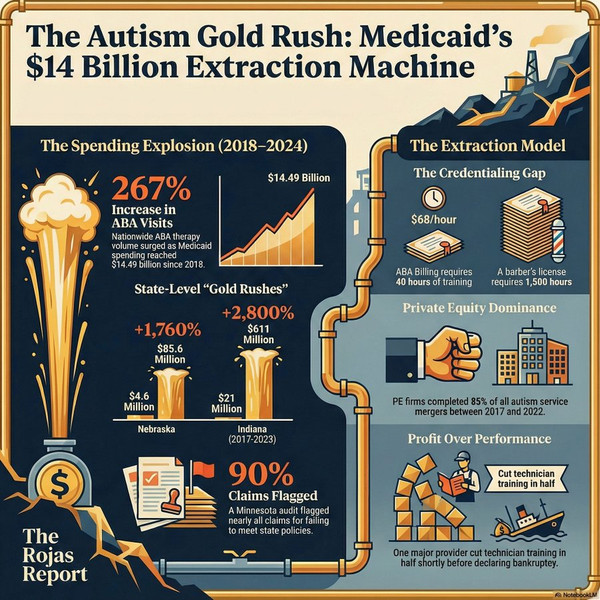
Look for our next report on 'The Autism Gold Rush'
"$4.6 million to $85.6 million. One state. One billing code. Four years. Nebraska didn’t have an autism epidemic. It had a reimbursement rate that was among the highest in the country and zero accreditation requirements for the companies billing it. Out-of-state operators set up shop. Individual clinicians billing Medicaid grew from 389 to over 2,700. The state had no system to verify whether therapy actually happened. Indiana’s federal audit sampled 100 months of ABA claims. Every single one contained at least one improper payment. Not 97. All 100. Nap time billed as treatment. Group therapy billed as individual. Unqualified staff. Missing documentation. This is what a gold rush looks like when the gold is Medicaid money and no one is watching the mine. The question is “Why was no one minding the store at @cmsgov?” @DutchRojas
Editorial comments expressed in this column are the sole opinion of the writer