
Why Old-School Polling Still Outperforms the Betting Sites
For the past decade, a seductive narrative has taken hold in political journalism: prediction markets and betting sites like Polymarket, PredictIt, and Kalshi have outsmarted the dusty world of telephone pollsters. The argument goes that when "cold, hard cash" is on the line, traders become bloodless, rational analysts—superior to the biased, error-prone humans who answer pollsters' phone calls. If you squint at the headlines, it almost sounds plausible. But look closely at the last ten years of major elections, and the legend crumbles. The truth is that traditional polling—especially live-caller phone polling—has a far stronger track record than the gambling sites. In fact, the markets' most famous moments are often their most embarrassing failures.
The Brexit Catastrophe
If you want to understand the hubris of prediction markets, start with the 2016 Brexit referendum. British pollsters using phone and online surveys spent the final week of the campaign showing an essentially dead heat. Some polls had "Leave" slightly ahead; others had "Remain" narrowly in front. The picture was clear: this was a coin flip.
The betting markets, however, were living in a fantasy. On referendum day, Betfair’s odds implied roughly an 85 to 90 percent probability that Remain would win. Across London trading floors and prediction sites, money piled up on the status quo because the conventional wisdom said voters wouldn't actually take the leap. When the results came in— Leave won 52 to 48—the markets weren't slightly off. They were catastrophically wrong. In that defining political moment of the decade, it wasn't the pollsters who needed the correction. It was the traders.
2016 Trump vs. Clinton: Everyone Missed, and Markets Missed Harder
The 2016 U.S. presidential election is often cited as proof that the polling industry is broken, but that’s only half the story. Yes, state-level pollsters underestimated Donald Trump’s support in the Rust Belt, and the ensuing hysteria about a "broken" polling industry became part of the political canon. But look at the national picture: the final polling average had Hillary Clinton winning the popular vote by about 3.2 percentage points; she won it by 2.1. That is not a failure. That is a remarkably accurate estimate of the national mood.
Meanwhile, what were the betting sites saying? On election eve, PredictIt had Clinton contracts trading near 80 to 90 cents—implying an 80 to 90 percent chance of victory. Intrade’s successor markets and Betfair were similarly bullish on Clinton. Nate Silver’s polling model—hated by some Democrats for giving Trump a roughly 30 percent shot—ended up being more generous to Trump than nearly every major prediction market. When the Midwestern firewall cracked and Trump won the Electoral College, it wasn't the pollsters alone who were stunned; the markets were just as wrong, and in many cases, even more confidently wrong.
The 2020 Draw: Markets Didn’t Uncover Any Hidden Truth
By 2020, prediction market enthusiasts claimed the lessons of 2016 had been learned. And indeed, the markets correctly predicted a Joe Biden victory. But so did almost every reputable pollster. The national polls had Biden ahead by roughly 8 points; he won by 4.5. State-level pollsters again underestimated Trump’s support in places like Wisconsin and Florida, leading to a narrative that the polls had "missed." Yet prediction markets were hardly nailing the specifics either. They priced Biden as a heavy favorite but also failed to accurately forecast just how close several swing states would be.
More importantly, the market prices were largely just aggregating what the polls were already saying. When a high-quality live-caller poll from The New York Times/Siena or Monmouth moved a race, the market moved with it. There is little evidence that traders possessed some independent, mystical insight beyond the survey data available to everyone. The best academic research on the subject confirms this: when you properly debias polls using established statistical techniques, they often contain as much or more forecasting power than the markets. Markets aren’t an alternative oracle; they’re an echo chamber with a price tag.
https://thoroughlyreviewed.com
The Invisible Biases of the Trading Floor
Why do prediction markets keep stumbling? Because the idea that betting sites are populated by neutral, demographic-perfect analysts is absurd. Platforms like Polymarket run on cryptocurrency and attract a user base that skews heavily male, young, wealthy, and tech-libertarian. That’s not a representative slice of the American electorate. It is its own bubble.
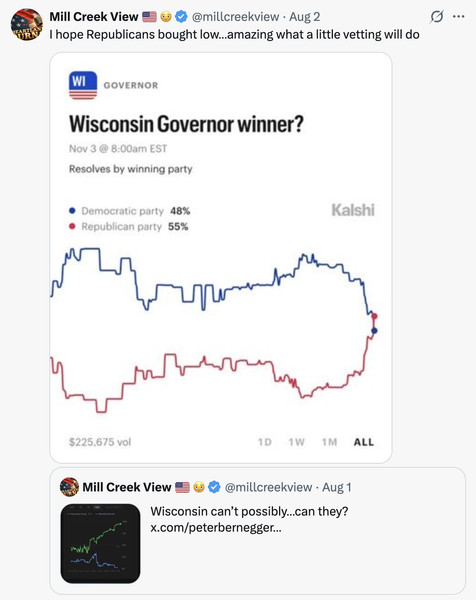
These markets are also shockingly vulnerable to manipulation. During the 2012 election, the Irish betting exchange Intrade saw suspicious trading patterns favoring Mitt Romney that later appeared to be the work of a single trader trying to create a false narrative. In 2024, questions swirled around large "whale" bets on Polymarket that may have moved prices not because of secret knowledge, but because one wealthy actor wanted to signal confidence in a candidate. Polls, for all their flaws, at least rely on probability sampling and methodological transparency. A market price is just the whims of whoever has the most money to spend.
2024: The Exception That Proves the Rule?
Prediction market advocates will point to 2024 as their vindication. While many polling averages and models showed a toss-up or slight Harris lead heading into November, Polymarket consistently gave Donald Trump an edge. When Trump won the Electoral College comfortably, the markets looked prescient. But dig deeper, and the picture complicates. Several high-quality traditional pollsters—including Trafalgar and some USC/Dornsife models—had also captured a Trump advantage or a dead heat. The "miss" in 2024 was not universal across polling, but concentrated in media-aggregator averages and low-quality online surveys. Furthermore, a single election cycle in which a betting site guessed correctly does not erase a decade that includes Brexit, 2016, and multiple midterm surprises.
The Enduring Power of the Phone Call
There is a reason the best forecasters in the business—Nate Silver, but also election analysts at CNN, ABC, and The New York Times—still begin with polls, not Polymarket. Live-caller phone polling, despite declines in response rates, remains the gold standard for a reason. A professional interviewer can clarify questions, verify that a respondent is actually engaged, and avoid the self-selection bias that plagues online panels and betting platforms alike. When rigorous phone pollsters miss, they usually miss for understandable statistical reasons (hard-to-reach demographics, late swings, who even has a land line anymore?) that apply equally to any other forecasting method.
The fantasy of the omniscient betting site is just that: a fantasy. For every headline praising prediction markets, there is a Brexit-level disaster hiding in the fine print. Over the last ten years, the record is clear. Traditional pollsters, using actual human contact and rigorous sampling, have proven more reliable than the gamblers. When the stakes are cash, traders can be just as emotional, tribal, and wrong as the rest of us.
Editorial comments expressed in this column are the sole opinion of the writer
