

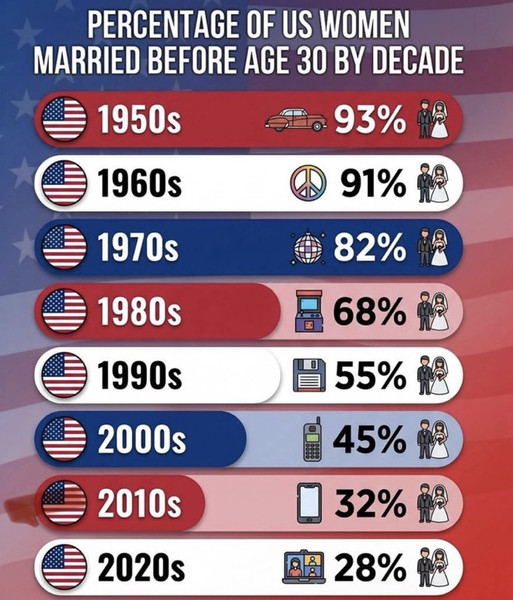
The shift—roughly 82% to under 70% of women married by age 30 between the 1970s and 1980s—reflects one of the most rapid structural breaks in U.S. marriage patterns on record. While different Census tabulations quote slightly different baselines (some show ~85–91% in 1970, with sharp drops accelerating through the 1980s), the causal story is consistent: it wasn’t a single change, but a convergence of legal, economic, technological, and cultural shifts that matured right in that window.
Here are the main drivers that broke the old norm of early marriage:
1. Women’s Economic Independence Became Mainstream
By the late 1970s and 1980s, women’s labor-force participation and wages had risen enough that marriage was no longer an economic necessity for many. As Brookings researchers noted, in 1970 about **44% of women ages 30–50 had no independent earnings**; by later decades that was down to 25%. As women gained control over their own finances, they could support delays in marriage to pursue careers or simply remain single without facing destitution.
2. The Birth Control Pill’s Generational Ripple Effect
The pill was approved in 1960, but its full social impact hit the cohorts coming of age in the 1970s and 1980s. By the time those women reached their late 20s, they had spent a decade with reliable, legal contraception that let them invest in college and careers without the “biological clock” pressure to marry early. Harvard economists Claudia Goldin and Lawrence Katz found that early legal access to the pill significantly **delayed marriage and motherhood** and increased women’s professional occupation rates.
3. No-Fault Divorce Became Nationwide
California passed the first no-fault divorce law in 1969, and by the late 1970s most states had followed. The practical effect was twofold:
- It made **exit from marriage easier**, reducing the “security” marriage once offered and making young people more cautious about marrying young.
- Divorce rates peaked around **1979–1981**. Watching that wave made many delay or avoid marriage until they felt more certain.
4. Cohabitation Went Mainstream as an Alternative
Living together without marrying shifted from fringe to normal during the 1980s. Sociological estimates suggest that by the mid-to-late 1980s, **about half of all first marriages were preceded by cohabitation**. This gave couples a way to test partnerships, share expenses, and delay—or skip—the formal marriage step entirely.
5. Higher Education and Career Prioritization
The 1970s and 1980s were the first decades in which large numbers of women pursued four-year degrees and professional careers as the default path rather than the exception. Title IX (1972) expanded access, and by the 1980s women were beginning to outpace men in college enrollment in many fields. More time in school and early career building naturally pushed marriage ages back.
6. Changing Male Economic Prospects and Rising “Material” Expectations
The 1970s stagflation and the industrial restructuring of the early 1980s eroded the “family wage” many working-class men had relied on. At the same time, cultural expectations for what a stable marriage required (housing, dual incomes, financial security) rose. Researchers note that **deteriorating economic prospects for non-college men** and heightened material expectations for marriage contributed to lower marriage rates, particularly among less-educated groups.
Bottom Line
The 1970s-to-1980s drop was the tipping point where marriage shifted from a near-universal early-life milestone to an optional, later-life capstone. The women who would have married at 22 in 1970 were instead graduating college, starting careers, cohabiting, or simply choosing to remain single in 1985—because the legal, economic, and technological constraints that once made early marriage the only viable path had largely dissolved.
Editorial comments expressed in this column are the sole opinion of the writer
