

"Democracy is not a spectator sport, Democracy is you! The American people, no matter what their political persuasion, must make it clear that American democracy will not be destroyed". Senator (I-VT) Bernie Sanders
“A republic, if you can keep it” Benjamin Franklin (1787)
As we begin preparations for American’s 250th anniversary celebrations this year, the Supreme Court in February, cleared the way for California to use a new congressional map intended to give Democrats five additional seats in the U.S. House of Representatives.
In a one-sentence order in Tangipa v. Newsom the justices turned down a request from a group of California Republicans that would have required the state to continue to use the map in place for the last several federal elections in the state while their challenge to the map moves forward.
A divided three-judge district court – which Congress has tasked with hearing congressional redistricting cases – turned down their request, leaving the new map in place.
Writing for the majority, U.S. District Judge Josephine Staton concluded “that the evidence of any racial motivation driving redistricting is exceptionally weak, while the evidence of partisan motivations is overwhelming.”
The current push to redraw California's congressional districts represents a striking display of political hypocrisy—one that threatens to undermine the very democratic institutions progressive leaders claim to protect. While Democrats have spent years decrying Republican redistricting efforts in states like Texas as existential threats to democracy, they now seek to weaponize the same tactics in the nation's most populous state.
The statistics tell a damning story of systemic disenfranchisement. In heavily Democratic states, Republican voters consistently face electoral outcomes that bear no relationship to their actual numbers. In Massachusetts, Republicans comprise 36% of the electorate yet hold exactly zero congressional seats. Connecticut, at 42% Republican representation, similarly returns zero GOP members to Congress. Maine (46%), New Mexico (46%), and New Hampshire (48%) all follow this same pattern—significant Republican voting populations completely shut out of federal representation.
This isn't coincidence—it's calculated cartography.
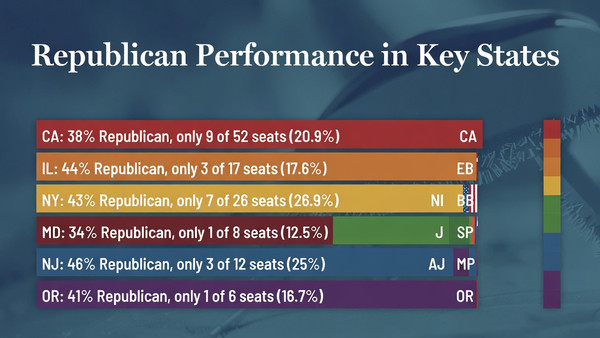
The six major blue states paint an even bleaker picture. Out of 121 total House seats across California, Illinois, New York, Maryland, New Jersey, and Oregon, Republicans hold merely 24 seats despite averaging 42% of the popular vote. California itself exemplifies this disparity: with 38% Republican voters, the party holds just 9 of 52 seats (*20.9%). Illinois gives Republicans 44% of votes but only 17.6% of seats. Maryland, with 34% Republican voters, reserves a paltry 12.5% of congressional representation for them. Reduced to 5 California will have only *10%, lowest in the country.
In 2025, Washington state had 30 Democrats and 19 Republicans in the Senate and 59 Democrats and 39 Republicans in the House (39%).
When Texas Republicans moved to shore up their congressional advantages, Democratic leaders issued apocalyptic warnings about the death of democracy. News networks ran wall-to-wall coverage. Editorial boards penned frantic op-eds. Activists organized nationwide protests.
When the opportunity arised for California Democrats to engage in “saving democracy”, the moral outrage evaporates. The principles that were allegedly non-negotiable suddenly become "pragmatic necessities." The Constitution that mattered becomes mere parchment to be worked around.
This isn't principled opposition to gerrymandering—it's competitive grievance. The progressive movement has never sought fair maps; they've simply wanted maps that favored their side. The current redistricting push exposes this calculation nakedly.
The special election represented a crossroads for American democracy. Approving new partisan maps in California wouldn't just shift a handful of congressional seats—it would normalize the worst instincts of our political class. It would signal that gerrymandering is acceptable behavior, provided the "right" party engages in it.
When both parties embrace winner-take-all map-drawing, voters lose. Communities of interest are fractured into electoral oblivion. Competitive districts become historical artifacts. Citizens morph from participants into pawns—herded into predetermined outcomes by algorithms and partisan operatives.
The Democratic Party's record speaks for itself. They have mastered the art of vote suppression through cartography, engineering safe districts while lecturing others about voter rights. Now they ask California voters to bless this continued distortion.
True democracy demands consistency. Either gerrymandering is wrong and must be opposed regardless of which party benefits, or we've abandoned the pretense entirely and acknowledged that raw power—not principle—governs American politics.
George Washington is the primary Founding Father who strongly rallied against political parties, famously warning against "the baneful effects of the spirit of party" in his 1796 Farewell Address. He viewed parties as dangerous, divisive, and a threat to national unity. John Adams stated that a division into two parties is to be "dreaded as the greatest political evil". Alexander Hamilton called political parties "the most fatal disease" of popular governments. James Madison discussed the risks of factions, though he became a key player in the party system.
For voters in red states (Republicans hold veto-proof **supermajorities in both chambers of the legislature in 19 states) who believe that representative government should actually represent the people, the choice is clear: Reject these latest redistricting schemes. Don't let the architects of electoral distortion rewrite the rules yet again.
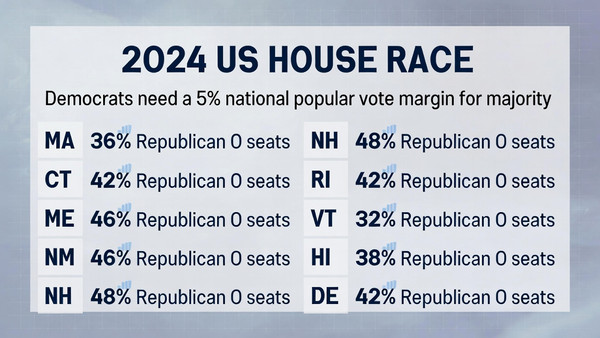
OUT OF THE 121 HOUSE SEATS IN THE 6 STATES LISTED BELOW, REPUBLICANS ONLY HOLD 24 SEATS WHILE HAVING AN AVERAGE OF 42% OF THE VOTES
**Republican supermajorities in both the state House and Senate include:
- South: Alabama, Arkansas, Florida, Georgia, Kentucky, Louisiana, Mississippi, Oklahoma, South Carolina, Tennessee, West Virginia.
- Midwest/Other: Idaho, Indiana, Iowa, Missouri, Ohio, South Dakota, Utah, Wyoming.
