
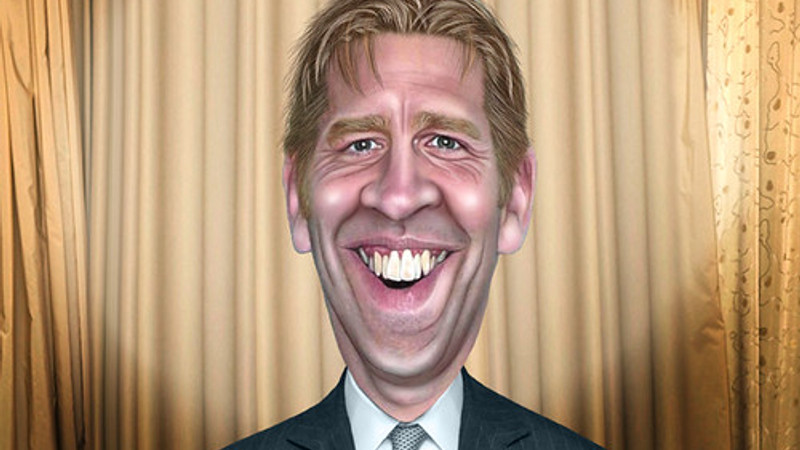
In a raw and deeply personal interview with New York Times columnist Ross Douthat, former Republican Senator Ben Sasse of Nebraska has opened up about his battle with terminal pancreatic cancer, offering a stark reflection on mortality, faith, and his unfinished vision for a fractured America.
Sasse, who at 53 received the devastating diagnosis in mid-December 2025, spoke with Douthat as part of the newspaper's "Interesting Times" podcast, candidly discussing how terminal illness has reshaped his perspective on life, politics, and what it means to leave behind a meaningful legacy. The interview, released April 9, comes roughly four months after Sasse first revealed his Stage 4 diagnosis, which he described at the time as "a death sentence."
"I got a three- to four-month life expectancy, and I'm at Day 99 or something since then," Sasse told Douthat. "I'm doing a heck of a lot better than I was doing at Christmas."
The contrast between the former senator's medical trajectory and his unflinching approach to death has caught the attention of political observers and the public alike, offering a rare moment of vulnerability from a figure known more for academic reserve than emotional disclosure.
From the Senate to the Sickbed
Sasse's political career had already taken several unexpected turns before his diagnosis. After serving two terms in the U.S. Senate, he resigned in January 2023 to become president of his alma mater, the University of Florida—an unusual career move for a sitting senator. His tenure lasted just 17 months. In July 2024, he abruptly resigned, citing his wife Melissa's worsening health after she suffered strokes in 2007 and had recently been diagnosed with epilepsy.
The decision to leave the university presidency highlighted a pattern throughout Sasse's life: family obligations repeatedly pulling at his professional ambitions. Now, with his own life expectancy measured in months rather than decades, those family calculations have taken on an even more profound urgency.
A Christian Philosophy of Death
What distinguishes Sasse's response to his diagnosis is his embrace of Christian theology as a framework for understanding mortality—though not in a way that avoids death's horror. "Death is something we should hate," he told Douthat, rejecting any suggestion that terminal illness should be romanticized. "Death is terrible. We should never sugarcoat it. It is not how things are meant to be."
Yet as a Presbyterian elder, Sasse also draws upon the Apostle Paul's declaration that "to live is Christ, to die is gain." He describes death as "the final enemy"—emphasizing that while it remains an enemy worth fighting, it is also an enemy that will ultimately be defeated through resurrection and the restoration of the world.
This theological tension between hating death and accepting it has given Sasse clarity in his final months. "I did not feel great fear about my death," he explained. "I didn't want the pain I was going through. I didn't want to be a pansy ass in the final moments."
The View From Illness
Perhaps most striking in the interview is how Sasse's proximity to death has intensified his concern for the country he describes as deeply divided. The title of the Times piece captures this duality: "How Ben Sasse Is Living Now That He Is Dying" emphasizes that he remains focused on "healing the America he's leaving behind."
Throughout his Senate career, Sasse positioned himself as a conservative critic of populism and partisanship, often infuriating President Trump while maintaining his conservative voting record. In the interview, terminal illness appears to have crystallized rather than dimmed these convictions—suggesting that facing extinction can sharpen political purpose rather than dissolve it.
His doctors at Houston's MD Anderson Cancer Center—Drs. Shubham Pant and Bob Wolff—have earned his praise for their approach to treatment. Sasse described them as using "a little pickax on a giant Hoover Dam working on pancreatic cancer," acknowledging the often-futile nature of their work while celebrating their determination to crack even small improvements in understanding the disease.
Mediated Mortality
The format of the interview itself merits attention. Released as a video conversation with a full transcript available, Douthat's "Interesting Times" has positioned itself as a space for the kind of extended, contemplative discussion rarely found in political media. Douthat, himself a conservative Catholic who has written extensively about his own struggles with chronic illness (Lyme disease), brings a particular empathy to the conversation—two men of similar ideological bent discussing the limits of embodied existence.
The result is a piece that transcends standard political journalism. While Sasse discusses policy and America's future, the interview's power derives from watching a public figure perform the work of dying in public—negotiating pain management, family conversations, and the strange freedom that comes with knowing one's approximate expiration date.
Legacy Questions
At 53, Sasse leaves behind a complicated political legacy. Elected in 2014 as part of the Republican wave that gave his party control of the Senate, he quickly established himself as an intellectual voice on the right, with a Ph.D. in history from Yale and experience leading Midland University in Nebraska. His criticism of Trump during the 2016 campaign, followed by his vote to convict the former president during the second impeachment trial, made him a pariah among the GOP base even as he maintained conservative orthodoxy on most legislative matters.
His departure from the Senate to lead a university struck many as politically strange; his rapid departure from that university presidency as his wife's health declined seemed to confirm the personal calculus driving his career decisions. Now, the pancreatic cancer diagnosis reframes everything—a life cut short not by ambition thwarted but by cellular betrayal.
What remains is the interview itself: a document of how one prominent American Christian is approaching death in an era when the country seems increasingly incapable of collective mourning or shared grief. Whether Sasse's final months can contribute to the national healing he seeks remains to be seen. But in speaking openly about dying, he has at least modeled a different kind of political communication—one measured not in tweets or fundraising appeals but in the finite breaths of a man who has run out of time to dissemble.
The interview is available on The New York Times website and the "Interesting Times" podcast feed.
