
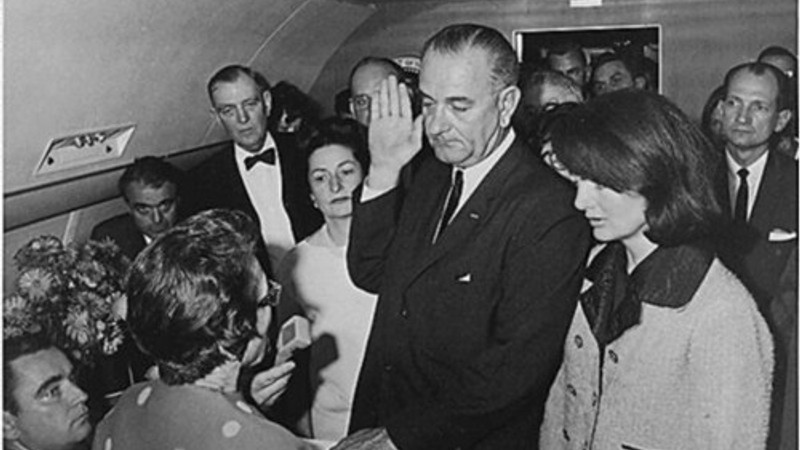
The American political landscape of the twentieth century was shaped by a peculiar form of electoral cynicism that began in the ballot-stuffing precincts of Jim Wells County, Texas, and achieved its apotheosis in the marble corridors of the United States Supreme Court. Lyndon Baines Johnson, who entered the Senate through the fraud of Box 13 and the "Duke of Duval" George Parr's manufactured votes, spent his presidency attempting to purchase demographic loyalty through civil rights legislation—a calculation captured in the disputed but symbolically potent remark about securing black votes for two centuries. Richard Nixon, recognizing the opportunity Johnson's genuine idealism (or manipulative philanthropy) had created, constructed the Southern Strategy to harvest the white voters Johnson acknowledged losing. Today's Supreme Court, through its dismantling of the Voting Rights Act and related protections, has effectively "fixed" this cynical architecture—not by repairing its moral deficiencies, but by completing the circuit Johnson began: transforming voting from a guaranteed right into a contest of power, administered by the victors, in which the heirs to both Box 13's fraud and Nixon's demographic calculations determine who may participate.
The Foundations: Box 13 and the Morality of Power
To understand the current jurisprudential landscape, one must begin in Alice, Texas, in 1948, where Precinct 13 produced exactly 202 ballots for Lyndon Johnson, recorded in identical handwriting and alphabetical order, delivered six days after the election, providing his 87-vote victory over Coke Stevenson. This was not mere political hardball; it was criminal conspiracy between Johnson and Parr, the Democratic boss who controlled South Texas through patronage, intimidation, and the casual manufacturing of non-existent voters. Johnson's aide John Connally secured these votes through manipulation of the county's political machinery, demonstrating that Johnson's conception of electoral democracy was instrumental rather than principled—votes were counters to be accumulated by any means necessary, not expressions of citizen will to be protected.
This foundational experience shaped Johnson's approach to the Civil Rights Act of 1964 and the Voting Rights Act of 1965. Whether or not Johnson actually uttered the phrase attributed to him by Air Force One steward Robert MacMillan—"I'll have those n******s voting Democratic for the next two hundred years"—the sentiment aligns perfectly with his documented political calculations. Johnson explicitly told aide Bill Moyers that the Civil Rights Act would cost Democrats the South for a generation. He understood, as a practitioner of Parr's machine politics understood, that voting behavior could be engineered through control of institutional levers. The difference between Box 13's manufactured 202 votes and the VRA's enfranchisement of millions was scale and direction, not fundamental philosophy: both represented the deployment of state power to reshape the electorate according to partisan advantage.
The Nixon Correction: Harvesting the Whites Johnson Abandoned
Richard Nixon's Southern Strategy, refined by Kevin Phillips and executed through the 1968 and 1972 campaigns, represented the market correction to Johnson's demographic speculation. If Johnson sought to exchange Southern whites for newly enfranchised blacks, Nixon proposed to make that exchange permanent. Operating through "positive polarization"—deliberately alienating minority voters to consolidate white resentment—Nixon transformed the GOP from the party of Lincoln into the party of Strom Thurmond and George Wallace's constituency.
The strategy relied on the same insight that animated Box 13: elections are determined not by abstract democratic principles but by the manipulation of salient grievances. Where Parr manipulated poor Tejanos through economic dependency, Nixon manipulated suburban whites through coded appeals to "law and order," "states' rights," and opposition to forced busing. The 1968 campaign explicitly targeted the Wallace voters who had demonstrated that explicit white-supremacist politics could win electoral votes; by 1972, Nixon had absorbed this constituency while stripping away the overt racial rhetoric that made Wallace toxic to national audiences.
Crucially, Nixon's strategy depended on the institutional weaknesses that Johnson's civil rights legislation had inadvertently exposed. As the Voting Rights Act subjected Southern jurisdictions to federal oversight through preclearance requirements, it simultaneously overrode the local Democratic machines that had previously controlled black voters through patronage. This created a window for Republican organizers to compete for white voters who felt betrayed by national Democratic commitments to integration, while the black voters Johnson had "purchased" found themselves defended by federal oversight rather than local party bosses.
Richard Nixon's private racism, revealed through the White House tapes and the diaries of his aides, exposes the authentic contempt underlying his public Southern Strategy's coded appeals. Unlike the carefully crafted "dog whistles" of his campaigns—"law and order," "states' rights," opposition to busing—Nixon's unguarded remarks in the Oval Office were overt, vicious, and unambiguously white supremacist.
The most infamous example emerged from a 1971 conversation with aide Bob Haldeman regarding the United Nations representation of African nations. Upon learning that 12 African countries had voted to expel Taiwan in favor of seating Communist China, Nixon erupted: "Africa is hopeless. The worst thing is to have a Black African there. That's the worst. ... These Africans, they are the most illiterate, the most uneducated people in the world. ... They are very, very sensitive. Very sensitive. And they can't do anything." He continued with a remark so crude it shocked even Haldeman: "They refer to them as 'black Africans.' Well, so are monkeys from Africa, aren't they?" The comparison of Black African diplomats to primates was not metaphorical racism; it was the raw vocabulary of dehumanization.
Nixon's anti-Black animus extended to domestic affairs. Following the Supreme Court's *Swann v. Charlotte-Mecklenburg* decision upholding busing for integration in 1971, Nixon privately complained that the Court was "catering to the Negroes" and that "the Negroes can't run the country. They can't even run their own neighborhoods." He told Haldeman that Black Americans had "never had it so good" but were "ungrateful" and "impossible to please." These remarks were not aberrations but patterns: Nixon referred to Jewish Americans as "kikes" and "yids" in multiple Oval Office conversations, blamed Jews for "the whole problem" of anti-war opposition, and claimed that Jewish intellectuals "have to prove they're not really Jewish" by attacking him.
The contrast between private bigotry and public positioning reveals the essential fraudulence of Nixon's political persona. While publicly meeting with Black leaders, establishing the Office of Minority Business Enterprise, and enforcing (however reluctantly) desegregation of Southern schools, Nixon privately described these constituencies as subhuman, ungrateful, and dangerous. His taped remarks about Black servants in the White House—complaining that they were "incompetent" and "lazy" mere days after hosting celebratory events for Black history month—demonstrate that for Nixon, racial equality was strictly performative, a cost of doing political business rather than a principle worth holding.
What makes these remarks historically significant is not merely their vulgarity—presidents before and after have harbored prejudices—but their systematic relationship to policy. Nixon's private racism informed concrete governmental decisions: the abandonment of aggressive school desegregation enforcement, the Justice Department's retreat from civil rights litigation, the targeting of Black political organizations through COINTELPRO operations, and the manipulation of welfare policy to punish urban (read: black) recipients. When Nixon told Haldeman that "the Negroes" needed to be "disciplined" and that they "respond to fear," he was not merely venting prejudice; he was articulating the governing philosophy that produced his administration's punitive domestic agenda.
The exposure of these remarks through the tapes contextualizes the Southern Strategy not as political opportunism abstracted from personal conviction, but as the authentic expression of Nixon's worldview. He did not adopt racist policies to win votes; he sought votes to empower his racist policies. The "positive polarization" Kevin Phillips described was not a cynical calculation divorced from belief—it was the method by which Nixon's private contempt for non-white Americans became public governmental action.
The Roberts Court: Completing the Circuit
Today's Supreme Court has systematically dismantled the Voting Rights Act's protections, effectively returning American electoral jurisprudence to the pre-1965 era of decentralized manipulation. The process began with *Shelby County v. Holder* (2013), which struck down Section 4(b)'s coverage formula—the mechanism determining which jurisdictions required federal preclearance for voting changes. Chief Justice Roberts, writing for the majority, declared that "our country has changed" and that the South no longer required the "extraordinary" remedial measures of 1965. This was judicial gaslighting: the contemporary proliferation of voter ID laws, polling place closures, and redistricting schemes immediately following *Shelby* demonstrated that the jurisdictions which produced Box 13's fraud had merely exchanged crude ballot stuffing for sophisticated systemic exclusion.
The Court's subsequent decisions in *Brnovich v. Democratic National Committee* (2021) and related cases have effectively neutered Section 2 of the VRA, which prohibits voting practices that discriminate on the basis of race. By requiring plaintiffs to demonstrate that challenged practices impose "substantial and disproportionate burdens" while simultaneously discounting disparate racial impacts unless specific discriminatory intent can be proven, the Court has reverted to the *Gompers* era of procedural analysis that privileged formal neutrality over substantive equality.
Most ironically, the Court's 2023 decision in *Allen v. Milligan*—which surprisingly struck down Alabama's racially gerrymandered congressional map—represents not a reversal of this trend but its capstone. By acknowledging that Section 2 still requires the creation of majority-minority districts where "compact" enclaves of minority voters exist, the Court acknowledged the demographic reality that Johnson's civil rights legislation and Nixon's Southern Strategy together produced: racially polarized voting patterns so entrenched that without federal intervention, minority representation would be mathematically impossible. The Court simultaneously enforced and exposed the architecture of cynicism: black voters remain sufficiently Democratic (fulfilling Johnson's calculation) and white voters sufficiently Republican (fulfilling Nixon's harvest) that race and party are functionally synonymous in the American South.
MLK in Alabama: The Prophetic Antithesis
Martin Luther King Jr.'s presence in Alabama—Birmingham in 1963, Selma in 1965, Montgomery throughout—provides the essential moral counterpoint to this architecture of cynicism. When King led the Children's Crusade against Bull Connor's dogs and fire hoses, or marched across the Edmund Pettus Bridge into state troopers' truncheons, he was assaulting precisely the political machinery that produced Box 13 and that Nixon's Southern Strategy sought to preserve through more sophisticated means. King's Letter from Birmingham Jail explicitly condemned the "white moderate" who preferred "order" to justice—the precise demographic Nixon would later mobilize through "law and order" rhetoric.
The cruel irony is that King's martyrdom and sacrifice enabled the legislative victories that Johnson manipulated for partisan advantage, which Nixon exploited for demographic realignment, which the Roberts Court has now jurisprudentially entombed. Alabama, where King suffered his greatest indignities, remains the laboratory for voting restriction: the state that resisted *Brown v. Board* with "massive resistance," that produced the 2022 redistricting scheme struck down in *Milligan*, that continues to close polling places in majority-Black counties while requiring IDs that disproportionately burden minority voters.
King's vision of a "beloved community" built on genuine integration and mutual recognition stands in absolute opposition to the calculus shared by Johnson, Nixon, and the current Court's majority. Where Johnson saw votes to be purchased, Nixon saw whites to be harvested, and Roberts sees federalism to be restored, King saw souls to be redeemed. The current Court's project of "fixing" the electoral architecture—returning control to states, requiring proof of individual discriminatory intent rather than addressing disparate impacts, treating preclearance as outdated federal overreach—represents the triumph of Box 13's morality: elections as exercises of power rather than expressions of popular will, administered by those who win, to perpetuate their winning.
The Permanent Fix
The Supreme Court has not merely eroded the Voting Rights Act; it has restored the essential conditions that made Box 13 possible and the Southern Strategy effective. By removing federal oversight, requiring plaintiffs to navigate labyrinthine procedural obstacles to prove discrimination, and blessing redistricting schemes that aggregate or dilute minority voting power according to partisan convenience, the Court has fixed Johnson's cynical calculation in constitutional amber. The Black votes Johnson sought to purchase are now technically free, but structurally constrained—concentrated in gerrymandered districts or scattered through cracking and packing, subject to ID requirements and polling place closures that replicate the literacy tests and poll taxes of the Jim Crow era.
Nixon's Southern Strategy is now the default partisan alignment of the region; the "Solid South" has transformed from Democratic to Republican, while the Voting Rights Act that enabled this transformation by enfranchising black voters has been judicially dismantled before it could fulfill its promise of genuine participatory equality. The Roberts Court's jurisprudence completes the cynical circuit that began with Parr's 202 manufactured votes: in America, voting remains a privilege to be manipulated by those who control the administrative machinery of elections, not a right guaranteed to all citizens. The only difference between Box 13 and the contemporary landscape is the sophistication of the manipulation—algorithmic gerrymandering has replaced alphabetical ballot stuffing, but the fundamental premise, that power determines membership in the polity rather than membership determining power, remains Johnson's enduring, unfortunate legacy.
Editorial comments expressed in this column are the sole opinion of the writer
