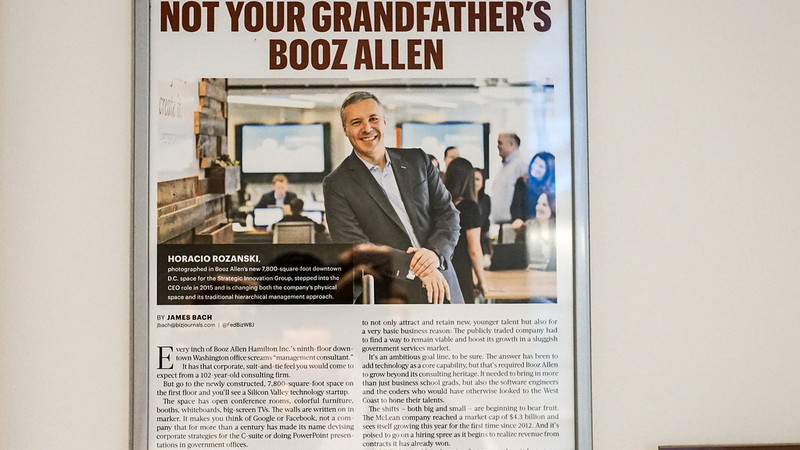
The Treasury Department on Monday said it would cancel 31 contracts with Booz Allen Hamilton, citing its failure to ” implement adequate safeguards” after a past employee leaked tax data, including President Trump’s returns, to media outlets. With this long overdue move it's worth revisiting how Booz Allen and many for profit corporations came to work for the goverment originally, now almost 60 years later.
The Shadow Rulers: Booz Allen Hamilton's Enduring Influence on Government Operations
The relationship between government and private contractors represents a delicate balance between public interest and private expertise. While outsourcing certain government functions can bring specialized knowledge and innovative approaches, it also raises critical questions about accountability, transparency, and democratic control. One company that features prominently across decades of this government-consultant relationship is Booz Allen Hamilton. From its involvement in the Nixon administration's controversial restructuring efforts to its role in modern intelligence operations, Booz Allen Hamilton represents a case study in how private entities can gain substantial influence within government structures. This relationship through two historical lenses: the pioneering privatization efforts of Donald Rumsfeld and Dick Cheney in the late 1960s, and more recent controversies involving the same contractor multiple decades later.
Historical Context: Privatization Experiments Under Nixon
In 1969, President Richard Nixon appointed 37-year-old Congressman Donald Rumsfeld (July 9, 1932 - June 29, 2021) to head the Office of Economic Opportunity (OEO), the agency responsible for overseeing the War on Poverty. Tasked with restructuring the agency, Rumsfeld, aided by his chief of staff Dick Cheney (January 30, 1941 - November 3, 2025), immediately began bringing in private management consultants to perform functions traditionally handled by career civil servants. According to "The Shadow Government," a 1976 book about the federal consulting industry, Cheney later recalled: "Don found himself with a bureaucracy that hated him.... [He] was forced to seek outside help. I remember Don reciting to me the Al Smith statement, 'If I don't look to my friends for help, who do I look to, my enemies?'"
Rumsfeld relied heavily on two consulting firms—Booz Allen Hamilton and Arthur Andersen, now defuncted—to design the agency's reorganization. These consultants established operations near Rumsfeld's office and began interviewing more than 100 employees, making recommendations about who should be sidelined. Although civil service rules prevented mass firings, Rumsfeld effectively neutralized career employees by stripping them of their responsibilities. When he released a new agency telephone directory, it no longer included listings for 108 government employees, including over 70 senior managers. Some were left without desks, aimlessly wandering the agency's halls in a state of bureaucratic limbo.
The blurring of government and contractor roles became particularly evident with Paul Anderson, a Booz Allen consultant on leave as a White House fellow who served as one of Rumsfeld's top advisers and gatekeepers. In a significant conflict of interest, Anderson awarded the multimillion-dollar contract to Booz Allen on Rumsfeld's behalf before returning to the firm. As Anderson himself noted: "No one knew that my status had changed" when he moved seamlessly from federal employee back to government contractor. Under his recommendation, the agency shifted its budget priorities—decreasing funding for poverty programs while increasing spending on additional management consultants.
Legal and Ethical Implications
The OEO experiment raised serious questions about the legality and propriety of using private contractors to make effectively governmental decisions. Guttman and Willner contended in their book that this approach skirted the law, as only government officials—not contractors—are authorized to make policy decisions. At the OEO, they found it was "sometimes difficult to tell the difference between an 'official decision' and a 'consultant's recommendation.'"
This Concern was not limited to observers of the process. When Rumsfeld's successor, Frank Carlucci (later Ronald Reagan's Defense secretary), testified before Congress in 1971, he announced dramatic curtailment of the agency's spending on management contractors, which had reached $110 million between 1965 and 1971. "We did not think we were getting our money's worth," Carlucci stated, effectively repudiating the expensive consulting-driven approach that had characterized Rumsfeld's tenure.
Modern Continuities and Expanding Influence
While the OEO experiment occurred over fifty years ago, recent revelations suggest that Booz Allen Hamilton's influence within government has expanded rather than diminished. A social media post from 2024 highlighted several contemporary connections between the firm and controversial government operations:
Notably, a Pentagon advisor fired for "colluding against Trump" was identified as a Booz Allen Hamilton contractor. Additionally, the Twitter post noted that the individual responsible for leaking Trump's tax returns was also employed by Booz Allen. These incidents reinforce concerns about the potential for contractors to act independently of democratic oversight in politically sensitive matters.
Perhaps most revealing are Booz Allen's social media surveillance capabilities through its subcontractors. The Twitter post highlighted a government contract where Booz Allen Hamilton, as the prime contractor, engaged POPILY, INC. (operating as Yonder, formerly New Knowledge) to provide "social media data collection, normalization, aggregation, storage, and advanced analytics services through the New Knowledge platform."
This connection is particularly significant because New Knowledge previously worked with Hamilton68—a project accused of manufacturing claims about Russian bot interference in US elections. The contract specified that their platform would perform "message level standardization and metadata extraction, and compute analytics required for social media analysis," with normalized messages and analytics made available through an API to "software systems"—presumably government agencies.
Analysis: Patterns and implications
The historical continuity between these two time periods reveals troubling patterns in the government-consultant relationship:
First, the blurring of lines between official government functions and contracted services identified at OEO in 1969 has become more pronounced rather than less. Whereas early concerns focused on consultants making policy decisions inappropriately, modern contracts may involve contractors conducting surveillance on American citizens or analyzing political content with minimal oversight.
Second, the career pathways between government service and contractor employment at Booz Allen Hamilton have become institutionalized. The seamless transition of Paul Anderson from government employee back to contractor mirrors contemporary career patterns where individuals rotate between government agencies and their contracting firms, raising questions about where loyalty ultimately lies.
Third, the strategic positioning of contractors has become more sophisticated. While Rumsfeld brought consultants into physical proximity within government agencies and used them as gatekeepers, modern contractors operate in the digital realm, providing critical analytical infrastructure for national security operations without public scrutiny.
Fourth, accountability mechanisms have proven ineffective at preventing issues from recurring. Despite Carlucci's criticism of excessive outsourcing at OEO, and despite numerous security breaches involving Booz Allen contractors—including the Edward Snowden revelations—the company's position within government contracting has remained secure.
Conclusion
The relationship between government and private contractors, exemplified by Booz Allen Hamilton's enduring presence, represents a democratic challenge that has evolved but not diminished over fifty years. The early warning signs identified during Rumsfeld and Cheney's tenure at the Office of Economic Opportunity have become more complex in the digital age, with contractors now positioned to monitor, analyze, and potentially influence public discourse through sophisticated social media surveillance capabilities.
Addressing these challenges requires reimagining both the scope and oversight of government contracting. Several recommendations emerge from this historical analysis:
- Clearer legal boundaries must be established to prevent contractors from making policy decisions or acting as gatekeepers to government officials.
- Government agencies should maintain core competencies in critical areas rather than becoming dependent on contractors for essential functions.
- Revolving door restrictions should prevent the seamless movement between government service and contractor employment.
- Enhanced transparency regarding government contracts, particularly those involving social media monitoring or content analysis.
- Strengthened whistleblower protections to encourage reporting of contractor misconduct.
- Robust congressional oversight specifically focused on the government-consultant relationship, with regular audits of contractor performance and cost-efficiency.
As the experience of the past fifty years demonstrates, the temptation to outsource government functions to private contractors, like Halliburton, Facebook or Twitter, will likely persist, offering efficiency benefits but creating accountability challenges. The enduring influence of firms like Booz Allen Hamilton across administrations and decades suggests that without stronger safeguards, the shadow government observed by critics in the 1970s will continue to expand its reach—now with digital capabilities far beyond what Rumsfeld and Cheney could have imagined when they first invited consultants into those rooms at the Office of Economic Opportunity.
Editorial comments expressed in this column are the sole opinion of the writer