
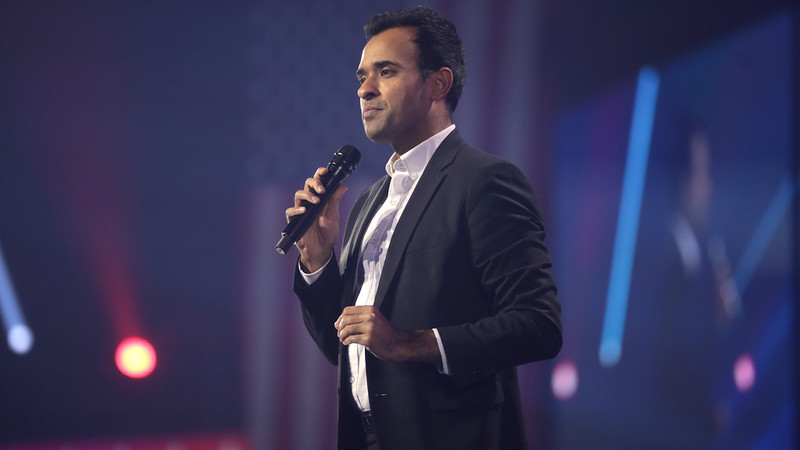
Ohio has long been the heartbeat of American Republican politics. The birthplace of seven Presidents; Grant, Hayes, Garfield, Harrison, McKinley, Taft, and Harding. The Buckeye State practically invented the modern GOP. From its founding in Ripon, Wisconsin-inspired grassroots to its dominance in presidential politics, Ohio Republicans built a coalition of farmers, factory workers, and suburban professionals that kept the party competitive for generations.
Ohio is only one commander-in-chief behind Virginia, nicknamed the "Mother of Presidents" because it is the birhplace of eight U.S. preisdents, the highest number of any state. This includes four of the nation's first five presidents—Washington, Jefferson, Madison, and Monroe—who dominated early American leadership, known as the "Virginia dynasty".
VP JD Vance, was born and raised in Middletown, Ohio and is anticipated in many pollical pundit corners to make the tie.
For decades, Ohio was the nation's quintessential swing state—deciding presidential elections with razor-thin margins. Barack Obama won it twice; George W. Bush won it twice before him. But something shifted starting in 2016. Donald Trump's populist message resonated with Ohio's working-class voters, and the state voted for him decisively in three consecutive cycles (51% in 2016, 53% in 2020, and 55% in 2024). Ohio appeared to have transitioned from purple battleground to reliably red territory.
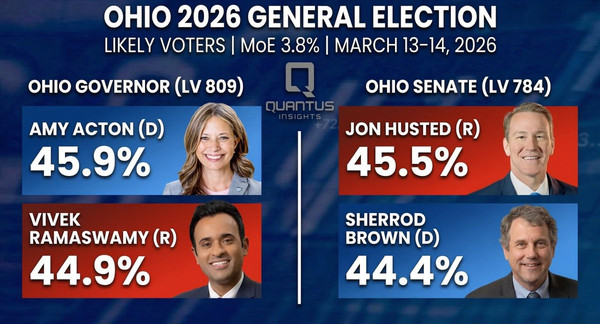
Source: quantusinsights.org 3/16/2026
Yet the 2026 governor's race tells a different story. A recent EMC Research poll shows Republican candidate Vivek Ramaswamy trailing Democrat Amy Acton by ten points—a stunning 53% to 43% deficit that should alarm GOP strategists. How can this be happening in a state that just gave Trump a landslide victory?
Several factors explain Ramaswamy's struggles. First, Ohio Republicans themselves are divided. Attorney General Dave Yost publicly stated that Ramaswamy was the "wrong choice." Many conservatives have soured on his campaign, viewing the tech entrepreneur and failed presidential candidate as an opportunist who parachuted into Ohio rather than someone with deep roots in the state.
Second, Ramaswamy's political style—aggressive, prone to controversy, and heavy on culture-war rhetoric—may play well at CPAC but doesn't translate to effective governance in a midwestern state facing real economic challenges. His attempt to rebrand himself as a more conventional politician appears unconvincing to voters who remember his radical primary run.
Third, Amy Acton represents something different. Seemingly forgetting the former Ohio Department of Health director resigned after facing an intense backlash over her role in the state’s lockdown measures. Now projecting competence and empathy while claiming to have navigated the unprecedented challenges. As a medical doctor, she offers voters an alternative to political theater—practical problem-solving over ideological warfare, never mind she also faced harsh and sometimes ugly pushback for her orders that contributed to the closing of businesses and kept people home for weeks.
The poll numbers suggest Ohio may be experiencing its own political recalibration. After years of Republican dominance, voters appear to be questioning whether far-right populism delivers tangible results. If Acton can maintain her lead, it would signal that Ohio is not permanently red but remains responsive to candidates who address kitchen-table issues rather than culture wars.
For Ramaswamy, the path forward requires convincing Ohioans he understands their lives better than his elite resume suggests. Time will tell whether he can close this gap—but for now, the Republican from the party's birthplace finds himself decidedly behind in a race he expected to win. It’s no help that as of March 2026, the 70th governor of Ohio, Republican Governor Mike DeWine holds a low approval rating. A December 2025 poll showed a 26% job approval rating and a 45% disapproval rating. His approval fell six points, and disapproval rose five points compared to an earlier August 2025 poll.
As of February 2026, President Donald Trump has a 41% job approval rating in Ohio, with a net favorability rating of -19 (38% favorable to 57% unfavorable), according to the BGSU Poll. The poll also indicates that 13% of his 2024 voters now regret their vote.
If Vivek pulls this out he will likely want to do it without Trump and DeWine’s help. The 2026 Ohio gubernatorial election is scheduled to take place on November 3, 2026.
Editorial comments expressed in this column are the sole opinion of the writer
New Episode ever Friday on YouTube, iTunes and everywhere you get your podcasts
