
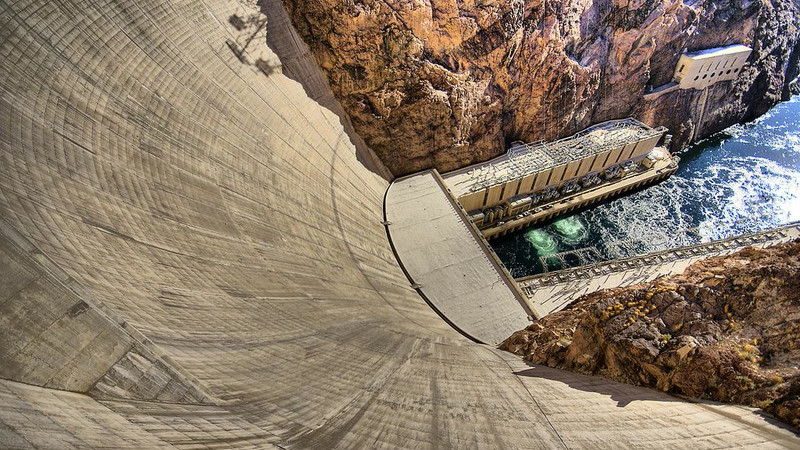
FROM THE RIM of Lake Powell, you can’t see the danger line. There isn’t a flashing gauge or a chart on the canyon wall that warns visitors when one of the most important machines in America begins to fail. There’s only an invisible number: 3,490 feet above sea level.
Engineers call it “minimum power pool.” Above that elevation, Lake Powell can still push water through Glen Canyon Dam’s massive penstocks, spin its turbines, and send electricity across the Southwest with no trouble. Below it, the dam loses the function that helped justify its existence. The river still wants to move, but the machine starts running out of ways to move it.
Glen Canyon Dam and Lake Powell sit near the center of the Colorado River system, upstream from Hoover Dam and Lake Mead. Together those reservoirs store the water that cities, farms, and power plants across the Southwest depend on. Now the entire system is being pushed past its limits, and Lake Powell is where the cracks are really starting to show.
Since 2000, the Southwest has been caught in a megadrought that has steadily pulled down water levels in both Lake Powell and Lake Mead. Climate change has made that trend hotter, drier, and harder to reverse. In 2026, a punishingly weak snowpack and an extreme heat wave pushed the basin deeper into emergency. The Bureau of Reclamation began taking steps to keep Lake Powell’s water levels high enough for electricity generation; Hoover Dam’s hydropower output is expected to drop by 40 percent of its maximum capacity this year.
“It’s a crisis moment for the Colorado River,” says John Berggren, regional policy manager for Western Resource Advocates. “We’ve known about this problem for years.
