
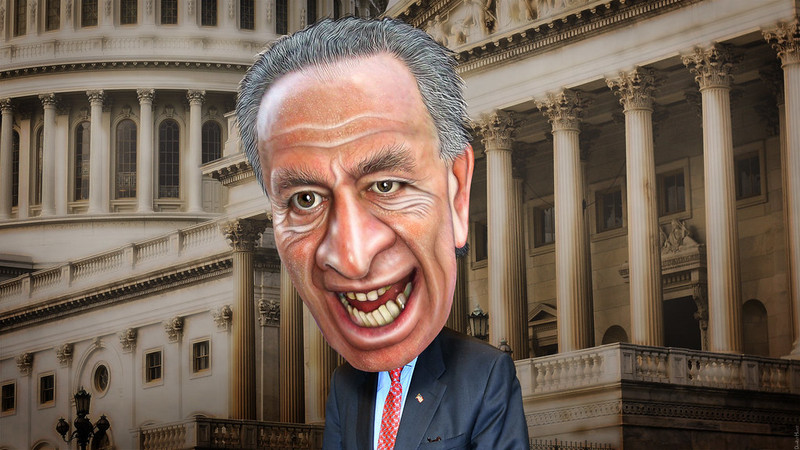
“…the good news is the Democrats put in 235 progressive judges last year and they are intentionally ruling against Trump in over 100 lawsuits.” US Senator Charles Ellis “Chuck” Schumer (D-NY)
During President Trump's second term, multiple federal judges have issued injunctions halting executive actions on topics ranging from spending freezes to workforce management and immigration policy. Critics, including administration officials and legal scholars aligned with expansive executive power theories, have argued these interventions represent judicial activism that impedes presidential authority under Article II of the Constitution.
**Case Analysis: Separation of Powers Concerns**
**Federal Spending Authority (Judge John McConnell Jr., D. Rhode Island)**
*The Ruling:* Judge McConnell issued a preliminary injunction blocking the administration's attempt to freeze trillions in federal spending, ruling that the action "fundamentally undermines the distinct constitutional roles of each branch of our government."
**Critics' Argument:** Supporters of executive flexibility argue that Article II requires the President to "take Care that the Laws be faithfully executed," which includes discretion in implementation timing. They contend McConnell's ruling effectively allows federal agencies to demand immediate disbursement of funds, removing executive branch discretion to prioritize spending or pause programs pending review. The argument follows that Congress appropriates funds, but the executive controls their timing and administration—a traditional executive function.
**Military Personnel Policy (Judge Ana Reyes, D.D.C.)**
*The Ruling:* Judge Reyes blocked the administration's transgender military service ban, ruling it was discriminatory and not sufficiently justified by military readiness arguments.
**Critics' Argument:** Challengers cite *Goldman v. Weinberger* (1986) and *Rostker v. Goldberg* (1981) establishing judicial deference to military judgment on personnel matters. Critics argue Reyes substituted her own assessment of military readiness for that of the Commander-in-Chief and professional military advisors. The argument asserts that when courts override military personnel decisions based on equitable factors rather than clear statutory violations, they usurp the President's constitutional authority as Commander-in-Chief.
**Election Administration (Judges Colleen Kollar-Kotelly and Loren AliKhan, D.D.C.)**
*The Ruling:* Both judges blocked portions of executive orders requiring proof-of-citizenship documentation for federal elections and imposing restrictions on mail-in ballot counting.
**Critics' Argument:** While the Constitution assigns states authority over elections (Article I, Section 4; 17th Amendment), the executive orders operated primarily on federal agencies and federal election security funding. Critics argue these judges created a "right to not show identification" not found in statute or Constitution. The administration contends Article II gives the President authority to direct federal agencies—including the Election Assistance Commission—and that judicial intervention here represents policy disagreement dressed in constitutional language.
**Federal Workforce Management (Multiple Judges)**
*The Rulings:* Judges including Beryl Howell and Tanya Chutkan have issued orders regarding workforce reductions, collective bargaining changes, and the "DOGE" reorganization initiative.
**Critics' Argument:** Administration supporters argue these judges have ignored the precedents established in cases like *Myers v. United States* (1926) and *Humphrey's Executor* carve-outs. They contend that management of the federal workforce—hire, fire, and organizational structure—is quintessentially executive in nature. When judges enjoin workforce reductions, they argue, courts are not interpreting law but managing federal agencies.
Statutory arguments under 5 U.S.C. various sections provide federal employees procedural protections, but critics note that presidential authority to reorganize and reduce agencies has historically been broad, subject primarily to Congressional appropriations riders or specific statutory limitations—not general equitable injunctions.
**Birthright Citizenship (Multiple District Judges)**
*The Ruling:* Various federal judges issued nationwide injunctions blocking implementation of orders ending automatic citizenship for children born to non-citizen parents.
**Analysis:** Unlike other cases involving internal administration, birthright citizenship raises genuine constitutional questions about the interpretation of the Fourteenth Amendment's "subject to the jurisdiction thereof" clause. However, critics of the judicial response argued that the appropriate forum for resolving this constitutional question is the Supreme Court through regular appellate process, not through emergency injunctions issued by single district judges.
**Legal Doctrines in Tension**
Several legal principles animate the debate:
1. **The Major Questions Doctrine:** Some executive actions arguably implicate "major questions" requiring explicit Congressional authorization—arguably favoring judicial review.
2. **The Unitary Executive Theory:** Posits that Article II vesting of "executive Power" means the President must have supervision and control over the entire executive branch, including independent agencies.
3. **Political Question Doctrine:** Questions whether certain matters—particularly military personnel, foreign affairs, and federal workforce management—are constitutionally committed to political branches rather than courts.
4. **Nationwide Injunctions:** Even the Supreme Court has expressed concern about single district judges issuing nationwide injunctions, noting in various 2025 decisions that such relief should be "rare" and "carefully tailored."
The tension between judicial review and executive administration is not new—it dates to *Marbury v. Madison*. However, the scale and scope of judicial intervention during this administration has prompted renewed debate about whether some district courts have moved from interpreting law to administering government.
Proponents of strong executive authority argue that when judges use equitable powers to manage federal agencies, dictate hiring and firing practices, override military personnel decisions, and control the timing of federal spending, they cease to function as courts and instead operate as super-administrators with life tenure and no electoral accountability.
Whether these actions constitute proper judicial review or judicial activism depends largely on one's constitutional theory regarding separation of powers, the scope of Article II, and the appropriate level of deference to presidential authority in matters of administration, national security, and foreign affairs.
