

or decades, “Wall Street” was America’s all-purpose byword for capitalist villainy. “Big tech” is now running it close, and for good reason. Silicon Valley has, in recent years, produced high-profile bad actors at a remarkable pace. And after at least two decades of semi-stable alignment with the Democratic Party, influential figures in tech lurched right post-pandemic, burrowing into anti-democratic and extremist political thought. Some of this has since burst into Washington: Elon Musk’s DOGE initiative owes much to the move-fast-and-break-things ethos of Silicon Valley.
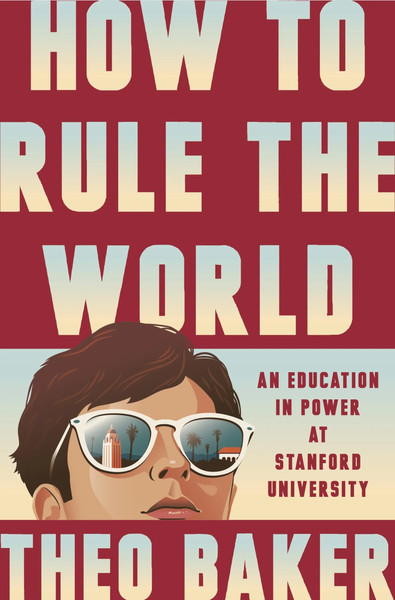
Penguin Press, 336 pp.
Theo Baker, an investigative journalist wunderkind and soon-to-be Stanford graduate, is not the first to trace Silicon Valley’s rot to his university. (The authors Malcolm Harris, John Carreyrou, and Noam Cohen have each staked out similar territory.) But he is the first to document, with rigor and detail, the institution’s recent history and culture. Baker’s much-anticipated debut book, How to Rule the World, is three things at once: an account of his George Polk Award-winning investigation into former Stanford president Marc Tessier-Lavigne’s research misconduct, an ethnographic study of the campus’s social “underbelly,” and a personal memoir. It largely succeeds at all three purposes. But Baker’s disdain for his subjects is, too often, an obstacle to understanding them.
The book follows Baker’s freshman year, from his first steps in student journalism to the investigation that brought down Stanford’s president. Along the way, Baker experiences some typical things—the loss of his grandfather, his girlfriend, and his virginity—but also some highly atypical things, like rubbing shoulders with billionaires at lavish parties. Baker’s chapters on his investigation of Tessier-Lavigne are his strongest. His central allegation is that Tessier-Lavigne’s then-celebrated 2009 Nature paper on Alzheimer’s disease, produced while the Canadian neuroscientist led research at the biotech firm Genentech, was based on fabricated data, and that the firm’s internal review confirmed as much but never made the findings public. Four senior Genentech executives, all under NDA, independently corroborate this account to Baker. To test them, he periodically asks leading questions he knows to be false: they don’t bite.
